
Jasper Reports Complete Guide for Nama ERP
Overview
This comprehensive guide covers all aspects of developing Jasper Reports in Nama ERP, including the powerful NamaRep utility class that extends ServerNamaRep. NamaRep provides essential functions for localization, data retrieval, entity linking, pricing calculations, and more.
Quick Start: Adding Company Logo to Reports
To display the company logo in your reports:
- Create a parameter named
loginLegalEntityLogowith typejava.lang.Objectorjava.io.InputStream - Add an image component to your report
- Set the image expression to
$P{loginLegalEntityLogo}
The logo is automatically provided by the system when the report runs.
Adding Any Attachment/Image to Reports
// To retrieve any attachment by ID
NamaRep.getFile($F{attachmentId})
// OR
NamaRep.getAttachment($F{attachmentId})
Subreports
You can include subreports within a main report. A subreport can be either another existing report or an external report file.
Linking Subreports
To link a subreport:
- Create a parameter with the same ID as the subreport
- Set the parameter type to
java.io.InputStreamorjava.lang.Object - The system will automatically pass the subreport to this parameter
Extra Resources (Images, Files)
You can attach additional resources such as images to a report:
- Define a parameter with the same ID as the resource
- Set the parameter type to
java.lang.Object - The resource will be available through this parameter
NamaRep API Reference
Core Localization & Translation
Name Selection Based on Language
// Automatically selects Arabic or English name based on current language
NamaRep.name(name1, name2)  // Returns name1 for Arabic, name2 for English

// With fallback to code if names are empty
NamaRep.nameOrCode(code, name1, name2)

// Direct language selection
NamaRep.name(arabic, english)  // where arabic = name1 or code, english = name2 or altCode
Translation Methods
// Translate any value (strings, booleans, enums)
NamaRep.translate(value)

// Translate enum values
NamaRep.translate(enumValue)

// Translate boolean values to localized text
NamaRep.translate(true)  // Returns localized "Yes" or "نعم"

// Translate field IDs with entity context
NamaRep.title(entityType, fieldId)
NamaRep.translate(entityType, fieldId)

// Translate with prefix
NamaRep.translate("prefix", "value")  // Translates "prefix.value"

// Split translated text with pipe separator
NamaRep.head("header|subtitle")  // Returns "header"
NamaRep.sub("header|subtitle")   // Returns "subtitle"
Date & Time Functions
Day Names
NamaRep.dayName($F{dateField})     // Returns day name in current language
NamaRep.arDayName($F{dateField})   // Arabic day name
NamaRep.enDayName($F{dateField})   // English day name
NamaRep.dayName(dayNumber)         // 1=Sunday, 2=Monday, etc.
Hijri Calendar Support
// Convert Gregorian to Hijri
NamaRep.toHijri($F{date})                    // Full Hijri date string
NamaRep.toHijriDate($F{date})                // HijriDate object
NamaRep.hijriDay($F{date})                   // Day in Hijri (padded)
NamaRep.hijriMonth($F{date})                 // Month in Hijri (padded)
NamaRep.hijriYear($F{date})                  // Year in Hijri
NamaRep.hijri_yyyyMMdd($F{date})            // Format: yyyyMMdd

// Custom formatting
NamaRep.hijriDay($F{date})+"/"+NamaRep.hijriMonth($F{date})+"/"+NamaRep.hijriYear($F{date})
Time Conversion
// Convert decimal hours to time format
NamaRep.decimalToTime(9.5)                      // Returns "09:30"
NamaRep.decimalToTimeWithSeconds(9.5)           // Returns "09:30:00" (includes seconds)
NamaRep.decimalToTimeNullable(0)                // Returns null instead of "00:00"
NamaRep.decimalToTimeWithSecondsNullable(0)     // Returns null instead of "00:00:00"

// Convert milliseconds to time format
NamaRep.timeToString(9120000)        // Returns "02:32"
NamaRep.timeToStringNullable(0)      // Returns null instead of "00:00"
Date Period Calculations
// Calculate period between dates (years, months, days)
// 1. Create variable with reset type none, increment type none
java.time.Period.between(
  new java.util.Date($F{FromDate}.getTime()).toInstant()
    .atZone(java.time.ZoneId.systemDefault()).toLocalDate(),
  java.time.LocalDate.now()
)

// 2. Use in text field expression
$V{period}.getYears()+" سنة "+$V{period}.getMonths()+" شهر "+$V{period}.getDays()+" يوم"

// Calculate months between dates
NamaRep.dateDiffInMonth(date1, date2)
Number Formatting & Conversion
Arabic Numerals
// Convert Western to Arabic-Hindi numerals (٠,١,٢,٣,٤,٥,٦,٧,٨,٩)
NamaRep.arNumbers("123")  // Returns "١٢٣"
NamaRep.arNumbers(value)
Numeric Field Helpers
// Null-safe operations
NamaRep.zeroIfNull(fieldOrVariable)        // Returns 0 if null
NamaRep.oneIfZero(fieldOrVariable)          // Returns 1 if zero
NamaRep.nullIfZero(fieldOrVariable)         // Returns null if zero

// Convert to BigDecimal
NamaRep.objectToDecimal(value)   // Safe conversion to BigDecimal
Saudi Riyal Symbol
// Returns SAR symbol as InputStream for image component
NamaRep.sar()
Tafqeet (Number to Words)
// Convert numbers to words in different languages
NamaRep.tafqeet(currencyCode, amount)        // Current language
NamaRep.tafqeetArabic(currencyCode, amount)  // Arabic
NamaRep.tafqeetEnglish(currencyCode, amount) // English
NamaRep.tafqeetFrench(currencyCode, amount)  // French
The configuration for currencies tafqeet can be found in Global Configuration under value.info.tafqeetInfo.currencyCode
Price Calculations
Price Calculator Usage
// Basic unit price calculation
NamaRep.priceCalculator()
  .item($F{item})
  .uom($F{UOM})
  .qty($F{Quantity})
  .unitPriceOnly()
  .price()
Creating Price Variables
This expression returns a full price Object. You should store it in a variable:
- Variable Class:
java.lang.Object - Calculation:
No Calculation Function - Increment type:
None - Reset type:
None
Complete Price Calculator Functions
// All available builder functions
NamaRep.priceCalculator()
  .item($F{itemIdOrCode})
  .customer($F{customerIdOrCode})
  .supplier($F{supplierIdOrCode})
  .uom($F{uomIdOrCode})
  .invoiceClassification($F{classificationIdOrCode})
  .ic($F{classificationIdOrCode})              // Short for invoiceClassification
  .legalEntity($F{legalEntityIdOrCode})
  .le($F{legalEntityIdOrCode})                  // Short for legalEntity
  .sector($F{sectorIdOrCode})
  .sc($F{sectorIdOrCode})                       // Short for sector
  .branch($F{branchIdOrCode})
  .br($F{branchIdOrCode})                       // Short for branch
  .department($F{departmentIdOrCode})
  .dep($F{departmentIdOrCode})                  // Short for department
  .analysisSet($F{analysisSetIdOrCode})
  .anset($F{analysisSetIdOrCode})               // Short for analysisSet
  .priceClassifier1($F{priceClassifier1IdOrCode})
  .pc1($F{priceClassifier1IdOrCode})            // Short for priceClassifier1
  .priceClassifier2($F{priceClassifier2IdOrCode})
  .pc2($F{priceClassifier2IdOrCode})
  .priceClassifier3($F{priceClassifier3IdOrCode})
  .pc3($F{priceClassifier3IdOrCode})
  .priceClassifier4($F{priceClassifier4IdOrCode})
  .pc4($F{priceClassifier4IdOrCode})
  .priceClassifier5($F{priceClassifier5IdOrCode})
  .pc5($F{priceClassifier5IdOrCode})
  .revision($F{revision})
  .color($F{colorCode})
  .size($F{size})
  .qty($F{qty})
  .date($F{date})
  .unitPriceOnly()
  .price()  // Must be last in chain
Accessing Price Components
After storing price in variable $V{price}, access components:
// Main values
$V{price}.unitPrice.primitiveValue
$V{price}.netValue.primitiveValue
$V{price}.custom.primitiveValue
$V{price}.totalCashShare.primitiveValue
$V{price}.totalPaymentMethodShare.primitiveValue

// Discount components (1-8 available)
$V{price}.discount1.percentage.primitiveValue
$V{price}.discount1.value.primitiveValue
$V{price}.discount1.afterValue.primitiveValue
$V{price}.discount1.maxNormalPercent.primitiveValue

// Header discount
$V{price}.headerDicount.percentage.primitiveValue
$V{price}.headerDicount.value.primitiveValue
$V{price}.headerDicount.afterValue.primitiveValue

// Tax components (1-4 available)
$V{price}.tax1.percentage.primitiveValue
$V{price}.tax1.value.primitiveValue
$V{price}.tax1.afterValue.primitiveValue
$V{price}.tax1.maxNormalPercent.primitiveValue
Entity Links & Navigation
Basic Entity Links
// Simple link to entity
NamaRep.link(entityType, id)
NamaRep.link(serverUrl, entityType, id)

// Advanced link builder with menu and view
NamaRep.link()
  .entityType($F{entityType})
  .id($F{id})
  .viewName("theViewName")
  .menuCode("abcMenu")
  .url(serverUrl)
  .toString()
Attachment Links
// Create link to attachment/document
NamaRep.attachmentLink(id)
NamaRep.attachmentLink(serverUrl, attachmentId)
Report Links
// Link to another report by code
NamaRep.repLinkByCode($P{REPORT_PARAMETERS_MAP}, "ReportCode")
  .p("p1 id").v(value expression)
  .p("p2 id").v(value expression)
  .copyParams()  // Copy all shared parameters from current report
  .toString()

// Reference parameters - multiple formats available
.p("param").v($F{id}, $F{entity}, $F{code}, $F{name1}, $F{name2})
.p("param").v($F{id}, $F{entity}, $F{code})
.p("param").ref($F{entityType}, $F{id})
.p("param").refCode($F{entityType}, $F{code})

// If you do not want to add the server url (the link will be #rpt:xxx instead of https://abc.namasoft.com/erp/#rpt:xxx) use the following
.directLink()
Report Link Examples
// Example 1: Account Statement
NamaRep.repLinkByCode($P{REPORT_PARAMETERS_MAP}, "Statement")
  .copyParams()
  .p("fromAccount").v($F{accountId}, $F{accountEntityType}, $F{accountCode})
  .p("toAccount").v($F{accountId}, "Account", $F{accountCode})
  .toString()

// Example 2: Sales Profit Summary
NamaRep.repLinkByCode($P{REPORT_PARAMETERS_MAP}, "SalesProfitSummary")
  .copyParams($P{REPORT_PARAMETERS_MAP})
  .p("SalesInvoice").ref("SalesInvoice", $F{SSIid})
  .p("cust").refCode("Customer", "Customer501")
  .p("fromDate").v("23-04-2014")
  .p("showDetails").v("true")
  .toString()

// Example 3: Subsidiary Account Statement
NamaRep.repLinkByCode($P{REPORT_PARAMETERS_MAP}, "SubsidiaryAccountStatement")
  .p("subsidiaryType").v($F{CustomerEntityType})
  .p("fromSubsidiary").v($F{customerId}, $F{CustomerEntityType}, $F{customerCode})
  .p("toSubsidiary").v($F{customerId}, $F{CustomerEntityType}, $F{customerCode})
  .p("accuontType").v("mainAccount")
  .toString()
Public Report Links (No Authentication)
To share a report link externally (e.g., to customers) without requiring login:
NamaRep.repLinkByCode($P{REPORT_PARAMETERS_MAP}, "ARG000046-report")
  .p("Code_Equals").ref($F{entityType}, $F{id})
  .toNoAuthResultLink()
Filtered List View Links
You can create hyperlinks that open a filtered list view for any entity type. This is useful when you want users to click a link in a report and see a pre-filtered list of records.
Basic Usage
NamaRep.listView()
  .entityType("SalesInvoice")
  .criteria($P{REPORT_SCRIPTLET}.tempo("""
    customer.code,Equal,{customerCode},AND;
    valueDate,GreaterThanOrEqual,{fromDate},AND;
    """))
  .toString()

// To enable direct link to list view, use the following
.directLink()
Builder Methods
| Method | Description |
|---|---|
.entityType(String) | The entity type to display (e.g., "SalesInvoice", "Customer") |
.criteria(String) | Filter criteria in text format (see below) |
.listViewName(String) | Specific list view name to use |
.menuCode(String) | Menu code to open the list view in |
.orderBy(String) | Field to sort by |
.ascending(Boolean) | Sort direction (true = ascending) |
.currentPage(Integer) | Page number to display |
.pageSize(Integer) | Number of records per page (-1 for all) |
.showTree(Boolean) | Show as tree view |
.extraCriteriaId(String) | Additional criteria definition ID |
Using Tempo for Dynamic Criteria
The most powerful feature is combining the list view builder with Tempo syntax to dynamically inject report field values into the criteria:
$P{REPORT_SCRIPTLET}.tempo("""
  field,Operator,{value},AND;
  """)
Inside the curly brackets {...}, you can reference:
- Fields:
{fieldName}- directly use field names without$F{} - Parameters:
{paramName}- directly use parameter names without$P{} - Variables:
{varName}- directly use variable names without$V{}
Complete Example
Suppose you have a report showing customers and want to add a link that opens all sales invoices for that customer:
NamaRep.listView()
  .entityType("SalesInvoice")
  .criteria($P{REPORT_SCRIPTLET}.tempo("""
    customer.code,Equal,{customerCode},AND;
    valueDate,GreaterThanOrEqual,{fromDate},AND;
    valueDate,LessThanOrEqual,{toDate},AND;
    """))
  .listViewName("SalesInvoicesForCustomer")
  .orderBy("valueDate")
  .ascending(false)
  .toString()
This creates a clickable link that opens the Sales Invoice list view filtered by:
- Customer code matching the current row's
customerCodefield - Value date between the report's
fromDateandtoDateparameters
Criteria Format Reference
The criteria string follows the Text Criteria format:
fieldID,operator,value,logic;Available Operators:
Equal,NotEqualGreaterThan,GreaterThanOrEqualLessThan,LessThanOrEqualStartsWith,NotStartsWithEndsWith,NotEndWithContains,NotContainIn,NotIn
Logic Connectors: AND, OR
Date Format: dd-MM-yyyy
Reference Format: id:entityType:code (code is optional)
TIP
You can use the Criteria Definition screen to visually build filter conditions, then click Convert to Text to get the text format. This text can then be used as a template for your Tempo-enabled criteria.
URL Shortening
You can shorten report URLs using:
NamaRep.shortenURL(serverurl, signature, url)See {shortenurl()} section in Tempo documentation for more info.
Entity Creation (Creators)
Basic Creator
// Create new entity with fields
NamaRep.newWithFields("ReceiptVoucher")
  .f("term").value("POTermCode")
  .f("book").value("POBook1")
  .f("remarks").v("Auto Created")
  .f("fromDoc#type").v("SalesInvoice")
  .f("fromDoc#code").v($F{code})
  .menuCode("NormalReceiptMenu")
  .viewName("NormalReceipts")
  .toString()

// Alternative syntax
NamaRep.creator("ReceiptVoucher")
  .field("supplier").value(supplierId)
  .toString()
Creator with Line Details
For reports with detail bands that need to create entities with line items:
- Create variable
creatorLinkwith initial value expression:
NamaRep.newWithFields("PurchaseOrder")
  .field("term").value("P.Order.Term")
.root()- In detail band, add line items:
$V{creatorLink}
  .field("details.item.itemCode").value($F{code})
  .field("details.quantity").value($F{qty})
.row($V{REPORT_COUNT})- Generate final link:
$V{creatorLink}.toString()Approval System
Document Approval Links
// Approve/Reject/Return all lines
NamaRep.approveAllLink($P{REPORT_PARAMETERS_MAP})
NamaRep.rejectAllLink($P{REPORT_PARAMETERS_MAP})
NamaRep.returnAllLink($P{REPORT_PARAMETERS_MAP})
NamaRep.returnAllToPreviousStepLink($P{REPORT_PARAMETERS_MAP})

// With decision parameter
NamaRep.approveAllLink($P{REPORT_PARAMETERS_MAP}, decision)  // decision: "Approve", "Reject", or "Return"
Per-Line Approval (Concerned Lines)
For documents with line-level approvals:
// Approve/Reject specific line
NamaRep.approveLink($P{REPORT_PARAMETERS_MAP}, $F{lineNumber})
NamaRep.rejectLink($P{REPORT_PARAMETERS_MAP}, $F{lineNumber})
NamaRep.returnLink($P{REPORT_PARAMETERS_MAP}, $F{lineNumber})
NamaRep.returnToPreviousStepLink($P{REPORT_PARAMETERS_MAP}, $F{lineNumber})

// With reason code
NamaRep.approveLink($P{REPORT_PARAMETERS_MAP}, $F{lineNumber}, reasonCodeOrId)
NamaRep.rejectLink($P{REPORT_PARAMETERS_MAP}, $F{lineNumber}, reasonCodeOrId)

// Check if line needs approval
NamaRep.isConcernedLine($P{REPORT_PARAMETERS_MAP}, $F{lineNumber})
JavaScript Approval Dialog
// Show approval dialog in browser
NamaRep.approveFromJS(entityType, entityId, nextStepName,
                      concernedLines, nextStepSeq, summary)
Employee & HR Functions
Vacation Balances
// Default vacation types (1, 2, 3)
NamaRep.getVacation1RemainderBalance(empIdOrCode)
NamaRep.getVacation2RemainderBalance(empIdOrCode)
NamaRep.getVacation3RemainderBalance(empIdOrCode)

// Specific vacation type
NamaRep.getVacationRemainderBalance(empCodeOrId, vacationTypeIdOrCode)
NamaRep.getVacationRemainderBalance(empCodeOrId, vacationTypeIdOrCode, atDate)

// Detailed vacation information
NamaRep.getVacationAssignedConsumedRemainder(employeeId, vacationType)
NamaRep.getVacationAssignedConsumedRemainder(employeeId, vacationType, atDate)

// Balance per years
NamaRep.getRemainderBalancePerYears(employeeId, atDate, yearsCount)
Reward Points
Available Reward Points & Amounts
// Get available reward points for an entity (e.g., Customer, Supplier)
NamaRep.availableRewardPoints("Customer", $F{customerId})
NamaRep.availableRewardPoints("Customer", $F{customerCode})

// Get available reward amount for an entity
NamaRep.availableRewardAmount("Customer", $F{customerId})
NamaRep.availableRewardAmount("Customer", $F{customerCode})
Earned Points (Documents)
// Get earned points from a document (e.g., SalesInvoice)
NamaRep.earnedPoints("SalesInvoice", $F{invoiceId})
NamaRep.earnedPoints("SalesInvoice", $F{invoiceCode})
TIP
availableRewardPointsandavailableRewardAmountwork with any master file.earnedPointsonly works with document entities (e.g., SalesInvoice, NamaPOSSalesInvoice). It returnsnullfor master files.- All three methods accept either an ID or a code as the second parameter.
Database Operations
SQL Query Execution
// Execute SQL query with parameters
NamaRep.runSQLQuery(sql, paramName, paramValue, paramName, paramValue)

// Example with named parameters
NamaRep.executeQuery(
  "SELECT cast(w.name1 collate Arabic_CI_AI_KS_WS as varchar(250))
   FROM warehouse w WHERE w.id = :wid",
  "wid", $F{wid}
)

// Format query results
NamaRep.formatQueryResult(results, "\n", ",")  // Row separator, column separator
Module Configuration Access
// Get configuration value
NamaRep.getValueFromModuleConfig(moduleId, fieldId)

// Example
NamaRep.getValueFromModuleConfig("basic", "value.info.useCurrentUserAsSalesMan")
Available module names:
- accounting, basic, supplychain, fixedassets
- humanresource, dms, project, ecpa
- manufacturing, srvcenter, crm, contracting
- travel, realestate, housing, auditing
- education, namapos, mc
Security & Permissions
Security Constraints for Reports
How to Filter by Legal Entity, Sector, or Any Other Dimension
Suppose you want to filter data based on the record creator, edit or view permissions, and also by legal entity, sector, branch, or other dimensions within the account record. To do this, follow these steps:
1. Create Hidden Parameter SECURITY_CONSTRAINTS
Create a String parameter with "Not For Prompting" and default expression:
NamaRep.security()
  .fieldEntityType("Account")
  .tableAlias("acc")
  .capabilities("firstAuthor", "viewCapability", "usageCapability",
                "updateCapability", "legalEntity", "branch",
                "sector", "department", "analysisSet")
Expression Components:
.fieldEntityType("Account")- Specifies the entity type for security filtering.tableAlias("acc")- Table alias in your SQL query.capabilities(...)- List of security dimensions to filter by
Available capabilities:
firstAuthor- Filter by record creatorviewCapability,updateCapability,usageCapability- Permission-based filteringlegalEntity,branch,sector,department,analysisSet- Organizational filtering
2. Use in SQL Query
Include the parameter in your WHERE clause:
SELECT a, b, c
FROM Account acc
LEFT JOIN Table2 t2 ON t2.id = acc.someId
WHERE acc.code <> 'abc'
  AND $P!{SECURITY_CONSTRAINTS}
3. Multiple Table Security
For filtering on multiple tables:
NamaRep.security()
  .fieldEntityType("Account")
  .tableAlias("Account")
  .capabilities("firstAuthor", "viewCapability")
+ " AND " +
NamaRep.security()
  .fieldEntityType("FiscalYear")
  .tableAlias("FiscalYear")
  .capabilities("legalEntity", "branch", "sector")
Summary
This security filtering approach dynamically applies data visibility and editing rights based on user roles and organizational structure. The system automatically generates appropriate WHERE clauses based on user permissions.
Display Permissions
// Check if user can display parameter/field
NamaRep.canDisplay($P{param})
Utility Functions
HTML to Text Conversion
NamaRep.htmlToText(htmlContent)Serial Numbers
// Expand compressed serials
NamaRep.expandSerials(serials)                      // Default newline separator
NamaRep.expandSerials(serials, separator)           // Custom separator
NamaRep.unzipSerials(serials)                      // Returns List<String>
NamaRep.unzipSerialsWithNewLines(serials)
NamaRep.unzipSerialsWithComma(serials)
NamaRep.unzipSerialsWithSeparator(serials, ";")

// Compress serial ranges
NamaRep.zipSerialsRange(serials)
ZATCA QR Codes (Saudi Tax Authority)
// Generate ZATCA QR code
NamaRep.genZATCAQR(sellerName, vatNumber, timestamp,
                   invoiceAmount, vatAmount)

// With separate value and creation dates
NamaRep.genZATCAQRWithCreationDate(sellerName, vatNumber,
                                   valueDate, creationDate,
                                   invoiceAmount, vatAmount)

// From entity
NamaRep.genZatcaQrCodeFromEntity(entityType, idOrCode)
NamaRep.zatcaHashedInvoice(entityType, id)
Mobile QR Integrator
// Create QR code for mobile scanning and entity creation/update
// The QR code will be processed by Mobile QR Integrator when scanned

// Basic QR with integrator code
NamaRep.mobileQr()
    .code("IntegratorCode")
    .toString()

// QR with parameters
NamaRep.mobileQr()
    .code("CustomerAttendance")
    .addParam("customer", $F{customerCode})
    .addParam("date", $F{valueDate})
    .addParam("amount", $F{totalAmount})
    .toString()

// Encrypted QR (Base64 encoded)
NamaRep.mobileQr()
    .code("SecureIntegrator")
    .addParam("sensitive", $F{confidentialData})
    .encrypted()
    .toString()
Usage Notes:
- The QR code contains JSON with the integrator code/ID and parameters
- Parameters are accessible in entity flows via
$map.paramName - Encrypted QRs are automatically decrypted by the mobile app
- The integrator must be configured in MobileQRIntegrator entity
System Parameters in Reports
All reports have access to these system parameters:
Click to see all system parameters
User & Login Information
loginLanguage- Current language (Arabic/English)originalLoginLanguage- Original login languageloginUserId,loginUserCode,loginUserName1,loginUserName2loginUserTreatAsAuthorIds- Delegate user IDsloginEmployeeIdcurrentUser- Current user object
Organization Structure
loginLegalEntityId,loginLegalEntityCode,loginLegalEntityName1,loginLegalEntityName2loginSectorId,loginSectorCode,loginSectorName1,loginSectorName2loginBranchId,loginBranchCode,loginBranchName1,loginBranchName2loginDepartmentId,loginDepartmentCode,loginDepartmentName1,loginDepartmentName2loginAnalysisSetId,loginAnalysisSetCode,loginAnalysisSetName1,loginAnalysisSetName2
Public Organization IDs
publicLegalEntityId,publicSectorId,publicBranchIdpublicDepartmentId,publicAnalysisSetId
Logos & Branding
loginLegalEntityLogo- Primary logo (InputStream)loginLegalEntityLogo2throughloginLegalEntityLogo5- Additional logosreportsFooterNote1,reportsFooterNote2- Footer text
Report Context
formEntityType- Entity type for the form (can be used for translation)reportCode,reportId,reportName1,reportName2namaReportInstance- Report instance objectrunId- Unique run identifier
URLs
guiServerURL- GUI server URLexternalServerURL- External server URLcurrentGUIURL- Current GUI URL
Approval System
concernedLines- Lines requiring approvalcandidateEmployeeId,candidateEmployeeCode,candidateEmployeeName1,candidateEmployeeName2approvedRecordId,approvedRecordType,approvedRecordCodeapprovalSecret,approvalStepSeq
Security & Permissions
allowedCapabilities,allowedEntities,allowedDocuments,allowedFilesnotAllowedEntities,notAllowedDocuments,notAllowedFilesaccessibleLegalEntityIds,accessibleSectorIds,accessibleBranchIdsaccessibleDepartmentIds,accessibleAnalysisSetIds
Security Flags
legalEntityNotUsedInSecurity,sectorNotUsedInSecuritybranchNotUsedInSecurity,departmentNotUsedInSecurityanalysisSetNotUsedInSecurity
Other
posShiftCode- POS shift codecurrentReplicationSiteId,currentReplicationSiteCodecurrentReplicationSiteName1,currentReplicationSiteName2
Report Parameters
List Parameters (Multi-Selection)
To define a parameter that supports multiple selections:
Set the property
list = trueFor non-reference types, specify
listTypepropertyCapture selected values for display:
<parameterName>_csv: Translated values as CSV string<parameterName>_codecsv: Codes as CSV string<parameterName>_name1csv: Name1 fields as CSV string<parameterName>_name2csv: Name2 fields as CSV string
To prevent automatic grid display:
doNotAutoShowList = trueTo control the display widget for the list, set
listDisplayType:Default— the standard multi-selection input (used when the property is omitted)Dropdown— selected values render as removable chips inside an input; the full options list opens in a searchable dropdown menu. Ideal when the value set is largeChips— all allowed values render as inline clickable chips with selection toggled on click. Ideal when there are only a few options and you want them visible without opening a menu
Example:
xml<parameter name="MultiEmployee" class="java.util.List"> <property name="entityType" value="Employee"/> <property name="list" value="true"/> <property name="listDisplayType" value="Chips"/> </parameter>
Example: Multi-Selection Parameters
<!-- Reference type list parameter -->
<parameter name="MultiEmployee" class="java.util.List">
    <property name="entityType" value="Employee"/>
    <property name="arabic" value="الموظفين"/>
    <property name="english" value="Employees"/>
    <property name="property" value="code"/>
    <property name="list" value="true"/>
    <property name="doNotAutoShowList" value="false"/>
</parameter>
<parameter name="MultiEmployee_csv" class="java.lang.String" isForPrompting="false"/>

<!-- Non-reference type list parameter -->
<parameter name="MultiDate" class="java.util.Date">
    <property name="english" value="Dates"/>
    <property name="arabic" value="التواريخ"/>
    <property name="defaultValue" value="$monthStart()"/>
    <property name="list" value="true"/>
    <property name="listType" value="java.util.Date"/>
</parameter>
<parameter name="MultiDate_csv" class="java.lang.String" isForPrompting="false"/>
Date Range Parameters
When users filter a report by a date range, defining two separate "From Date" and "To Date" parameters works, but it takes up two prompt rows and the relationship between them isn't visually obvious. The showAsDateRange option lets you present a single, unified range picker in the prompt UI while keeping two real date parameters underneath for your SQL query to use.
The pattern relies on three parameters working together:
- A controller string parameter with
showAsDateRange = true. This is what the user sees and interacts with; it doesn't carry a value of its own. - A "from date" parameter with
isForPrompting="false"— referenced by the controller'sfromDateIdproperty. - A "to date" parameter with
isForPrompting="false"— referenced by the controller'stoDateIdproperty.
When the user picks a range, the system writes the chosen dates into the two underlying date parameters. From your query's perspective, nothing changes — you reference $P{FromValueDate} and $P{ToValueDate} exactly as you would any other date parameter.
- Example
<parameter name="FromValueDate" class="java.util.Date" isForPrompting="false">
    <property name="arabic" value="من التاريخ الفعلي"/>
    <property name="english" value="From Value Date"/>
</parameter>

<parameter name="ToValueDate" class="java.util.Date" isForPrompting="false">
    <property name="arabic" value="إلى التاريخ الفعلي"/>
    <property name="english" value="To Value Date"/>
</parameter>

<parameter name="ValueDate" class="java.lang.String">
    <property name="showAsDateRange" value="true"/>
    <property name="fromDateId" value="FromValueDate"/>
    <property name="toDateId" value="ToValueDate"/>
    <property name="arabic" value="التاريخ الفعلي"/>
    <property name="english" value="Value Date"/>
</parameter>
Then in your SQL query, reference the underlying date parameters directly:
WHERE valueDate >= $P{FromValueDate}
  AND valueDate <= $P{ToValueDate}
Or using $X
where $X{[BETWEEN],valueDate,FromValueDate,ToValueDate}- Requirements
- The controller parameter must be of type
java.lang.String. - Both date parameters must set
isForPrompting="false"so they don't appear as separate prompts alongside the range picker. - The values of
fromDateIdandtoDateIdmust match the names of the two date parameters exactly.
Parameter Properties Reference
Basic Properties
list:true/false- Enable multi-selectionlistType: Required for non-reference types (e.g.,java.util.Date)listDisplayType: Widget used to render a list parameter. One ofDefault,Dropdown,Chips.showAsDateRange:true/false- Render a string parameter as a unified date range picker. Used together withfromDateIdandtoDateId. See Date Range Parameters.fromDateId: Name of the underlying "from date" parameter whenshowAsDateRangeis enabled.toDateId: Name of the underlying "to date" parameter whenshowAsDateRangeis enabled.layout: Display layout (alone,spanned,normal,spanned2)required:true/false- Mark as mandatoryrequiredGroup: Group parameters where at least one must be filledhijri:true/false- Use Hijri calendar for datesnama-id: Internal identifier for Nama-specific functionality (Report Wizard)
Suggestions for Text Fields
suggestionquery: SQL query for autocomplete- Two columns: Code and Arabic display
- Three columns: Code, Arabic, and English
-- Example suggestion query
SELECT DISTINCT TOP 25 revisionId, revisionName
FROM ItemRevision
WHERE invItem_id = {fItem}
  AND (revisionId LIKE '%' + {revision} + '%'
       OR revisionName LIKE '%' + {revision} + '%')
Reference Selection
entityType: Entity to select fromproperty: Field to extract (code,name1,name2,startDate)
Combo Box (Drop Down)
enumType: Enum type for allowed valuesallowedValues: Comma-separated allowed values (renders as combo box)allowedValuesAr: Arabic translations for dropdown values (comma-separated, same order asallowedValues)allowedValuesEn: English translations for dropdown values (comma-separated, same order asallowedValues)
<parameter name="entityType" class="java.lang.String">
    <property name="enumType" value="EntityTypeDF"/>
    <property name="allowedValues" value="Employee,Supplier"/>
    <property name="allowedValuesAr" value="موظف,مورد"/>
    <property name="allowedValuesEn" value="Employee,Supplier"/>
</parameter>
Filtering Values
filter: Field filtering syntax:field,operator,value[,relation]- Multiple filters separated by semicolons
- Default relation is
AND - Use
${parameterId}to reference other parameters
Available operators:
Equal, EqualOrEmpty, NotEqual, NotEqualOrEmpty,
GreaterThan, GreaterThanOrEmpty, GreaterThanOrEqual, GreaterThanOrEqualOrEmpty,
LessThan, LessThanOrEmpty, LessThanOrEqual, LessThanOrEqualOrEmpty,
StartsWith, StartsWithOrEmpty, NotStartsWith, NotStartsWithOrEmpty,
EndsWith, EndsWithOrEmpty, NotEndWith, NotEndWithOrEmpty,
Contains, ContainsOrEmpty, NotContain, NotContainOrEmpty,
OpenBracket, CloseBracket, In
Examples:
forType,Equal,Department,AND;isLeaf,Equal,true
documentType,Equal,ReceiptVoucher
forType,Equal,${subsidiaryType}
Default Values
defaultValue: String value based on parameter type- Date:
dd-MM-yyyy - Time:
yyyy-MM-dd'T'HH:mm:ss.SSS - Reference:
id:entityType:code
- Date:
Dynamic Default Functions
$now()                  $today()
$monthStart()           $monthEnd()
$yearStart()            $yearEnd()
$quarterStart()         $quarterEnd()
$thirdStart()           $thirdEnd()
$halveStart()           $halveEnd()
$previousMonthStart()   $previousMonthEnd()
$nextMonthStart()       $nextMonthEnd()
$previousYearStart()    $previousYearEnd()
$nextYearStart()        $nextYearEnd()
$currentFiscalPeriod()  $currentUser()
$currentEmployee()
$todayPlusDays(n)       $todayPlusWeeks(n)
$todayPlusMonths(n)     $todayPlusYears(n)
For multi-value parameters, use @A=@X separator:
id:entityType:code@A=@Xid:entityType:code@A=@X...Display Control & Validation
NamaRep.canDisplay($P{param}): Use inprintWhenExpressionno-mirror = true: Prevent element mirroring
Range Validation
fromParam: Link "to" parameter to "from" parameterfromParamMaxGapInDays: Maximum gap in days between dates
<parameter name="toDate" class="java.util.Date">
    <property name="arabic" value="إلى تاريخ"/>
    <property name="english" value="To Date"/>
    <property name="fromParam" value="fromDate"/>
    <property name="fromParamMaxGapInDays" value="30"/>
</parameter>
Other Properties
arabic/english: Display labelsresource: Resource key for translationsrc: Reuse property from another parameterignore: Exclude from promptingtype: Special null handling or comparison type (e.g., for date comparisons with>,<operators)
Report Properties
Special report-level properties (consult development team for usage):
preRunUtil- Pre-execution utilityquestionsChangeUtil- Question change handlercomparisonType- Comparison type configuration
Creating Reports with Different Page Sizes
How to Create a Report with Subreports of Different Page Sizes Using JasperReports
You can implement this type of report easily in JasperReports by following these steps:
Using Book Reports for Multiple Page Sizes
- Create a Book Report: Start with a main report of type Book Report
- Add SQL Query: Write a simple SQL query with fields for conditional display
- Add Report Parts: Use Add Part to Content to add each subreport
- Set Print Conditions: Use Print When Expression for each part
- Pass Parameters: Define all required parameters and pass them to each part
Example: Mixed A4 and A3 Pages
Create a print template with two parts having different page sizes (A4 and A3), displayed based on a condition from the document's notes field. Each part can contain its own subreports.
Reference: Development request SRDRQ05261
Kill Reports Running for More Than N Seconds
Stopping Reports That Have Exceeded a Set Execution Time
When running large reports, the load on the system can sometimes prevent new users from logging in. In some cases, we are forced to stop the Tomcat service and restart it to resolve the problem.
A tool was therefore created to stop any report that has exceeded a set execution time (e.g., 10 or 120 seconds), without needing to restart the server.
Configuration Steps
- Edit
nama.properties:
kill-reports-running-more-than-seconds=120The number 120 represents the maximum seconds allowed for report execution.
- Apply Configuration: Navigate to:
/basic-services/monitorlogin?reload-config-and-kill-running-reports=true
This reloads the configuration and kills all reports exceeding the time limit.
Reference: Development request ECPADR00932
Adding Extra Fonts for PDF Printing
Nama ERP supports Times New Roman by default for Arabic text. To use different Arabic-supporting fonts (Cairo, Amiri, Droid Arabic Naskh, etc.):
1. Add Font in Jaspersoft Studio
- Open Jaspersoft Studio
- Go to
Window > Preferences - Navigate to
Jaspersoft Studio > Fonts - Click Add
2. Configure Font Properties
In the Font Family dialog:
- Choose the
.ttfor.otffont file(s) - Check ✅ Embed this font in PDF documents
- Set PDF Encoding to:
Identity-H
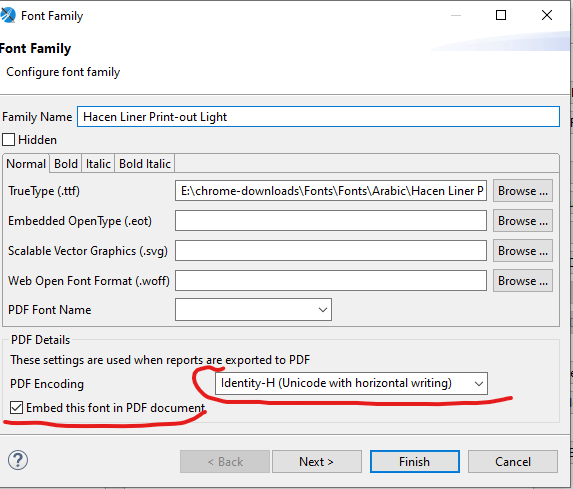
- Click Finish
3. Export Font as JAR
- After adding the font, click Export
- Save the generated
.jarfile
4. Deploy Font JAR in Tomcat
- Copy the exported
.jarfile totomcat/libfolder - Restart the Tomcat service
For POS Applications
For POS applications, upload the exported font JAR file to the Jasper Fonts field in POS UI Settings (إعدادات واجهة نقطة البيع). The system will automatically create the font extension file in the jasper-fonts-extension folder:
- When the POS application starts up
- When the POS UI Settings record is saved
Important: After updating POS machines to a version that supports jasper-fonts-extension, you must re-save the POS UI Settings record to trigger the font file deployment on each machine.
5. Use the Font in Reports
- Assign the new font family to text fields in your
.jrxmlfiles - The font will be embedded and rendered properly in PDFs, including Arabic characters
Best Practices
1. Variable Creation for Complex Objects
When working with price calculations or report links, create variables:
<variable name="price" class="java.lang.Object" calculation="No Calculation Function">
  <initialValueExpression>
    NamaRep.priceCalculator().item($F{item}).qty($F{qty}).price()
  </initialValueExpression>
</variable>
2. Null Safety
Always use null-safe methods when dealing with potentially null values:
NamaRep.zeroIfNull(value)              // Instead of direct value access
NamaRep.nameOrCode(code, name1, name2) // Fallback to code
3. Localization
Always use translation methods for user-facing text:
NamaRep.translate(enumValue)   // For enums
NamaRep.name(arabic, english)  // For dual-language fields
4. Performance Optimization
- Cache complex calculations in variables
- Use
copyParams()when linking reports to avoid parameter duplication - Batch SQL queries when possible
5. Security Constraints
Always apply security constraints when querying sensitive data:
SELECT * FROM Account acc
WHERE acc.active = true
  AND $P!{SECURITY_CONSTRAINTS}
Migration from Legacy Methods
Common replacements when updating old reports:
| Old Method | New Method |
|---|---|
| Direct field access | NamaRep.name(name1, name2) |
| Manual date formatting | NamaRep.datePattern() |
| Custom price queries | NamaRep.priceCalculator() |
| Manual translation | NamaRep.translate() |
Troubleshooting
Common Issues and Solutions
- Arabic text not displaying: Ensure font supports Arabic and PDF encoding is set to
Identity-H - Null pointer exceptions: Use null-safe methods like
zeroIfNull() - Price calculations returning null: Verify all required parameters are provided
- Links not working: Check that entity type and ID are valid
- Security constraints not applying: Ensure parameter name matches exactly in query
- Multi-selection not working: Verify
listandlistTypeproperties are set correctly - Subreports not loading: Check parameter ID matches subreport name exactly
Advanced Features Reference
Audit Trail (Version History)
The audit trail feature allows you to display detailed change history for any entity record in reports. This is useful for compliance, tracking modifications, and understanding how data evolved over time.
Basic Audit Trail Function
NamaRep.audit(entityType, id, versionNumber, actionType, language, outputFormat)Parameters:
entityType- The entity type (e.g., "SalesInvoice", "Customer")id- The record IDversionNumber- The version number to compare (usually current version)actionType- The action type (typically "Update")language- Output language:"arabic"or"english"outputFormat- Format type:"html"or"text"
Example - Display audit trail in Arabic HTML:
NamaRep.audit($F{entityType}, $F{id}, $F{versionNumber}, "Update", "arabic", "html")Example - Display audit trail in English text:
NamaRep.audit("Customer", $F{customerId}, $F{currentVersion}, "Update", "english", "text")What the Audit Trail Shows
The audit trail displays:
- Header Changes: Field modifications in the main record
- Field name
- Old value
- New value
- Detail Line Changes: Changes to collection items (e.g., invoice lines)
- Lines added
- Lines removed
- Lines modified
- Modification Info:
- Who made the change
- When the change was made
Output Formats
HTML Format:
- Produces formatted HTML tables with CSS styling
- Includes headers and organized sections
- Ideal for embedded display in reports and emails
Text Format:
- Plain text output with indentation
- Line-by-line change description
- Suitable for SMS, plain text emails, or simple displays
Language Options
- Arabic: All labels and field names in Arabic
- English: All labels and field names in English
Other Advanced Features
For additional advanced features, consult the development team:
- Group Expressions:
NamaRep.groupExpression(field1, field2, field3) - Order By Builder for complex sorting
- Encryption/Decryption utilities
- Values Holder for complex operations
- Report References with custom ordering
- Map creation utilities
- File operations and retrieval
Conclusion
This guide provides comprehensive coverage of Jasper Reports development in Nama ERP. The NamaRep utility class offers powerful tools for creating localized, secure, and feature-rich reports that integrate seamlessly with the ERP system. Always refer to this guide when developing new reports or maintaining existing ones.
For additional support or undocumented features, consult the Nama ERP development team.