
Partial Disposal
Not every asset record is one thing. When Al-Waha Industries bought ten identical office desks in a single delivery, registering ten separate assets would have meant ten depreciation lines every month for the rest of the decade, for no analytical gain whatsoever. So the desks were entered as one countable asset — FRN-0021, Office Desks (10) — with a count of ten.
That works beautifully until three of the desks are sold off. The asset is not leaving; only part of it is. That is what the Fixed Asset Partial Disposal Document is for.
You will find it at Assets > Documents > Fixed Asset Partial Disposal Document, on the fixedassets licence.
What "partial" means here
It means a number of units out of a countable asset. Nothing else.
It is not a percentage of the asset's value — you cannot dispose of "40% of a machine". It is not a named part or component — the document has no component structure at all, and the components you define for maintenance have no bearing on it. If you want to write off a machine's damaged control unit, that is a deduction on an addition and deduction document, not a partial disposal.
So the asset you point this document at has to be marked countable, and the count you enter has to be available. The picker on the screen offers exactly the assets that qualify: countable ones that are currently depreciating. If the asset you expect is missing from the list, the answer is almost always that it was never flagged as countable when it was registered.
Everything else on this page — how the money is worked out, what the entry looks like, when the commit is refused — follows the same logic as a full disposal, including the rule that depreciation must be run and processed with no period skipped before the document. Read that page first; this one only covers the differences.
The screen
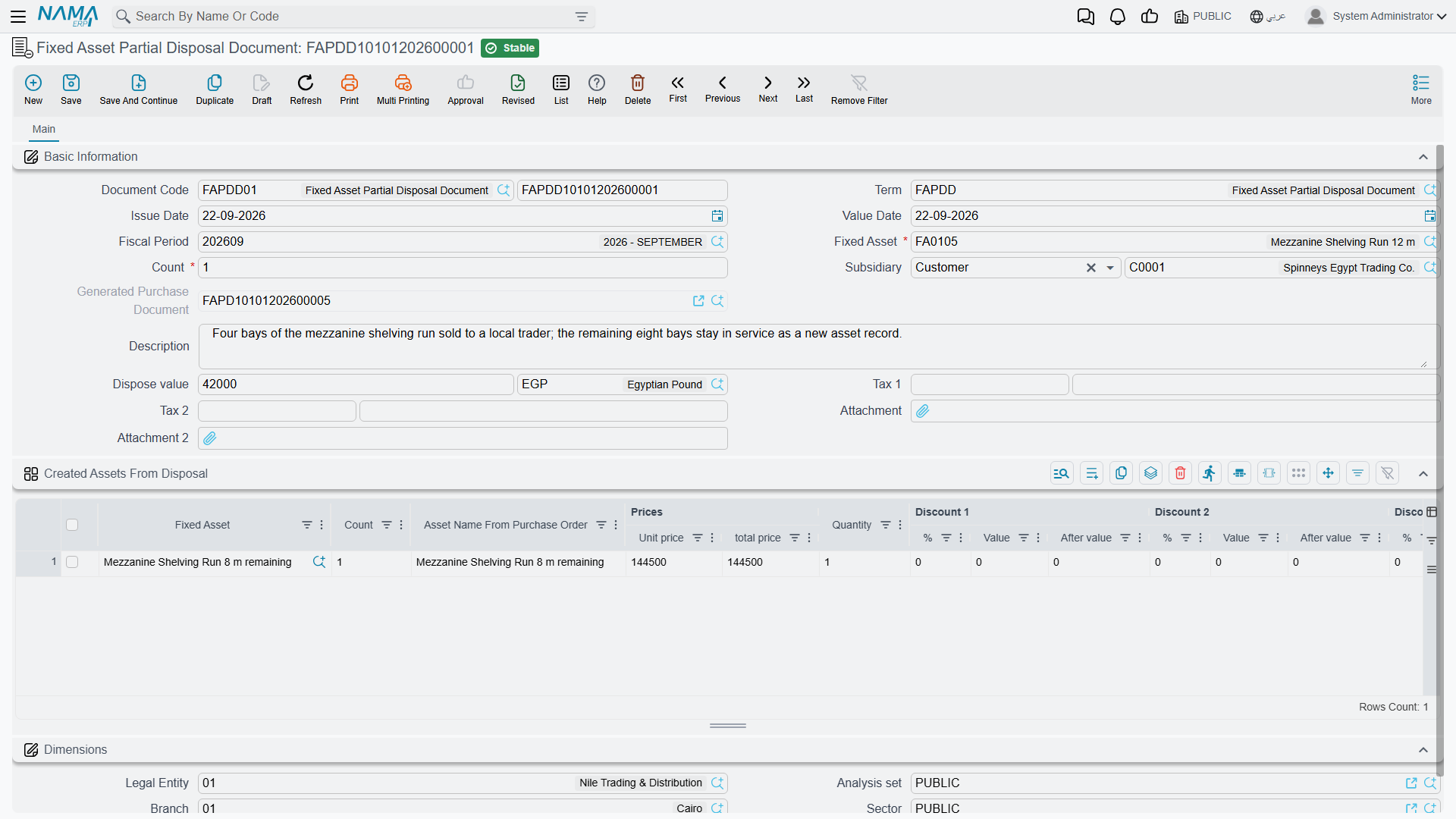
The header is the full disposal's header with two changes:
- Count (العدد) — how many units are leaving. Required.
- Dispose value (قيمة التخلص) — here it is an amount with its own currency field, which arrives filled with the currency you are working in. As on the full disposal, this is what you receive, before tax, and it is 0 for a scrap.
The Subsidiary (الذمة) names the counterparty, the Value Date (التاريخ الفعلي) is the cut-off for the ledger balances the document reads, and the Dimensions group carries the legal entity, analysis set, branch, sector and department. Partial-disposal entries always take their dimensions from the document.
Tax on a partial disposal is handled through Tax 1 — its percentage and value are filled from the term's tax plan when you pick the term, and recalculated when you change the dispose value.
There is no "reason" here either. Just as with a full disposal, a sale and a scrap are told apart by which document term you choose and what you put in the dispose value.
One account for both gain and loss
The partial disposal's term differs from the full disposal's in one way that matters when you set it up. Its accounting page holds a proceeds side and a single group titled Profit & Loss Account (حساب المكسب - الخسارة) — one account that is credited when the units go out at a gain and debited when they go out at a loss. Separate gain and loss accounts, which the full disposal supports, are not available here. If your chart of accounts insists on the two being separate, use a full disposal for the last of the units and keep partial disposals for the cases where the direction is predictable.
The arithmetic
The document reads the same two ledger balances a full disposal reads — the asset's cost account and its accumulated depreciation account, for this asset, up to the value date — and takes each one pro-rata to the asset's count:
- cost removed = cost balance ÷ count × units disposed
- accumulated depreciation removed = accumulated depreciation balance ÷ count × units disposed
and then, exactly as before:
gain or loss = dispose value − (cost removed − accumulated depreciation removed)
Three desks out of ten
FRN-0021 stands at cost 40,000 and accumulated depreciation 12,000, so a carrying amount of 28,000 across ten desks. Three of them are sold to a staff member for 9,000.
| Calculation | Result | |
|---|---|---|
| Cost removed | 40,000 ÷ 10 × 3 | 12,000 |
| Accumulated depreciation removed | 12,000 ÷ 10 × 3 | 3,600 |
| Book value of the three desks | 12,000 − 3,600 | 8,400 |
| Gain | 9,000 − 8,400 | +600 |
| Account | Debit | Credit |
|---|---|---|
| Receivable or bank — from the term's proceeds side | 9,000 | |
| Accumulated depreciation — the asset's own account | 3,600 | |
| Asset cost — the asset's own account | 12,000 | |
| Profit and loss on disposal — from the term | 600 | |
| Total | 12,600 | 12,600 |
Had the three desks been given away instead, the dispose value would have been 0 and the same single term account would have been debited with 8,400 as a loss.
What the asset looks like afterwards
On FRN-0021 | Before | After |
|---|---|---|
| Cost | 40,000 | 28,000 |
| Accumulated depreciation | 12,000 | 8,400 |
| Carrying amount | 28,000 | 19,600 |
| Current count | 10 | 7 |
| Disposed count | 0 | 3 |
| Status | Running Depreciation | Running Depreciation |
The status does not change. The asset is still there, still depreciating, just smaller — which is the whole point of the document.
What happens to the depreciation schedule
This is the part people get wrong when they first meet the document, so it is worth stating flatly: the remaining life does not change, and the monthly instalment does.
The partial disposal touches none of the asset's properties — not the useful life, not the remaining life, not the salvage value. What it changes is the carrying amount, and the instalment is recomputed from that every period as (carrying amount − salvage value) ÷ remaining life, exactly as described on the depreciation concepts page.
Suppose the desks were registered with no salvage value and had 40 periods still to run:
- before: 28,000 ÷ 40 = 700 a period
- after: 19,600 ÷ 40 = 490 a period
The seven remaining desks finish depreciating on exactly the same date the ten would have. Only the size of each instalment falls, and it falls by the same 30% the value did.
Actions on this screen
The partial disposal screen has no buttons of its own. The quantity you type drives everything: the proportion of cost and accumulated depreciation to remove, the gain or loss, and — if you asked for one — the new asset record for the salvaged part. All of it happens on commit.
What blocks a commit
| The rule | Why it is there |
|---|---|
| The asset must be countable | there is nothing to take a count out of otherwise |
| The count must be consistent with what the asset actually holds | you cannot dispose of more units than exist, or more than are currently in |
| Nothing may be recorded on the asset after the document's value date | the pro-rata figures are computed against balances at that date; a later document would be built on the wrong base |
| The asset may not be in its initial state, and may not already be fully disposed of | there is no value on the books to take out |
| Depreciation must be sequential up to the document's period | the accumulated depreciation removed must be the real posted figure |
| If the created-assets grid is filled, the term must name a fixed asset purchase book and term | those rows become a real acquisition document |
The depreciation rule is the only one with an escape hatch. The partial disposal's term carries an option — written in Arabic as السماح بعمل سند تخلص جزئي لاصل رغم عدم إنشاء سند الاهلاك للشهور السابقة — which lets the document commit even when earlier periods have not been depreciated.
Think before switching that option on
It does not change the arithmetic; it only removes the check. The accumulated depreciation the entry takes out is still whatever is actually posted in the ledger up to the value date, so with earlier periods missing you will remove less depreciation than the desks really carry, and the gain will come out correspondingly higher. Use the option when you genuinely need to record a disposal ahead of a backlog, and expect to fix the difference afterwards; do not leave it switched on as a convenience.
Assets salvaged out of a partial disposal
The partial disposal carries the same Created Assets From Disposal grid (الأصول الناتجه عند التخلص) as the full one: a place to register whatever you are keeping out of the units that left.

Each row is a fixed-asset purchase line — the new asset, its count, unit price and value, useful life, salvage value, depreciation start date, custodian and location. On commit they are turned into a real acquisition document, which the read-only field in the header then links to. Fill the grid and the term must name the purchase book and term that document will use.
Undoing a partial disposal
Cancel or delete the document and everything reverses: the entry it created is removed from the ledger by a delete request, its entry in the asset's history is deleted, the carrying amount and the instalment are recomputed without it, the disposed count comes back down and the current count goes back up. As with the full disposal, the cancellation is refused if anything has been recorded against the asset since — sort that document out first.
Retiring the last of the units
A partial disposal is designed for taking a slice off an asset that carries on. When the last units are going and the asset record itself should close, use the full disposal document instead: it clears the whole remaining balance to the last unit and sets the asset's status to disposed, which is what the register — and everything that reads it — expects to see at the end.