
Firing & Termination
Ending someone's employment is never just a status change. The moment a departure is confirmed, a chain of obligations comes due: the final settlement of unpaid salary, the cash-out of unused vacation, any outstanding loans — and, above all, the end-of-service gratuity the company owes for the years served. Nama models the departure itself with a lightweight request → document pair, and keeps the potentially complex gratuity rules in a reusable catalogue of termination reasons so that the same policy is applied consistently to everyone who leaves for the same reason.
Gulf-specific gratuity
The request → document flow and firing reasons are general HR. The gratuity calculation built on top of termination reasons — months-of-salary bands, percentage entitlements and the end-of-service cap — follows Gulf / KSA labour-law conventions and is Gulf-specific.
Request first, then document
Termination follows the standard HR triplet. A Firing Request (طلب إنهاء الخدمة) is the approval-gated application to let someone go; once accepted it produces a Firing Document (سند إنهاء الخدمة), the executed record that actually marks the employee as terminated. If your process doesn't need an approval step you can raise the document directly. For the full mechanics of how a request is accepted and turned into a document, see HR Requests, Documents & Aggregated Documents.
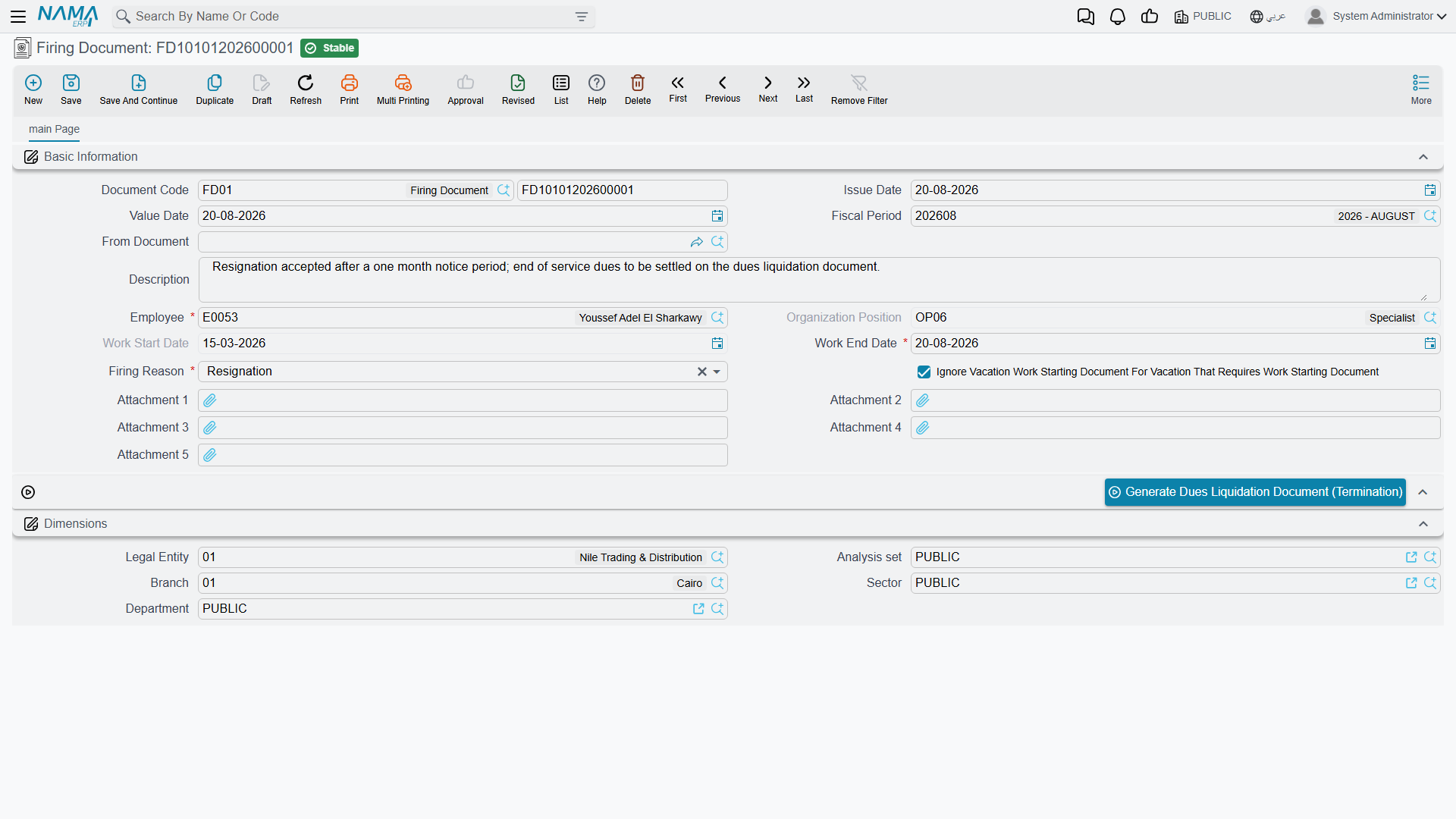
Both screens live under Payroll → Dues Liquidation and Firing — الرواتب > التصفية وانهاء الخدمات > سند إنهاء الخدمة (Payroll → Dues Liquidation and Firing → Firing Document). The firing document requires the payroll HR licence (humanresource-payroll).
The request and the document share the same core fields:
| Field (English) | Arabic label | Purpose |
|---|---|---|
| Employee | الموظف | The person being terminated. |
| Organization Position | الدرجة الوظيفية | Their grade at the time of leaving. |
| Work Start Date | تاريخ بدء العمل | Service start — the anchor for length-of-service. |
| Work End Date | تاريخ إنتهاء العمل | The last working day; the settlement counts up to here. |
| Firing Reason | سبب إنهاء الخدمة | Why they are leaving — this drives the gratuity (below). |
| From Document | بناءا على | On the document: links back to the accepted request. |
| Ignore Vacation Work Starting Document | تجاهل عمل سند مباشرة عمل للأجازات… | Skips generating a return-from-leave document for leaves that would otherwise require one. |
| Attachment 1–5 | مرفق ١–٥ | Supporting paperwork (resignation letter, clearance, etc.). |
The Firing Reason is a fixed list: Resignation (إستقالة), Dismissal (فصل), Pension (على المعاش), Suspension (وقف عن العمل), and ten open Other slots (Other 1…Other 10, أخرى ١…أخرى ١٠) you can repurpose for locally-defined reasons. The reason matters because it selects which gratuity policy applies.
Generating the settlement
Neither the firing request nor the firing document works out or pays the money itself — that is the job of the dues liquidation. To bridge the two, both screens carry a Generate Dues Liquidation Document (Termination) button (إنشاء مستند تصفية مستحقات (نهاية خدمة)). Pressing it opens a new dues liquidation pre-filled from the termination — the employee, the service dates and the applicable termination reason are carried across so you don't re-key them. From there the settlement computes gratuity, vacation cash-out, loans and final salary, nets them, and produces the payment. See Dues Liquidation for the money math.
Termination reasons — the gratuity rulebook
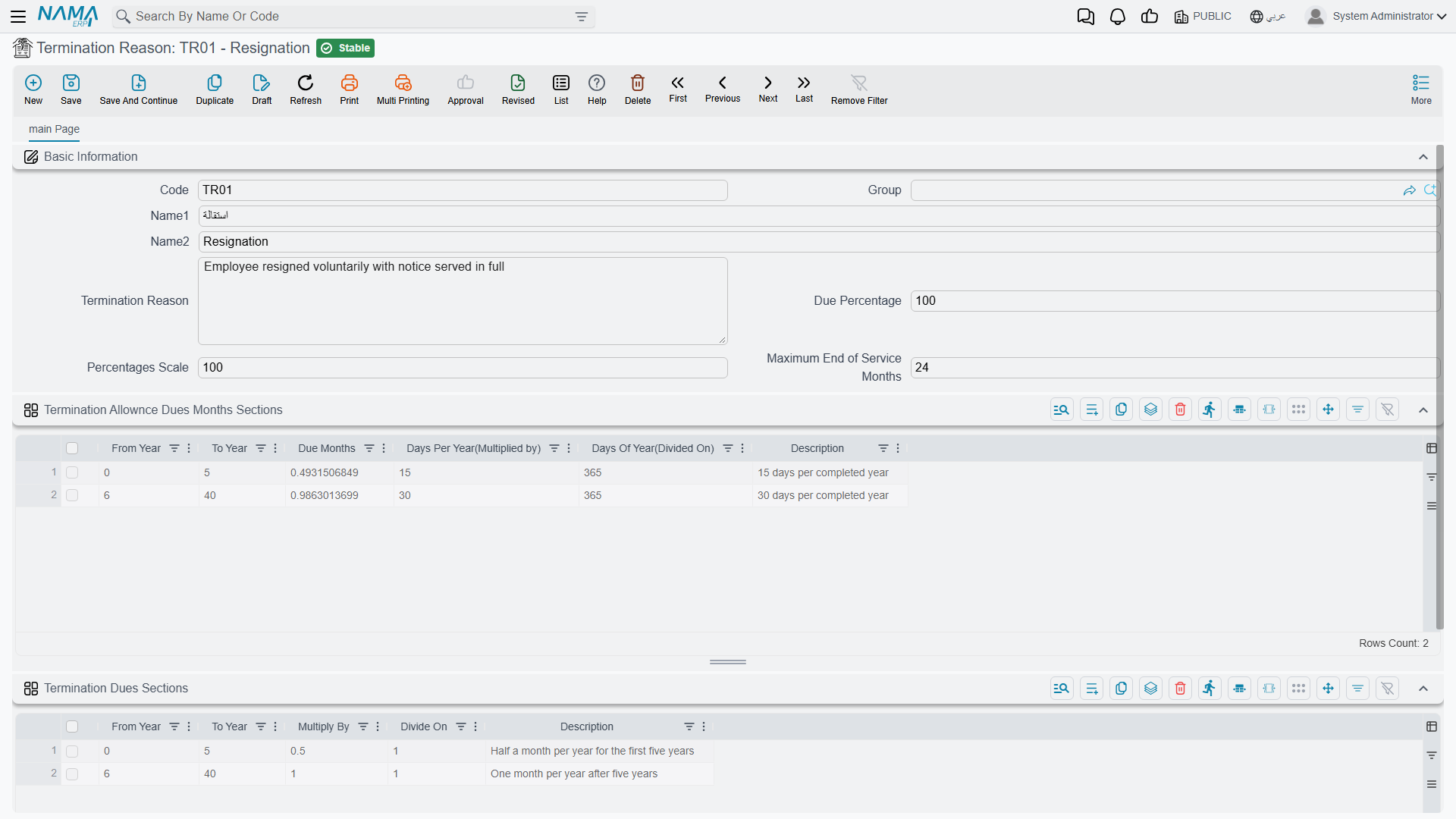
A Termination Reason (سبب نهاية الخدمة) is a master record that turns "why did they leave and how long did they serve" into "how many months of salary do we owe". One record can cover several firing reasons at once — the Termination Reason field (سبب نهاية الخدمة) on the header lists which firing reasons this rulebook applies to, so you might keep one policy for resignations and a more generous one for end-of-contract or pension. It is found at Payroll → Dues Liquidation and Firing → Termination Reason.
The gratuity is computed from two rule tables that work together, then clamped by an overall cap:
1. Months-of-salary bands — Termination Allowance Dues Months Sections (شرائح استحقاق شهور بدل نهاية الخدمة). Each row is a service band and the entitlement it earns:
| Column (English) | Arabic label | Meaning |
|---|---|---|
| From Year / To Year | من سنة / إلى سنة | The service-length band this row applies to. |
| Due Months | عدد شهور استحقاق بدل نهاية الخدمة | Months of salary earned per year inside this band. |
| Days Per Year (Multiplied by) | عدد الايام عن كل سنة (مضروبا في) | Alternative day-based factor: days credited per year. |
| Days Of Year (Divided on) | عدد الايام للسنة (مقسوما علي) | The divisor that turns those days into a fraction of a year. |
This is where the familiar Gulf pattern lives — for example half a month's wage for each of the first five years, a full month for every year beyond that becomes one band for years 0–5 and another for years 5 and up.
2. Percentage bands — Termination Dues Sections (شرائح نسبة استحقاق نهاية الخدمة). These scale the earned gratuity by how the person left:
| Column (English) | Arabic label | Meaning |
|---|---|---|
| From Year / To Year | من سنة / إلى سنة | The service-length band. |
| Multiply By | مضروب في | Numerator of the entitlement fraction. |
| Divide On | مقسوما علي | Denominator of the entitlement fraction. |
The classic resignation ladder — nothing under two years, one third between two and five years, two thirds between five and ten, the full amount after ten — is expressed as multiply-by / divide-on fractions (1÷3, 2÷3, 1÷1) per band.
Three header fields govern the whole record: Due Percentage (نسبة استحقاق نهاية الخدمة) sets an overall entitlement percentage, Percentages Scale (عدد خانات الكسر للنسب) controls rounding precision, and Maximum End of Service Months (الحد الأقصى لأشهر مكافأة نهاية الخدمة) caps the total gratuity — no matter how long the service, the payout can never exceed this many months of salary (the Gulf statutory ceiling).
Terminating many employees at once
For restructurings or end-of-project releases, the Aggregated Firing Document (سند إنهاء خدمة مجمع) — and its request counterpart, the Aggregated Firing Request (طلب إنهاء خدمة مجمعة) — let you process a whole list of employees from a single header. On commit the batch spawns one ordinary firing document per employee, each carrying its own reason, dates and eventual settlement. You manage the batch, not the generated singles; the aggregated pattern is explained in HR Requests, Documents & Aggregated Documents.
Actions on this screen
On the Firing Request and the Firing Document:
- Generate Dues Liquidation Document (Termination) — opens a new Dues Liquidation Document for the employee, linked back to this record, with the last work day and the liquidate-to date set to the work end date, the last liquidation date and the commencement date filled in, and the termination settlement switched on (see Generating the settlement). The record must be saved first; the new document opens unsaved for you to complete.
The Aggregated Firing Document, the Aggregated Firing Request and the Termination Reason have no buttons of their own.
Messages you may see
| Message | Why | What to do |
|---|---|---|
| The employee {0} has already fired by document {1} — «الموظف {0} لديه بالفعل سند إنهاء خدمة {1}» | The employee's state is already Dismissed, Resigned or Pension and an earlier firing document exists for them, so this one would end the same employment twice. | Work on the document named in the message; to re-hire and release the person again, put them back on the payroll first. |
| End date must be greater than start date — «تاريخ النهاية يجب أن يكون أكبر من تاريخ البداية» | The firing document's Work Start Date falls after its Work End Date, so the service span would be negative. | Correct the dates; the start date is the employee's own commencement date. |
| The employee {0} work start date is {1}, cannot be fired on same day — «تاريخ بداية العمل للموظف {0} هو {1} , لا يمكن انهاء خدمة الموظف بنفس اليوم» | The termination's value date is the employee's first working day — there is no served day to settle. | Use the following day as the value date, or cancel the work-starting document if the employee never actually started. |
| To Year must be greater than From Year — «إلي سنة يجب ان تكون اكبر من من سنة» | On a Termination Reason, a gratuity band's To Year is not above its From Year, so the service band covers nothing. | Set each band to run upwards, with each band starting where the previous one ended. |
Related pages
- Dues Liquidation — the settlement generated from a termination.
- HR Provisions — the gratuity liability that has been accruing all along.
- HR Requests, Documents & Aggregated Documents — the request → document → aggregated pattern behind firing.