
Real Estate Investment Funds
A fund is a simple idea. Several people put money into a pot, the pot buys property, the property gains value, and the gain comes back to them in proportion to what each of them put in.
The important word in that sentence is money. A Nama investment fund does not issue shares or units — there is no share count anywhere in the system. Each investor holds a money balance in the fund, and every calculation the fund performs works from that balance and its share of the total. Ali's 600,000 out of a 1,000,000 fund makes him a 60% investor because of the ratio of the amounts, not because he holds sixty of a hundred certificates.
Keep that in mind through this page. Everything the fund does is arithmetic on balances.
The worked example
Two investors start a fund:
- Ali puts in 600,000
- Sara puts in 400,000
The fund total is 1,000,000; Ali is 60%, Sara 40%. Later Ali takes 200,000 back out. We will follow those three movements through the three documents that produce them.
The fund itself is deliberately thin
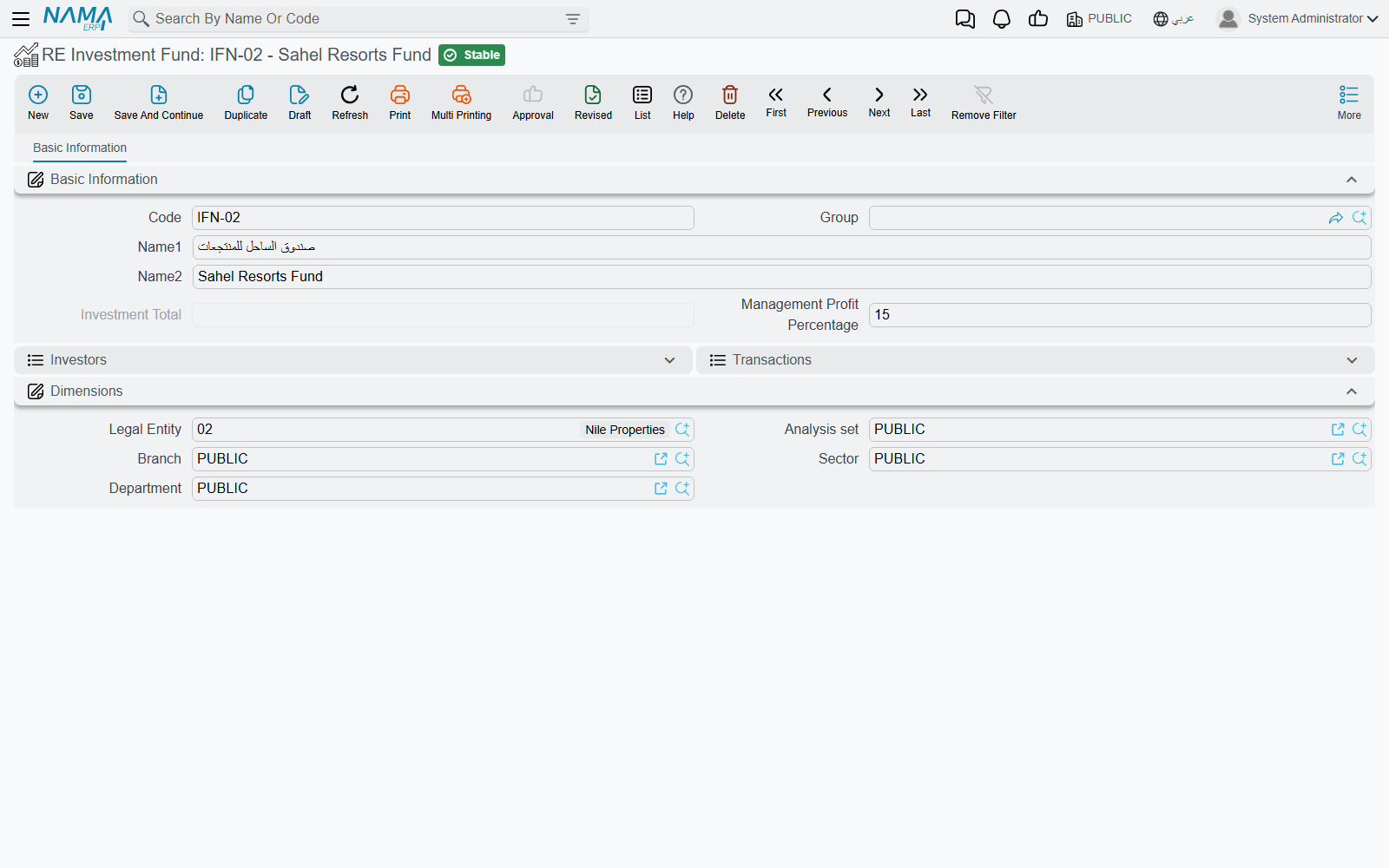
The fund master file lives at Real Estate and Property > Master Files > RE Investment Fund under the realestate licence, and when you open it for the first time you may wonder where the rest of the screen went. There is a code and a name, two lists, and exactly one number you are allowed to type.
That number is Management Profit Percentage — the cut the fund manager takes from each investor's profit. It is the only user-entered figure on the record, and it is read in exactly one place: the revaluation document's profit distribution. Nothing else on the fund is typed.
There is no bank account here, no currency, no capital target and no closing date. If you were expecting a fund to be a container of settings, it is not. It is a name that documents attach themselves to.
The two lists are built, not filled
Below the header sit two collapsible lists, and neither of them is a grid you edit:
Transactions is the raw log — one row for every document line that ever moved money in or out of this fund. Each row records the investor, the source document, the signed Investment Change, the type of movement, and the value date.
Investors is the roll-up — one row per investor, holding their Current Investment, their Join Date, their Full Exit Date if they have one, and the main-investor settings attached to them.
The Investors list is rebuilt by replaying the Transactions list in order: reset the row, then add each transaction's change to the running balance. A joining transaction stamps the join date, a full-exit transaction stamps the full-exit date, and the most recently seen main-investor settings win.
Investment Total on the header is then the sum of the investors' current investments. It is displayed, never typed, and it is recalculated whenever any investment document is committed, updated or cancelled. Cancel a finance addition and the total drops the moment the cancellation is processed — the fund's figure is always derived from documents, so it can never drift away from them.
Money in — the Finance Addition
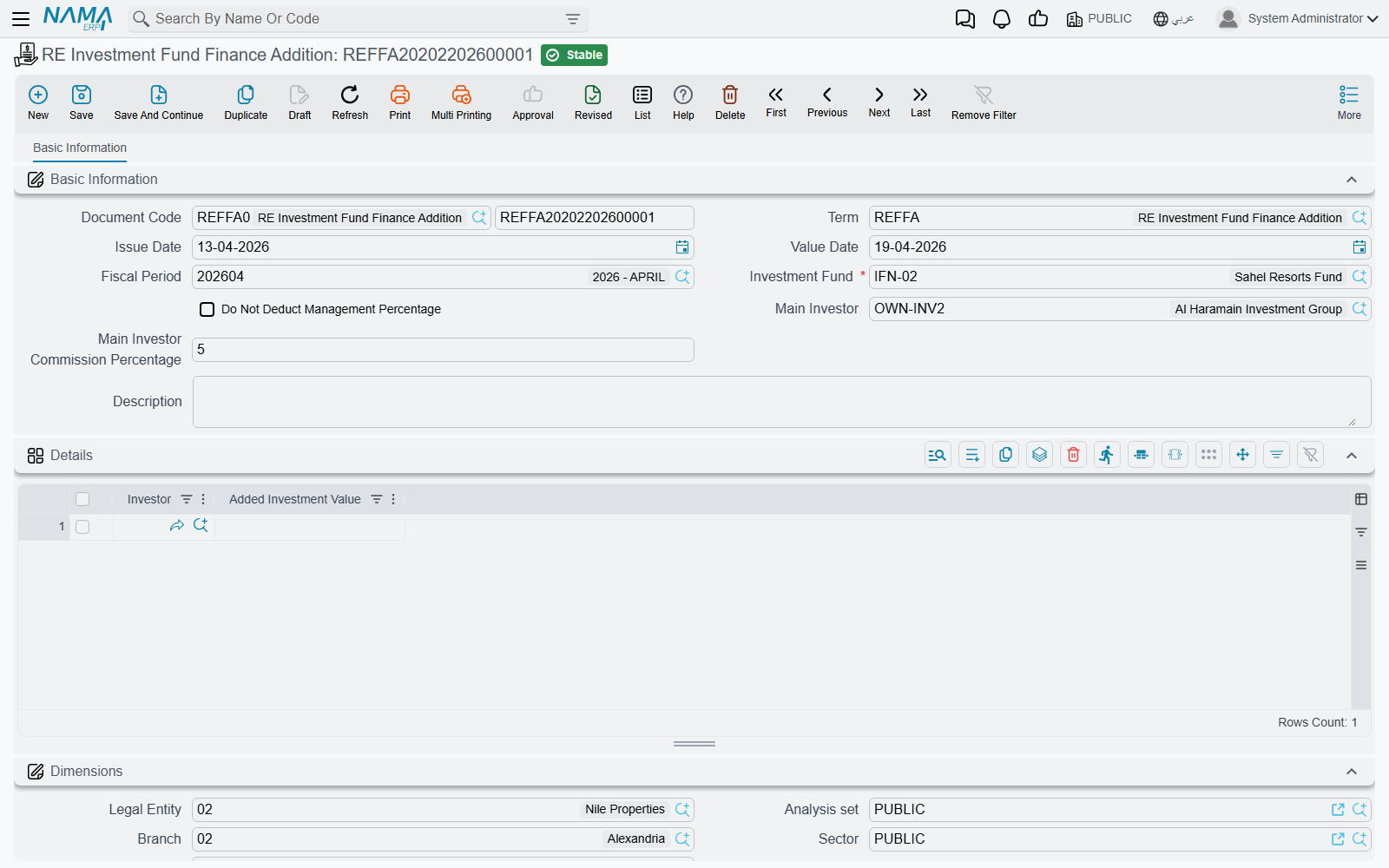
Real Estate and Property > Investment > RE Investment Fund Finance Addition is how money enters a fund, and it is worth being blunt about this: it is the only way an investor joins. There is no "add investor" button on the fund. If somebody's name is not on a finance addition, they are not in the fund.
The document is short. Name the fund it belongs to, then list the investors and how much each one is adding:
| Investor | Added Investment Value |
|---|---|
| Ali | 600,000 |
| Sara | 400,000 |
Commit it and two transactions of type Join are written, +600,000 and +400,000, the investor rows are rebuilt, and the fund total reads 1,000,000.
Only owners flagged as investors can be picked
Both the line's investor picker and the main-investor picker are restricted to owner records that carry the investor flag. If someone is missing from the list, the fix is on their owner record — see Owners and Contract Clauses.
The three header settings that follow the investor around
Above the grid sit three settings that are not about this document's money at all. They are copied onto every transaction row the document writes, and therefore onto each investor's roll-up row, where they stay until another finance addition overwrites them:
- Main Investor — the introducer or lead investor this money came in behind.
- Main Investor Commission Percentage — the slice of the management fee that gets passed to that main investor.
- Do Not Deduct Management Percentage — exempts this investor from the management cut altogether.
All three are consumed later, by the revaluation document, when profit is distributed. They are explained where they actually bite, in Estate Values, Additions and Revaluation.
The most recent finance addition wins
Because the roll-up replays transactions in order and keeps the last non-empty value it sees, an investor's main-investor and management settings come from their latest finance addition, not their first. Raise a second addition for Ali with a different main investor and Ali's row changes, retroactively, for every future distribution. If you want to top up an investor's money without changing their terms, copy the settings from the previous document onto the new one.
What it posts
The finance addition does have an accounting effect: one debit/credit pair per detail line, valued at that line's added investment value, in the legal entity's ledger main currency, from the two account sides on the document's term. The usual setup debits cash or bank and credits the investor's partners-capital account. Leave both sides empty and nothing is posted.
One point to get right when configuring the term: for account sides that resolve from the customer, the customer used is the header's Main Investor — not the investor on the line. If your accounts are meant to be picked up per investor, drive them from the line's subsidiary rather than from the customer side, and remember that a blank Main Investor leaves the customer side with nothing to resolve. The term itself is documented in Collection, Maintenance, Investment and Cost Document Terms.
Processing happens in the background as a business request; a failure is retried from the Business Requests list view with More menu → Reprocess / Recommit.
Money out — the Investor Exit
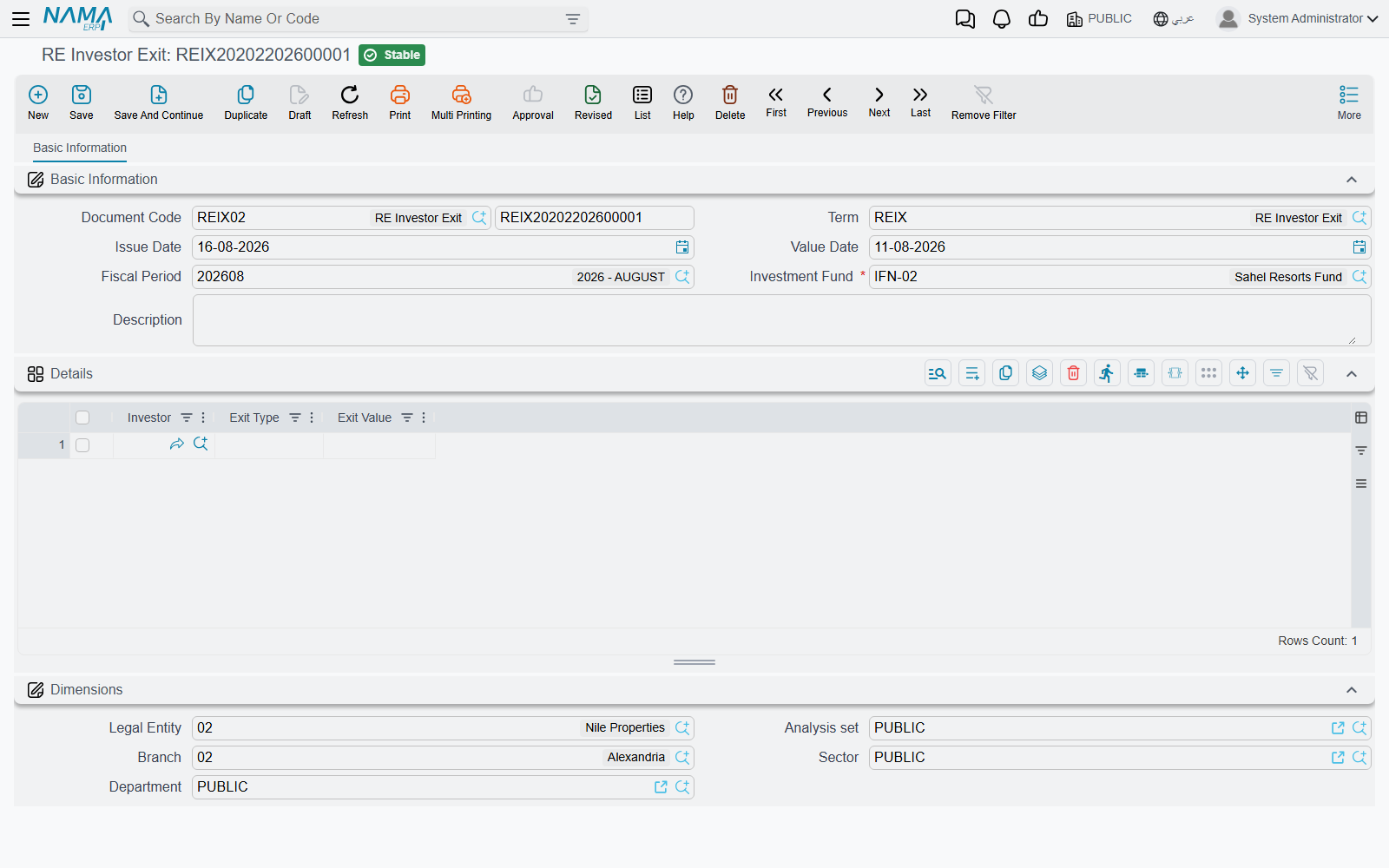
Real Estate and Property > Investment > RE Investor Exit does the reverse. Name the fund, then list who is leaving and with how much:
| Investor | Exit Type | Exit Value |
|---|---|---|
| Ali | Partial Exit | 200,000 |
The exit is stored as a negative investment change, so Ali's current investment drops by 200,000 the moment the document is committed. Full Exit does the same thing and additionally stamps the full-exit date on his investor row.
Two things about this document differ sharply from the finance addition, and both matter:
It has no accounting effect. None at all — no term, no ledger lines. It adjusts the fund's investor balances and nothing else. The cash actually leaving the company has to be recorded separately, normally with a payment voucher.
The exit value is typed by hand and is not checked against the balance. The system does not look up what the investor is holding and does not object if you type more or less than that.
Read the Investors list before committing an exit
Because nothing validates the amount, a Full Exit for less than the investor's balance will leave a residual balance sitting on a row that is stamped as fully exited — it will look closed while still holding money. Open the fund, read the investor's Current Investment, and type that exact figure for a full exit.
Dates matter more than you would expect
Profit distribution counts only the fund transactions dated before the revaluation's own value date. An exit dated on or after a revaluation therefore does not reduce that revaluation's share for the leaving investor — he is still treated as holding the money on the revaluation date. If an investor is supposed to miss out on a gain, his exit has to be dated before it.
Where the profit comes from
Nothing on this page makes money. A fund with investors and a bank of cash sitting in it earns nothing at all until it buys property and that property is revalued upward — the revaluation document is the fund's only profit engine, and it is also what pushes reinvested profit back into each investor's balance.
That, plus the purchase and improvement documents that build an estate's carrying value in the first place, is the subject of Estate Values, Additions and Revaluation.
Not the same thing as an agricultural investment contract
The Investment menu also holds Agricultural Investment Contract, which despite the neighbouring menu entry has nothing to do with the pooled fund on this page — different licence, different product, different money. See Agricultural Investment Contracts.