
Disposing of a Custody Item
Eventually the laptop stops being worth keeping. It is scrapped, or sold for whatever it will fetch, or the employee who lost it pays for it, or it is simply written off. Whichever of those happened, one document ends the item's life and takes its value back off whoever was holding it.
Assets > Custodys > Custody Disposal (الأصول > عهد > تخلص من العهدة), licence fixedassets-custody, with a book and a document term like every other document here.
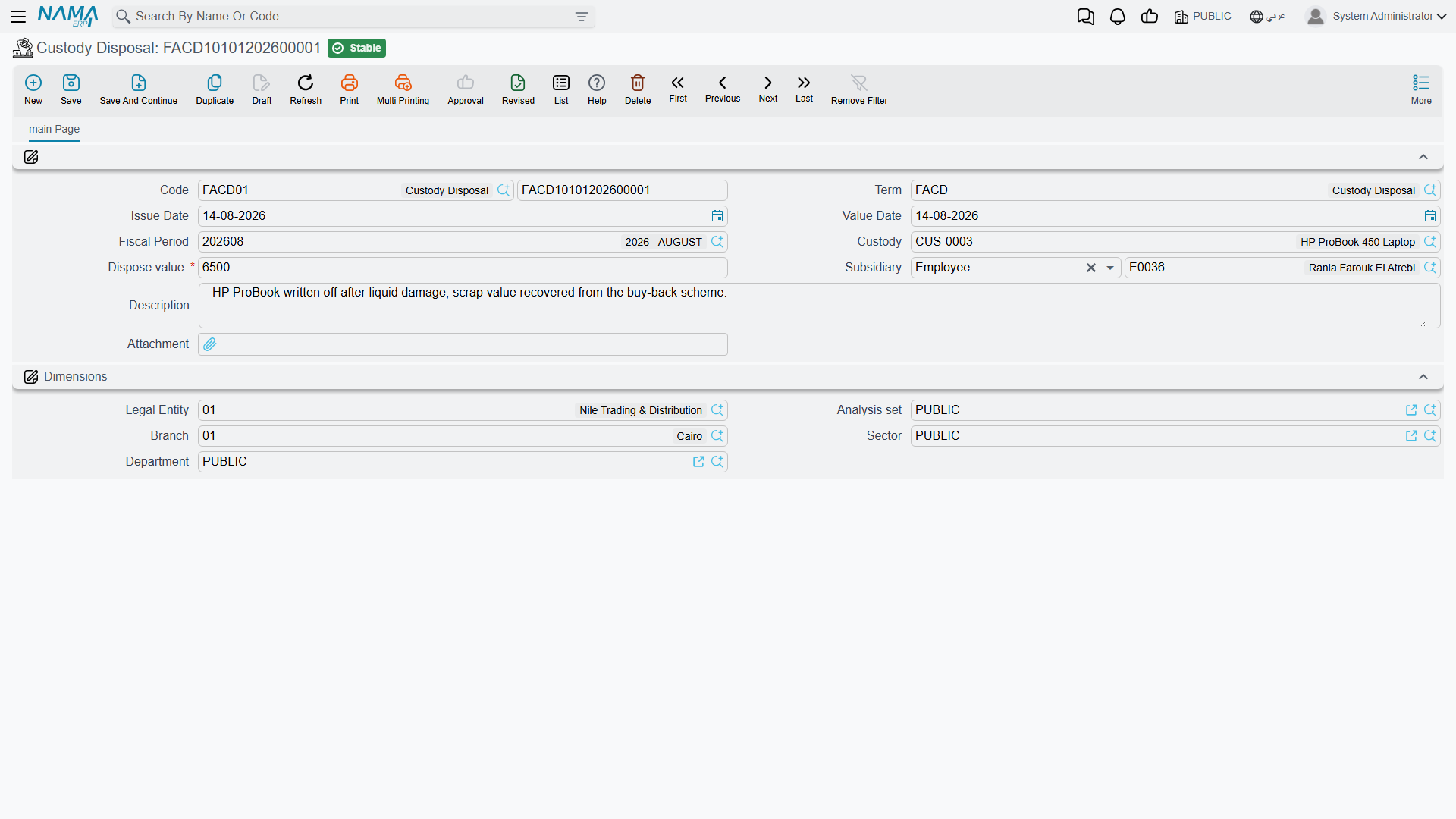
The screen is short on purpose
One page, one item, and one number that matters:
| Field | Arabic | Notes |
|---|---|---|
| Code (book / code) | الكود (الدفتر / الكود) | |
| Term | توجيه المستند | Where the accounts come from |
| Issue date / Value date | تاريخ التحرير / التاريخ الفعلي | |
| Fiscal Period | الفترة | |
| Custody | عهدة | The item being disposed of. The picker offers items in status Initial, Purchased or Delivered — anything that has not already been disposed of |
| Dispose value | قيمة التخلص | Required. What the disposal is worth: the sale proceeds, the amount recovered from the employee, or 0 for a pure write-off |
| Subsidiary | الذمة | The counterparty the dispose value is booked against — the buyer, the employee paying for it, the cash account, the write-off account |
| Description | ملاحظات | Why it was disposed of — the useful place to record "screen broken beyond repair" or "not returned on leaving" |
| Attachment | مرفق |
Note what is not on this screen: there is no reason list, no gain or loss field and no method picker. What kind of disposal this is comes out of two things only — the term you choose, which decides which accounts are hit, and the dispose value you type. Scrap, sale and write-off are the same document with different numbers and, if you want the accounting separated, different terms.
Al-Waha's laptop, three years on
CDY-0033 was bought for 6,000, delivered to Khaled Al-Mutairi, then transferred to Nouf Al-Harbi, who holds 100 % of it. In December 2028 Nouf leaves and buys the laptop from the company for 1,200.
Disposal document CDS-2028-004, value date 20 December 2028, custody CDY-0033, dispose value 1,200, subsidiary = the departing employee.
Committing it does two things. The item's status becomes Disposed, which takes it out of every picker — it can never be delivered or transferred again. And the accounting entry is created, as a business request processed in the background, in two distinct halves:
The holder half. For each of the item's current holders, their share of the item's price is taken off them. Nouf holds 100 % of an item priced at 6,000, so:
| Debit | Credit | |
|---|---|---|
| Custody disposal (from the term) | 6,000 | |
| Custodies with employees — Nouf Al-Harbi | 6,000 |
Had the item been the workshop toolkit held 50/50, this half would have produced two lines of 1,500, one against each technician.
The value half. One further pair for the dispose value, against the subsidiary you named:
| Debit | Credit | |
|---|---|---|
| Departing employee (receivable) | 1,200 | |
| Custody disposal (from the term) | 1,200 |
The difference is yours to place
This is the one thing to understand before setting the term up. The document does not work out a gain or a loss for you — unlike the fixed asset disposal, whose term carries separate gain and loss accounts, the custody disposal term has two account pairs and nothing else. The 6,000 that comes off the holder and the 1,200 that comes in from the buyer are booked independently.
So the difference — 4,800 here — has to land somewhere by construction. The usual way to arrange it is to point both halves at the same clearing account, as in the entries above: the 6,000 goes in as a debit, the 1,200 comes out as a credit, and what remains on that account is the 4,800 written off. Review that account periodically and clear it to the expense account you want the write-offs to appear in.
A pure write-off is the same document with 0 as the dispose value: the holder half takes the 6,000 off the employee, the value half books nothing, and the whole carried value stays on the clearing account as the loss.
Actions on this screen
The custody disposal screen has no buttons of its own — which fits a document this short. You name the item, the employee and the disposal value, save and commit; the accounting entry, the closing of the holding line and the change of the item's state all follow from the commit, not from anything you press. To reverse it, cancel or delete the document.
Returning an item is not a disposal
If somebody hands an item back and it is going out again to the next person, do not dispose of it — raise a transfer to the new holder. The transfer takes the value off the old holder in exactly the same way, and the item keeps its history and its status of Delivered so it can be issued again. Disposal is for items that are leaving the company altogether: sold, scrapped, lost, or written off. Once an item is in the Disposed status, nothing brings it back into circulation except cancelling or deleting the disposal.
There is also the Delivery/Receipt of Custodies document, which records hand-overs between employees and can carry fixed assets on the same lines. It is the natural choice when the movement being recorded is a physical hand-over rather than a change of accountability.
Undoing a disposal
If a disposal was raised in error, cancelling or deleting it reverses the accounting entry and works the item's status out again from its own history: if it has ever been delivered or transferred it goes back to Delivered, otherwise back to Purchased if it was bought, otherwise back to Initial. You do not have to remember where the item was in its life — the document reconstructs it.
Editing a committed disposal to point at a different item behaves the same way: the item it used to name gets its old status back and the new one is marked disposed.
Where the leftovers show up
Two places are worth checking after a round of disposals. The custody list screen filtered on status Disposed is the register's own answer to "what did we write off this year". And the stocktaking document ignores disposed items entirely when it builds its expected list — which is exactly why a disposal should be raised promptly for anything genuinely gone, rather than left to surface as a shortage at every count.