
Tags and Classification Files
Three small master files sit in the Service Center menu that a reader will reasonably expect to do something — and none of them does. They classify. They travel from the vehicle onto the job order, they appear as columns in list views and they group things for a human being reading a screen, and there their contribution ends.
This page covers all three together, honestly and briefly, so that nobody spends a morning configuring one and waiting for a behaviour that will not arrive.
Required licence
srvcenter
Accessories Kit
Accessories Kit (مجموعة ملحقات), under Service Center → Master Files, names the package a vehicle came with — AK-STD Standard Kit / مجموعة قياسية on Al-Sahra's VEH-2031.
It appears in three places, and always as a single reference field:
- on the vehicle file, in the product-details block;
- on the job order and the estimation, filled in for you from the vehicle when you pick the car;
- on a gate pass line, likewise filled in from the vehicle.
And it is written back onto the vehicle when a job document commits, if the vehicle's own field was still empty.
A tag, not a parts list
An accessories kit is a label. It contains no items, adds no lines to a document, carries no price, moves no stock, posts nothing and is checked by no validation. Naming a kit tells a later reader "this car arrived with the standard package"; it does not tell the system to bill or issue anything.
If you need the accessories themselves on a job, put them on the spare-parts grid as ordinary items.
No screen of its own has been registered
Unlike every other master file in the module, this one has no edit-screen layout registered for it. What you get when you open it from the menu has not been confirmed on a running system, so this documentation does not describe its screen. If the file is important to you, check it on your own installation before designing a process around it.
Visit Type
Visit Type (نوع الزيارة) classifies why the car came in — scheduled service, warranty claim, accident repair, complaint. Al-Sahra uses VT-SRV Scheduled Service / صيانة دورية for VEH-2031's March visit.
It lives under Service Center → Settings, and it is carried on the service request, the job order, the estimation, the inspection sheet and a gate pass line, plus the expected next visit type fields that project the vehicle's next appointment.
The screen holds code, group, the two names, and two settings:
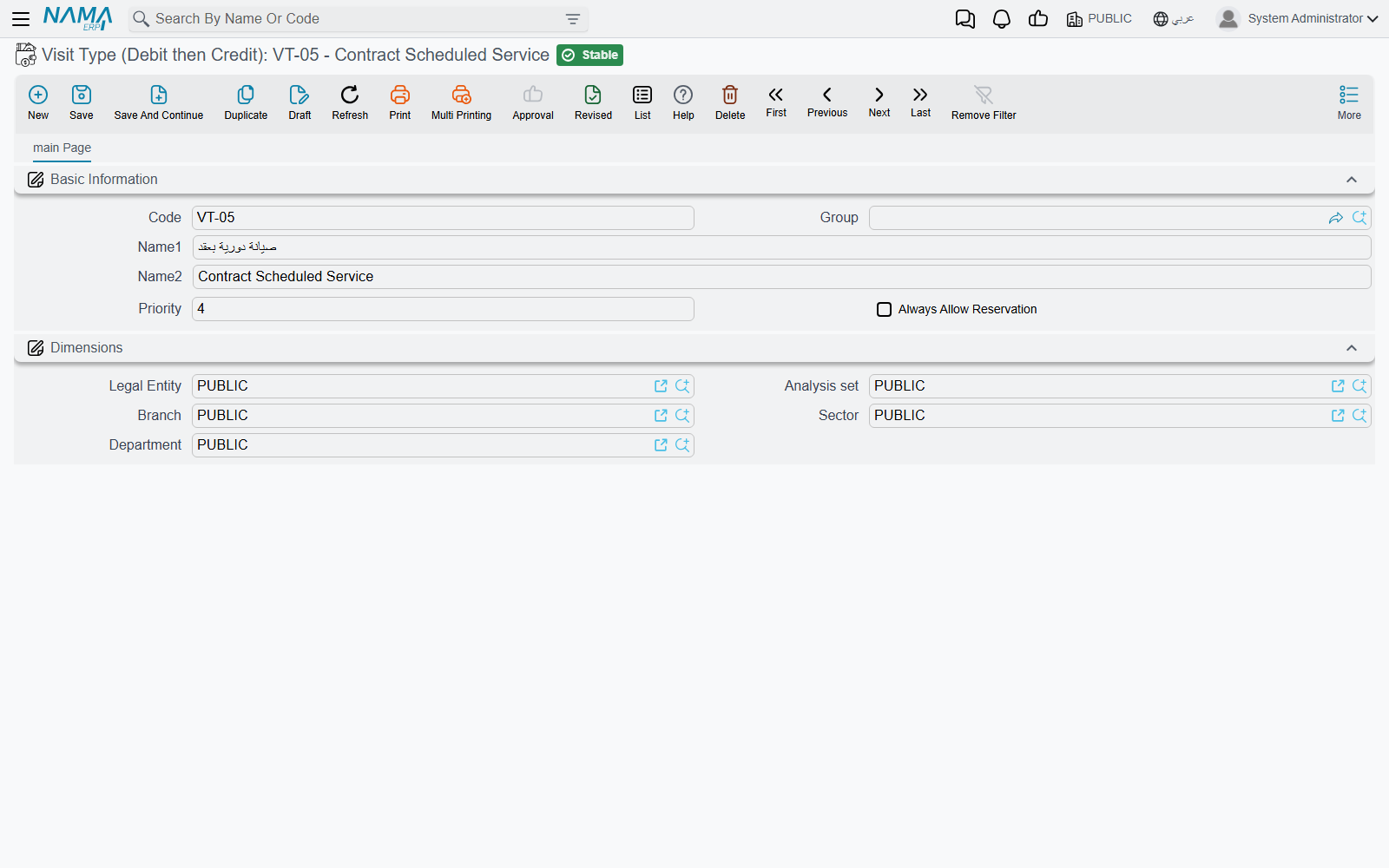
| Field | Arabic label |
|---|---|
| Priority | الأولوية |
| Always Allow Reservation | السماح بالحجز دائما |
Neither setting does anything
Priority and Always Allow Reservation are read by no code in the system. Setting a priority does not order anything; ticking Always Allow Reservation does not exempt an emergency visit from the appointment capacity check, and there is no third setting behind them that does.
A visit type is a classification label only. Use it to describe and to report; never build a booking rule on it, and never tell a service advisor that ticking a box here will get a car in.
Two menu-label defects to expect
The English menu entry reads "Visit Type (Debit then Credit)" — the parenthetical is a stray accounting label that has nothing to do with visits, and it does not appear in Arabic. The Settings folder itself also carries a stray leading space in both languages ( الإعدادات / Settings), so it may sort oddly in the menu tree. Both are cosmetic; the file is the one described here.
Standard Operation Classification
Standard Operation Classification (تصنيف خدمة), under Service Center → Master Files, holds code, both names, attachments and dimensions — nothing more.
Its one use in the whole module is the classification field (التصنيف) on the service task screen. Nothing else references it.
A free tag on the task
No price, no filter, no grouping rule and no report reads this classification. It is a column you can search a task list by, and a word a colleague can read. That is the whole of it.
It is still worth using — "mechanical", "electrical", "body", "valeting" makes a catalogue of two hundred tasks navigable — as long as nobody expects it to route work or price anything.
Why Fill Them In At All
Because list views, search criteria, custom reports and imports all read whatever you put in these fields, even though the module's own logic does not. A workshop that tags its tasks by discipline and its visits by reason can answer "how many warranty visits did we take in March" from a list view; a workshop that leaves them empty cannot. Just size the effort to what it buys — description and reporting, not behaviour.
The fourth small classification file, the product model category, is covered on the brands and models page, where it belongs to the same hierarchy as the brand and the model.