
Course Definitions and Courses
A training centre's brochure lists Advanced Excel for Accountants once: thirty hours, taught in English, in the classroom, aimed at the intermediate accounting level, ending with an attendance certificate. That entry in the brochure never changes.
What changes is the running of it. The spring intake starts on 1 March with Sarah Mansour teaching and Ahmed Fouad coordinating, and it is sold at 1,800 per student. The autumn intake starts on 15 September with a different lecturer and a different price. One brochure entry, two different things to organise, two different sets of marks.
That is exactly the split Nama makes. The Course Definition is the brochure entry — the catalogue card. The Course is the offering you actually run, and it is the record that fees, lecturers, dates and subject marks hang off.
The Course Definition — the catalogue card
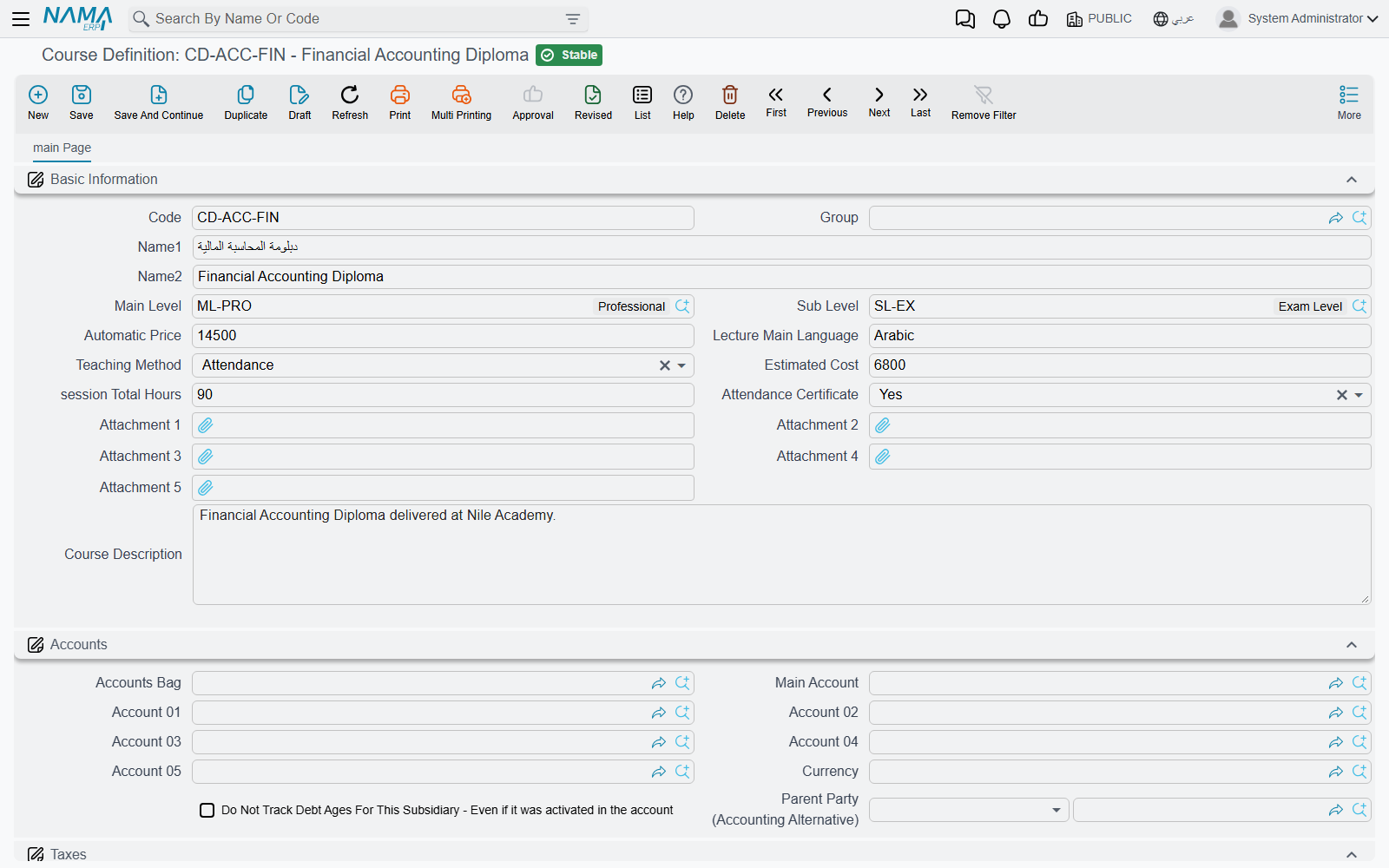
You create it from Education → Master Files → Course Definition (in Arabic التعليم ← الملفات ← تعريف دورة).
Beyond the usual code, group and Arabic/English names, the card answers the questions a prospectus answers:
| Field | What it says |
|---|---|
| Main Level (المستوى الرئيسي) / Sub Level (المستوى الفرعي) | The academic level the course sits at — "Intermediate", and under it "Intermediate – Finance" |
| Lecture Main Language (اللغة الرئيسية للمحاضرة) | Free text: English, Arabic, Arabic with English material — whatever your prospectus says |
| Teaching Method (طريقة التدريس) | Online (Online) or Attendance (الحضور) — delivered over the internet, or in a room |
| Session Total Hours (عدد ساعات الدورة) | How many teaching hours the course is worth — the 30 in "a 30-hour course" |
| Estimated Cost (التكلفة التقديرية) and Automatic Price (السعر التلقائي) | Planning figures recorded on the card for reference |
| Attendance Certificate (شهادة حضور) | Yes (نعم) or No (لا) — does finishing this course earn a certificate of attendance? |
| Course Description (وصف الدورة) | The long text you would put in the brochure |
| Attachment 1..5 (مرفق 1..5) | The syllabus, the accreditation letter, the sample material |
Main Level and Sub Level classify courses, not students
Both are small master files of their own — Education → Master Files → Main Level and → Sub Level — carrying nothing but a code and a name. It is worth being clear about what they are for, because their names invite the wrong guess: they are the course catalogue's two-tier classification. They have nothing to do with the Educational Stage / Class Room / Rank hierarchy that students belong to, which is described in Students, Guardians and the Academic Structure. A student is never placed on a Main Level; a course definition is.
The Course — the offering you run
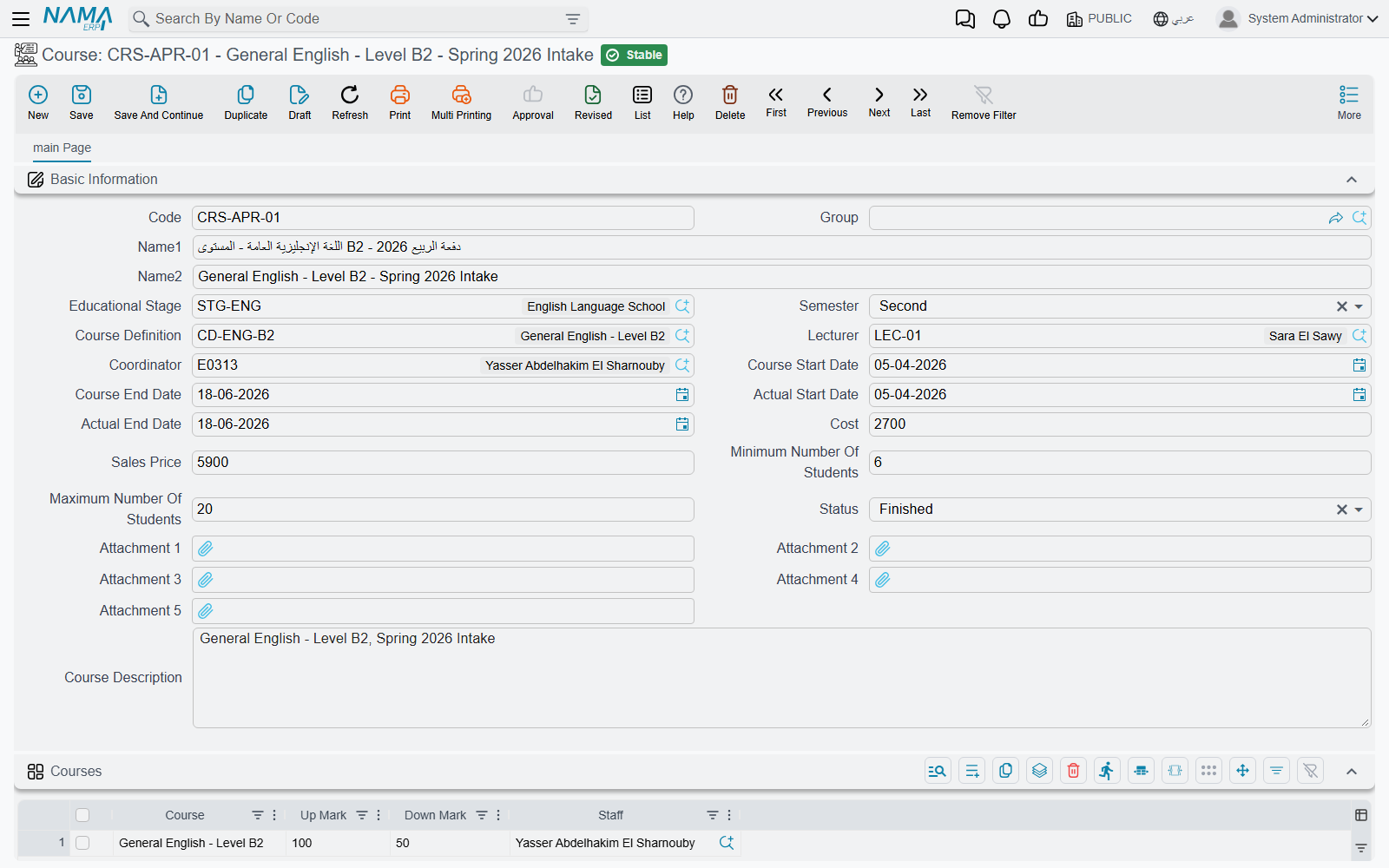
You create it from Education → Master Files → Course (in Arabic التعليم ← الملفات ← مادة دراسية).
Two records, and the labels overlap
The screen you are on is labelled Course / «مادة دراسية», and so is the grid inside it and each of that grid's lines. Read it this way: the record is the offering you are running, and the grid lines are the subjects that make it up. The rest of this page says "course" for the record and "subject" for the lines.
| Field | What it says |
|---|---|
| Educational Stage (المرحلة التعليمية) | The stage this offering belongs to |
| Semester (ترم دراسى) | First (الاول), Second (الثاني), Third (الثالث), Fourth (الرابع) or Annual (سنوى) |
| Course Definition (تعريف دورة) | Which catalogue card this is an offering of |
| Lecturer (المحاضر) | Who teaches it |
| Coordinator (المنسق) | Who administers it |
| Course Start Date (تاريخ بداية الدورة) and Course End Date (تاريخ نهاية الدورة) | The plan |
| Actual Start Date (تاريخ البداية الفعلي) and Actual End Date (تاريخ النهاية الفعلي) | What really happened, typed in when it happens |
| Cost (التكلفة) | What running this intake is expected to cost you — a figure you record |
| Sales Price (سعر البيع) | What one student pays. This one travels — see below |
| Minimum / Maximum Number Of Students (الحد الأدنى / الأقصى لعدد الطلاب) | The intake size you are planning for, written on the card for the people organising it |
| Course Description (وصف الدورة), Attachment 1..5 (مرفق 1..5) | As on the definition |
The Lecturer and Coordinator pair deserves a second look, because it is where readers most often trip. A Lecturer in Nama is its own master file, with its own contact details and stated pay basis — it is not an HR employee record, and creating one does not create an employee. The Coordinator beside it is an ordinary Employee. A staff member who both teaches a course and administers it therefore needs a record on each side. Both files are covered in Students, Guardians and the Academic Structure.
Below the basic information the screen carries the standard Accounts, Taxes and Dimensions groups that master files across Nama share.
Picking a Course Definition copies nothing
This is the point that surprises people, so it is worth stating flatly: choosing a Course Definition on a Course is a link, and only a link. Nothing is copied down — not the level, not the teaching language, not the teaching method, not the session hours, not the estimated cost, not the certificate flag.
A Course is therefore filled in entirely on its own. The definition it points at tells anyone reading the record which catalogue entry this intake belongs to, and lets you list every intake of Advanced Excel for Accountants side by side — but the dates, the lecturer, the price and the subjects are yours to type on the Course itself. When you open a new term of a course you already ran, the Duplicate (نسخة مماثلة) action on the previous intake is the quickest start: it brings the subjects grid with it, and you correct the dates, the lecturer and the price.
The subjects grid
The grid at the bottom of the Course breaks the offering into the parts a student is marked on. Each line names one subject and the two marks that go with it:
| Column | What it holds |
|---|---|
| Course (مادة دراسية) | The subject name — free text, typed in, not a reference to another record |
| Up Mark (الدرجة العظمى) | The maximum mark this subject is out of |
| Down Mark (الدرجة الصغرى) | The pass mark — the lowest mark that counts as a pass |
| Staff (مدرس المادة) | The employee teaching that subject |
For the Excel intake the grid might read: Formulas and Functions out of 40 with a pass at 20, Pivot Tables and Dashboards out of 30 with a pass at 15, and Financial Modelling out of 30 with a pass at 15 — 100 marks across three subjects.
Because the subject names are free text, they are exactly what you type. Spell them the way you want them to appear on every student's marks sheet, because that is precisely where they end up: Recording Marks pulls this grid across for the student, subject names and both marks included.
Where the money enters: the Sales Price
The Education module has an academic half and a financial half, and the Sales Price on the Course is the single field that joins them.
When you raise a Course Contract and pick the course on it, that course's Sales Price is written into the Unit Price (سعر الوحدة) of the contract's student lines. Our 1,800 becomes 1,800 per student; twelve students on one contract at a quantity of 1 each gives 21,600 to be scheduled and collected. From there the contract is in charge — discounts, taxes, instalments and collection all live on it, and it is the contract, not the course, that reaches the general ledger.
Set the price before you contract, not after
The price travels at the moment you pick the course on the contract. Changing a Course's Sales Price afterwards does not reach back into contracts already written — those keep the unit price they were given, which is usually what you want, since a signed agreement should not move on its own. It does mean the price on the Course wants to be right before the first contract of the intake is raised. On a contract already entered, correct the unit price on the student line by hand.
What the money side does from there — who pays, the instalment plan, collection and cancellation — is covered in Course Contracts, Payment Schedules and Collection and Cancelling a Course Contract.
Saving a Course or a Course Definition creates no accounting entry and no stock movement of its own. They are catalogue and planning records; the ledger only ever hears from the contract.