
Medical Service Catalog
Alongside general medical services, the hospital keeps specialized catalogs for each kind of clinical activity: lab tests, radiology, physiotherapy, and surgeries. These catalogs are what a doctor orders and what invoices are later priced from.
A shared pattern: "a sellable service type"
Lab, radiology, physiotherapy and surgery types all share the same shape — they are the items the hospital actually charges for:
- Basic Information: code, name, the parent category, tax plan, and the tax-authority item (for e-invoicing).
- Price-in-lists grid: a quick way to push this item's price straight into one or more price lists, varying by doctor/degree/insurer/patient class and period.
- Accounts and Taxes: each type behaves as its own accounting party.
- Medical Supplies tab: the default items issued from the warehouse when the service is performed.
- Medical Services tab: default linked medical services.
Lab tests
Laboratory Test Type defines a single test the lab offers (CBC, fasting glucose…). On top of the shared pattern, it has a unique tab defining the normal reference ranges for each result component, split by demographic: male / female / male-child / female-child (from–to) and the measuring unit. This grid is what later decides whether a patient's result is in or out of range.
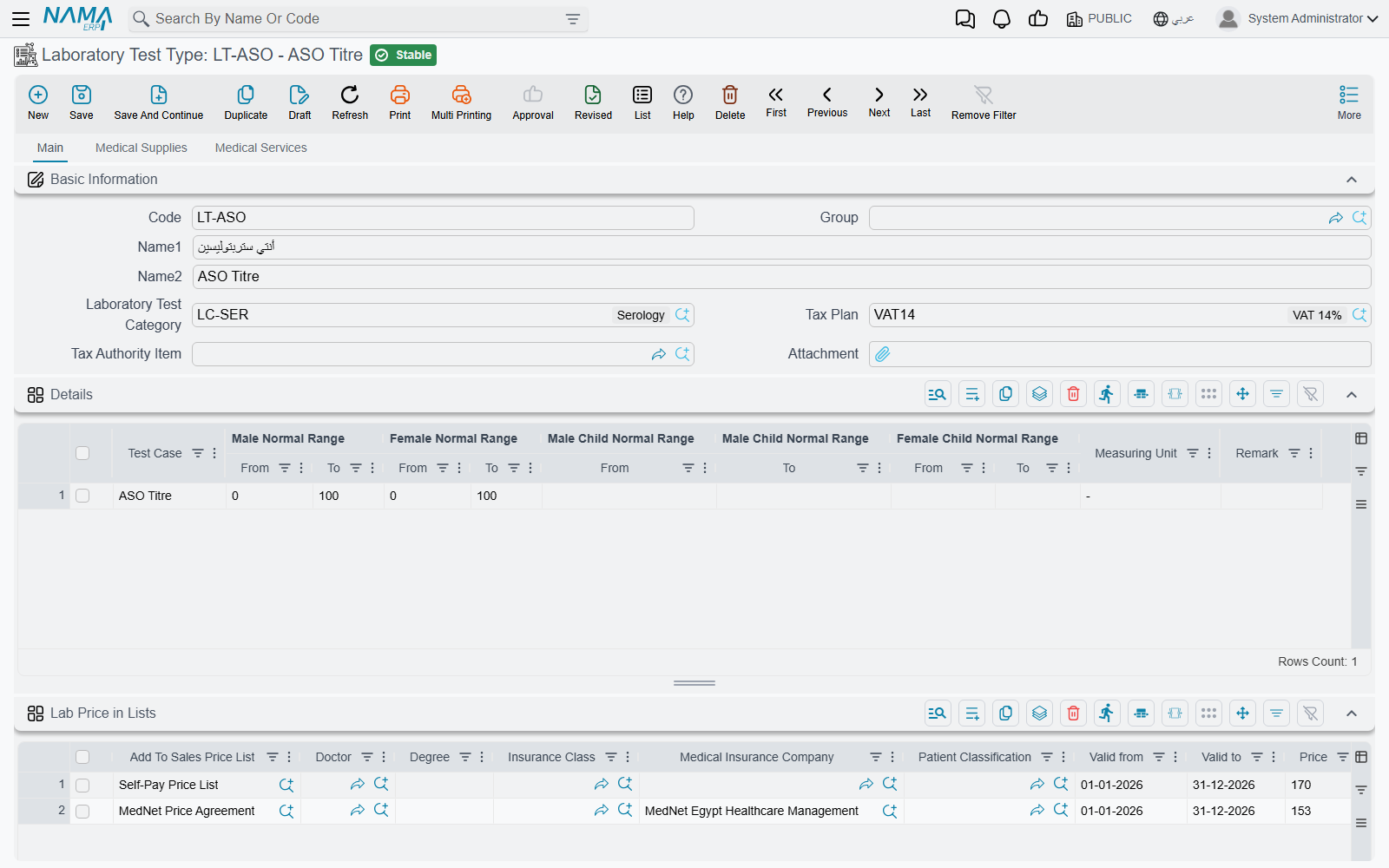
Tests are grouped under a Laboratory Test Category. The system also includes lab support lists: HMS Test as a result component, and Test Tube and Test Tube Color to describe sample tubes and their conventional cap colours.
Radiology and physiotherapy
Radiology Type defines a single imaging procedure (X-ray, CT, MRI, ultrasound…), follows the shared pattern, and is grouped under a Radiology Category.
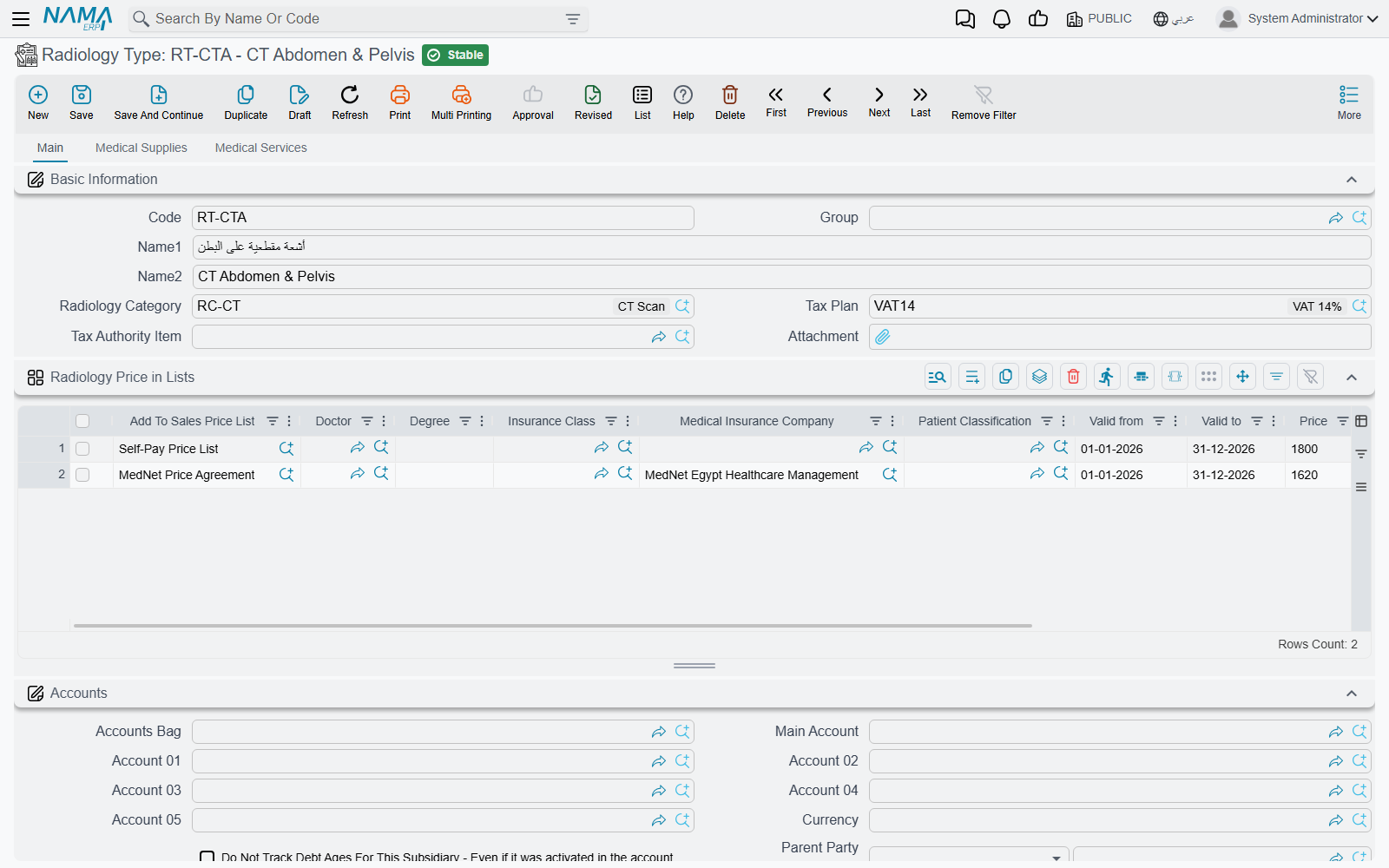
Similarly, Physical Therapy Type defines a physiotherapy session/procedure, grouped under a Physical Therapy Category.
Surgeries
Surgery Type defines an operation the hospital performs, adding surgery-specific details to the shared pattern: standard hours and the additional-hour price, and the fee components (surgeon fees, assistant, anesthesia, open surgery, other), along with a supplies warehouse and operative-document attachments. It's grouped under a Surgery Classification used as a pricing dimension.
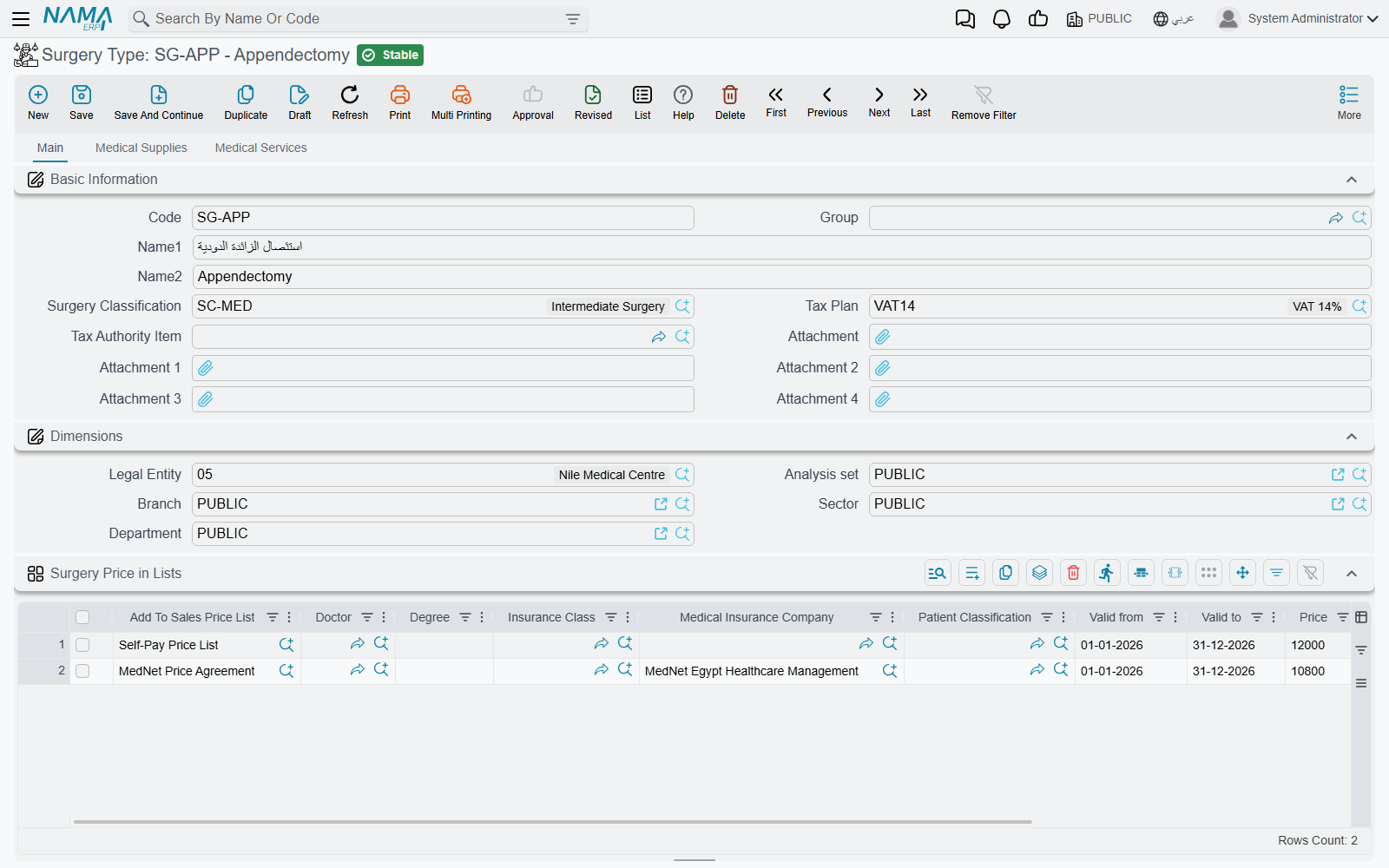
Surgery packages
Instead of billing an operation item by item, you can agree a fixed all-in price for it via a Surgery Package. The package links a doctor and surgery type to a billing item for non-agreed items (anything outside the bundle), and its details list a set of package items, each priced and optionally per room classification.
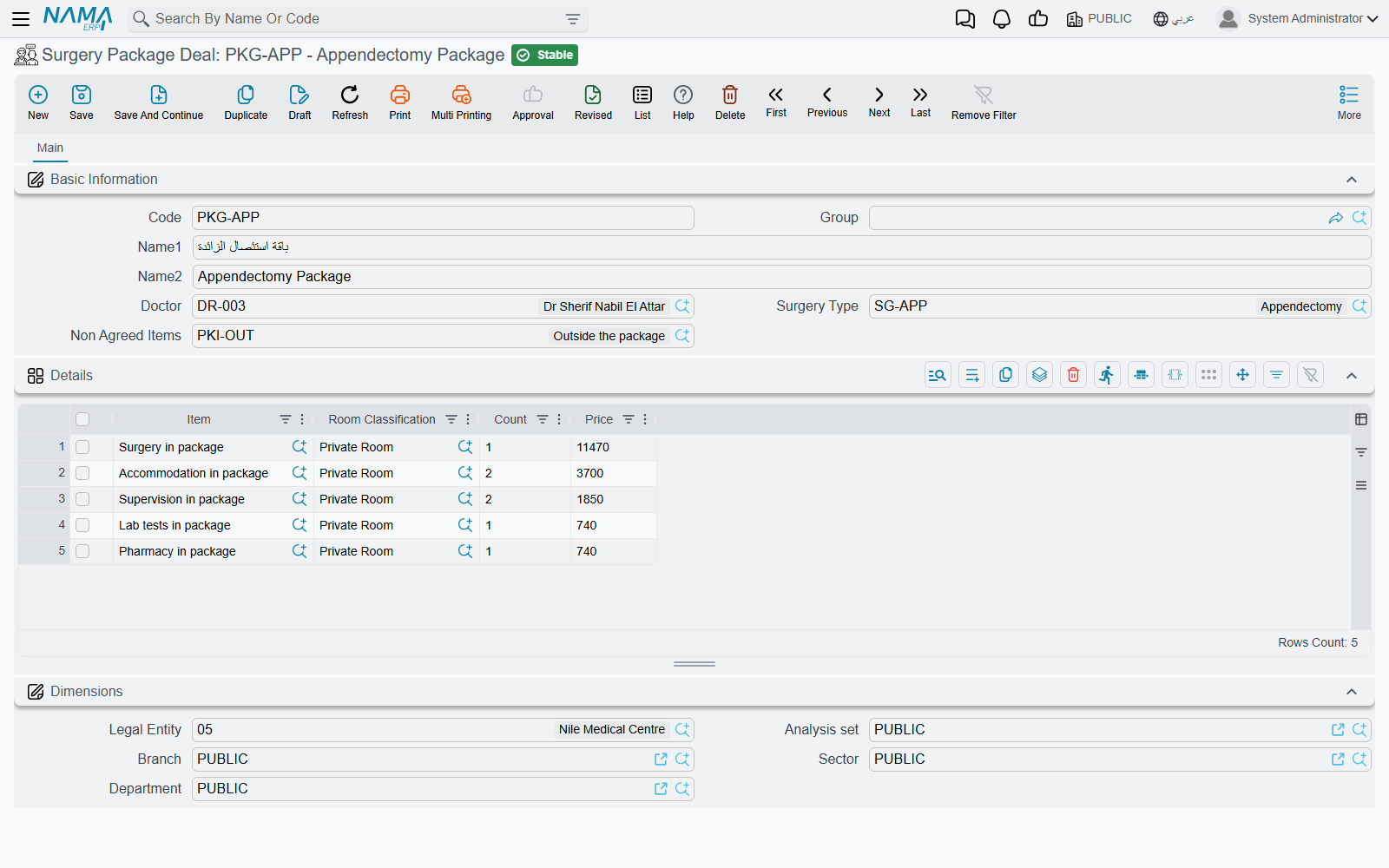
A Package Item is the line that appears inside the package, carrying flags that define what this line covers (supplies, check, accommodation, attendant, supervision, lab, radiology, physiotherapy, pharmacy, service, surgery, blood bank…) — i.e. it maps the package line to the real service category it represents. The package is later billed via the Surgery Package Invoice, which compares the agreed price to the actual price and posts the difference.