Invoicing & Billing
Billing is the hospital's financial backbone. The rule is simple: one invoice per service type. These invoices are very similar in structure and then differ in their lines by service type. All of them are documents that produce an accounting effect.
The common pattern across all invoices
Service invoices share one skeleton:
- Document header — document code, term, issue and value dates, fiscal period, and dimensions.
- Patient context — patient, patient admission (linking the charge to the admission), insurance company and class, patient/company endurance percentages, often the doctor, specialty and document category, and the cost-bearing parties.
- Service lines — each with a rich price block that computes: price, discount 1/2, patient/insurer split (a percent and value each), the insurance max value from the approval and from the admission, taxes split between patient and insurer, total patient due and total insurance due, and the cost percentage/value with its allocation to subsidiaries.
- Totals — mirroring the above at document level.
- Overhead lines — on most invoices.
Split billing is the core idea
Every line is automatically divided into a patient share and an insurance share (using the endurance percentages from the insurance approval and the admission), each taxed separately and posted to a distinct account in the term config. That term config is what maps the value types (patient value, insurance value, discounts, taxes, cost, subsidiary cost) to ledger accounts.
Service invoices
These follow the service pattern (price + supervision + addition-time cost for surgeries):
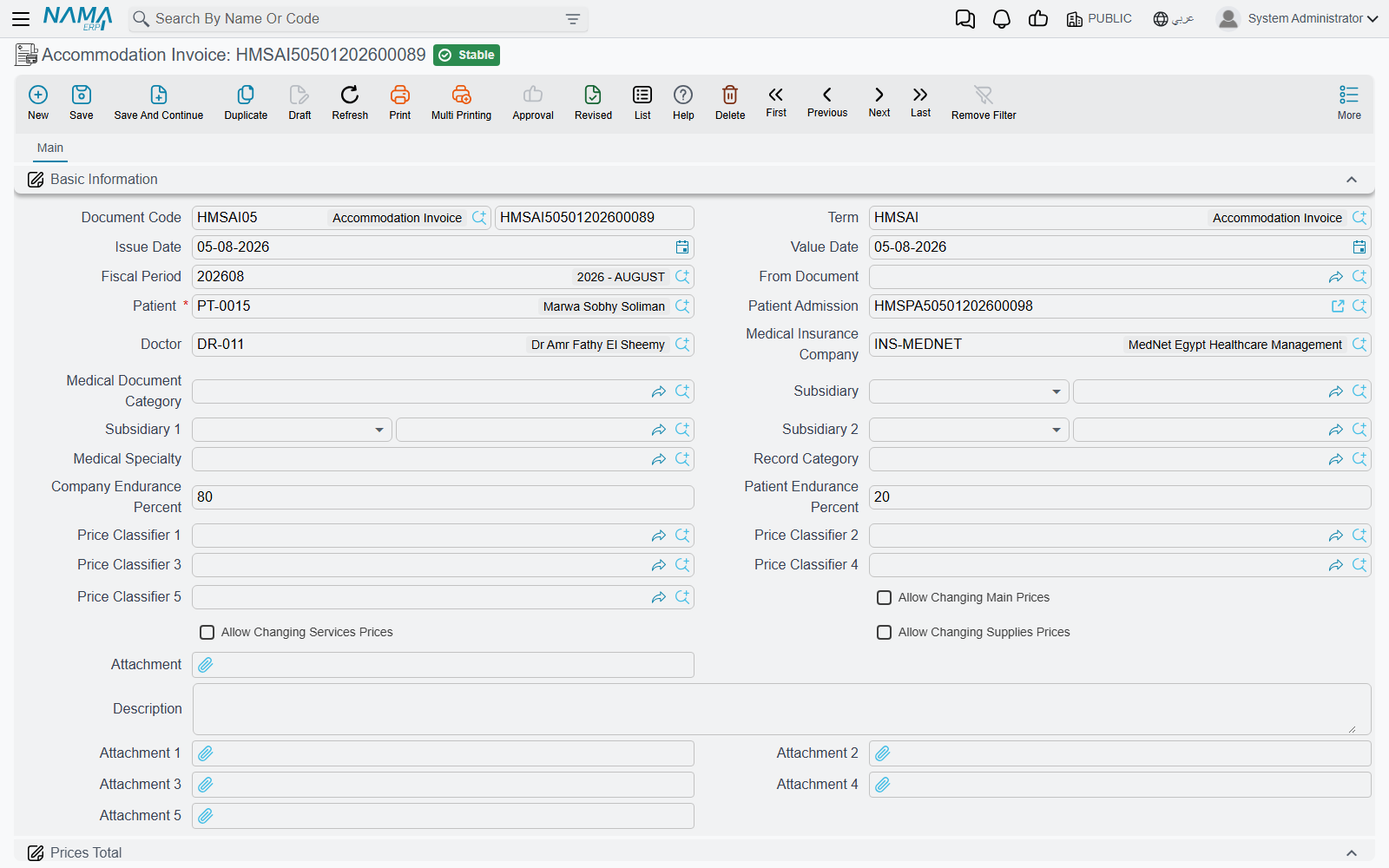
- Accommodation Invoice — the room/bed accommodation fee, usually auto-generated from the accommodation document.
- Attendant Invoice — accommodation for the patient's companion.
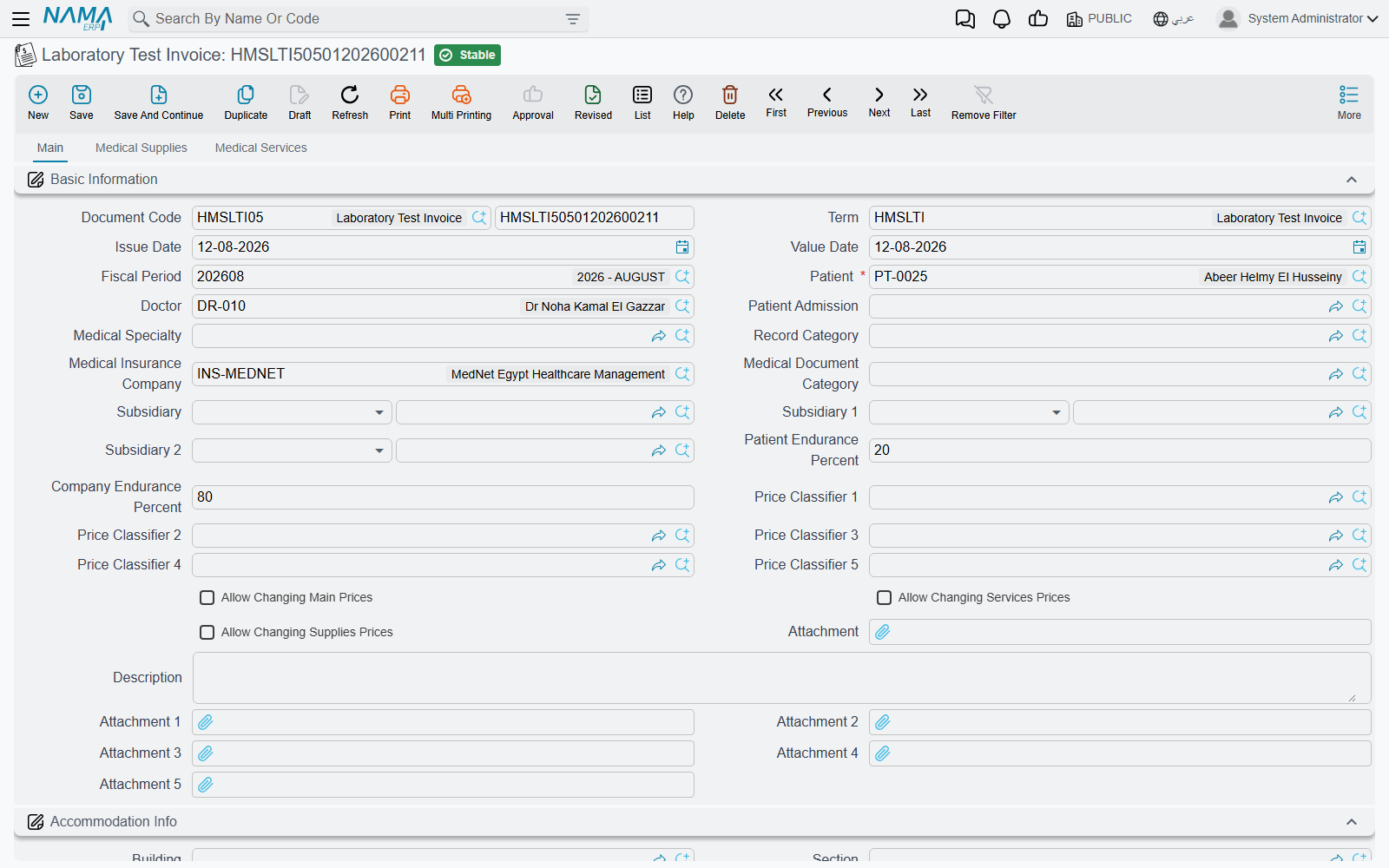
- Lab Test Invoice — lab tests, with optional supplies and services.
- Radiology Invoice — imaging and its supplies.
- Physical Therapy Invoice — physiotherapy sessions.
- Supervision Invoice — the doctor's supervision of the patient.
- Services Invoice — general medical services.
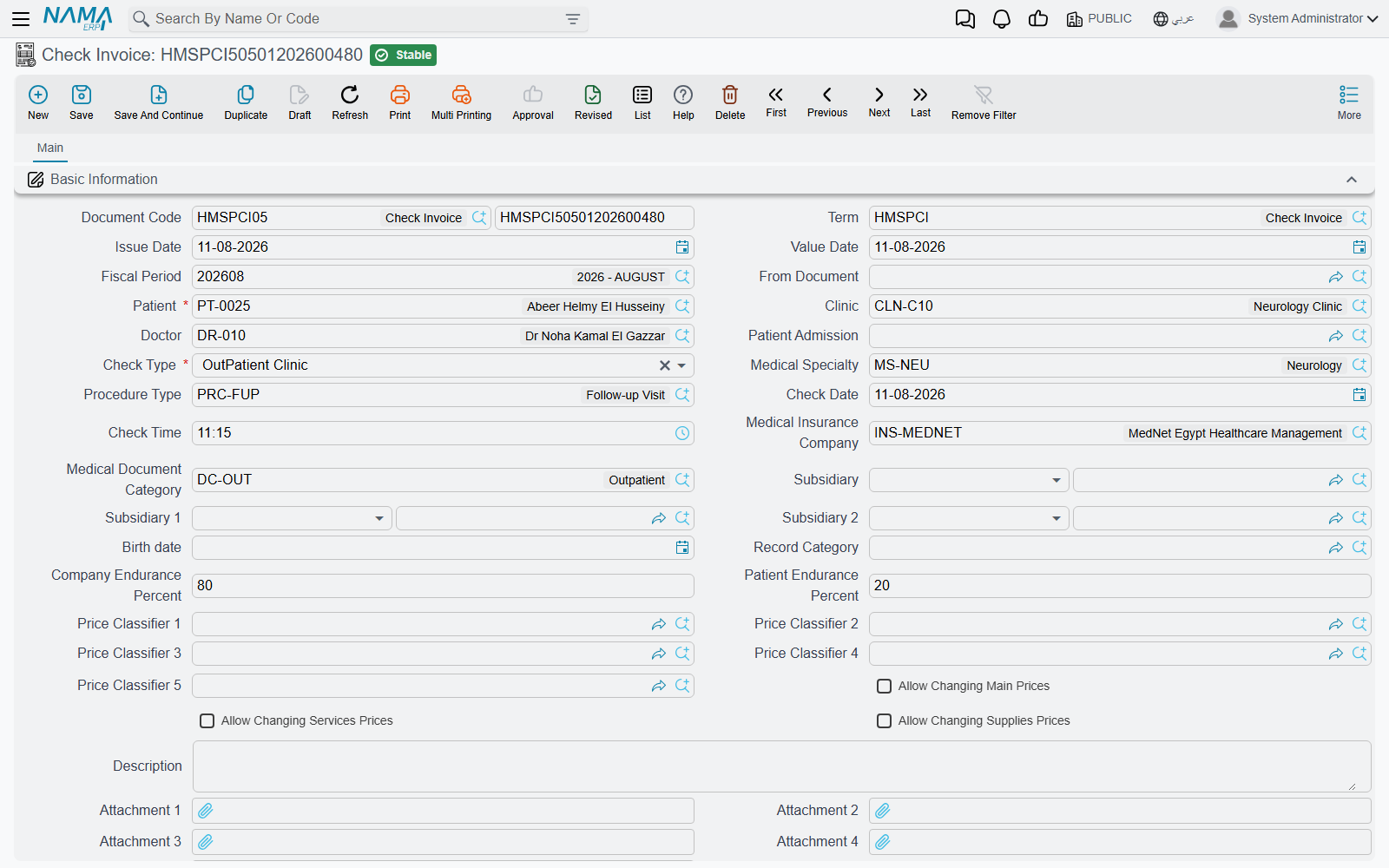
- Check Invoice — the outpatient consultation, uniquely carrying a Medicines grid for drugs prescribed at the visit.
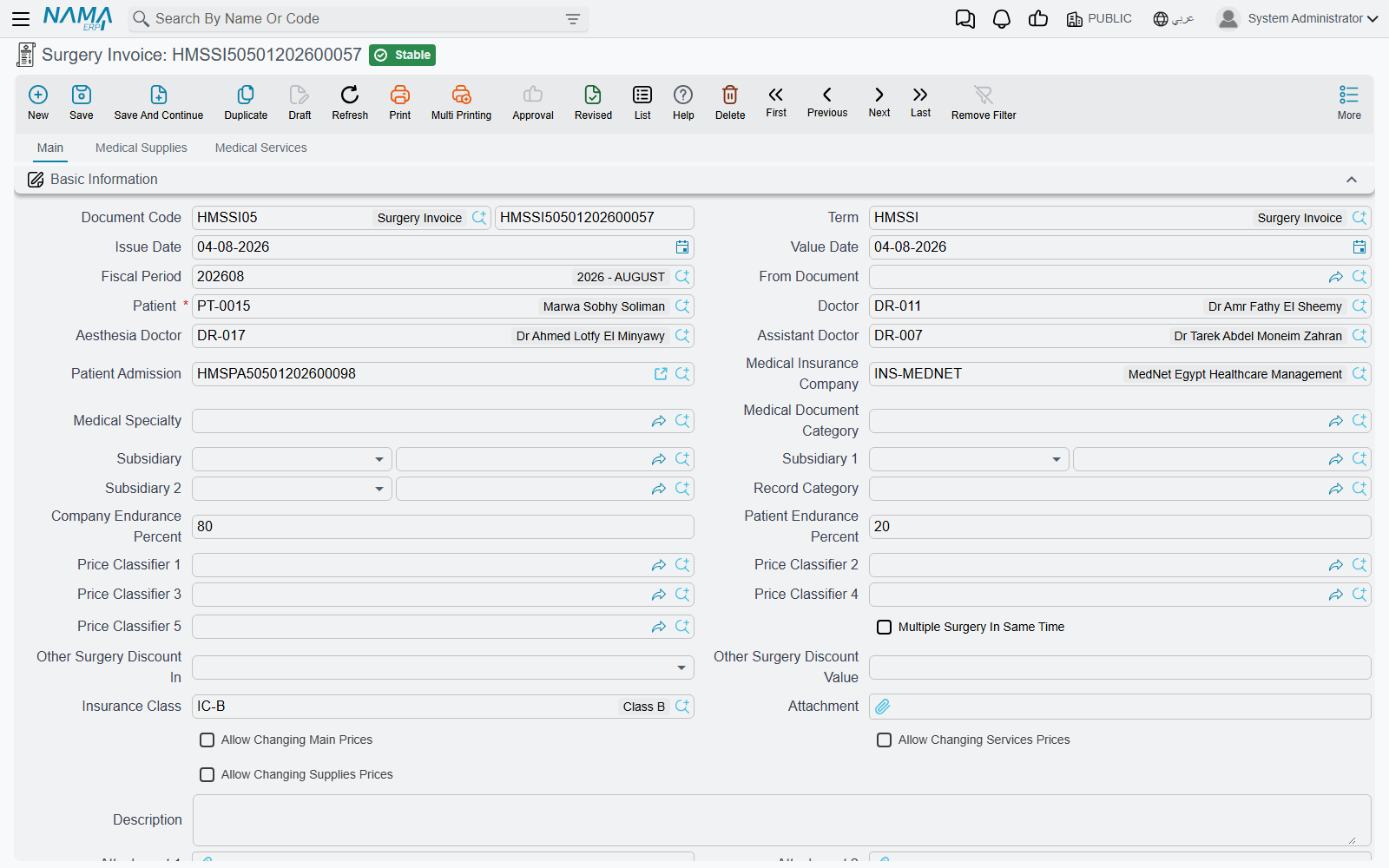
The richest of these is the Surgery Invoice: three tabs (surgery, supplies, services), with anesthesia and assistant doctors, price classifiers, accommodation info and attachments in the header; the surgery line breaks the fee into its components (open surgery, surgeon, assistant, anesthesia, other) with standard and additional hours. The supplies tab is a full inventory line that produces a stock issue.
Inventory invoices and returns
These invoices move stock and add Service Fees accounts; their line is a full inventory line (item, unit, lot, batch, expiry, warehouse):
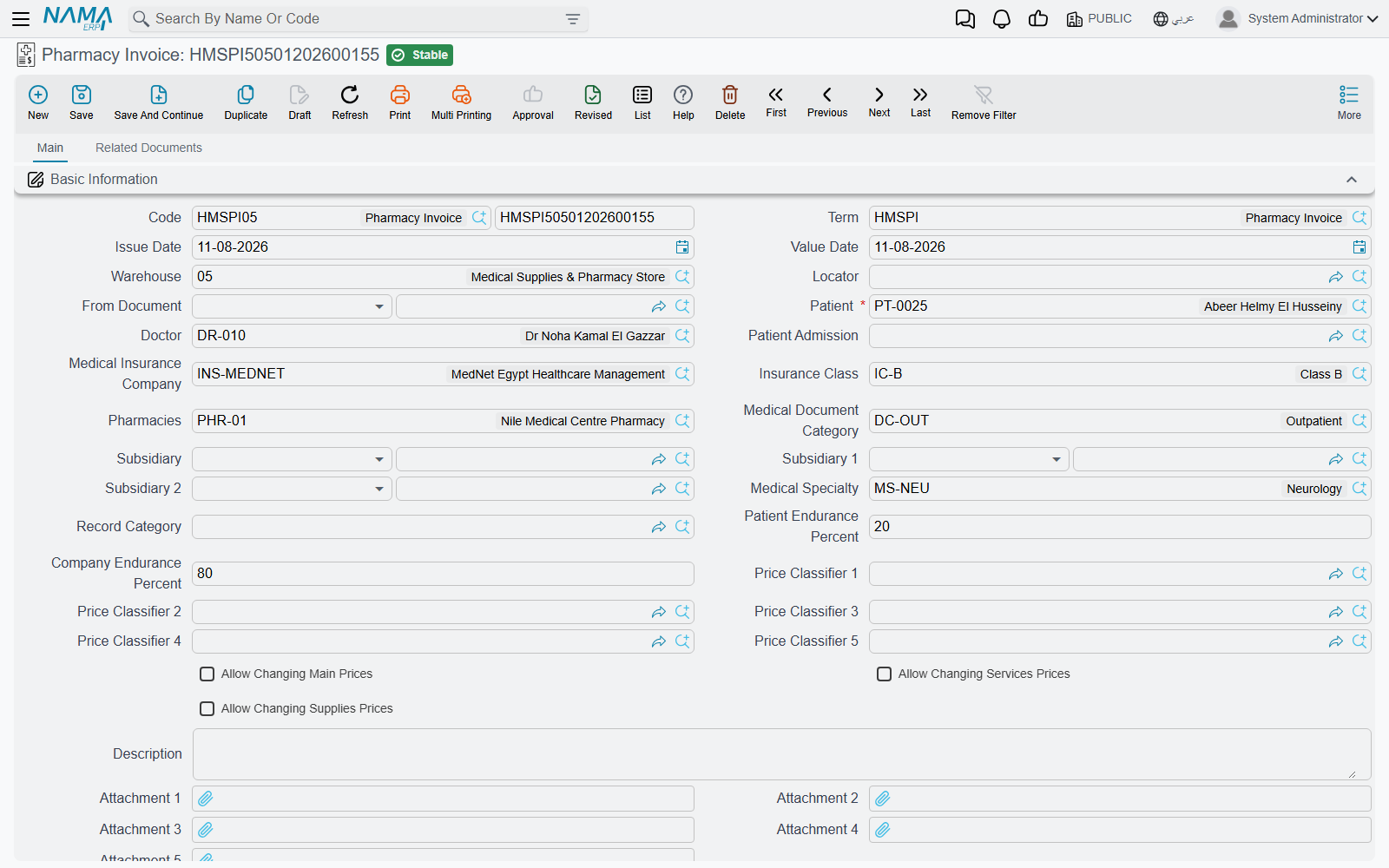
- Pharmacy Invoice and Pharmacy Return — dispensing drugs and returning them.
- Supplies Invoice and Supply Return — issuing supplies and returning them.
- Service And Supply Invoice — services and supplies on one document.
- Blood Bank Invoice — issuing blood units and related services (moves blood stock).
The surgery package invoice
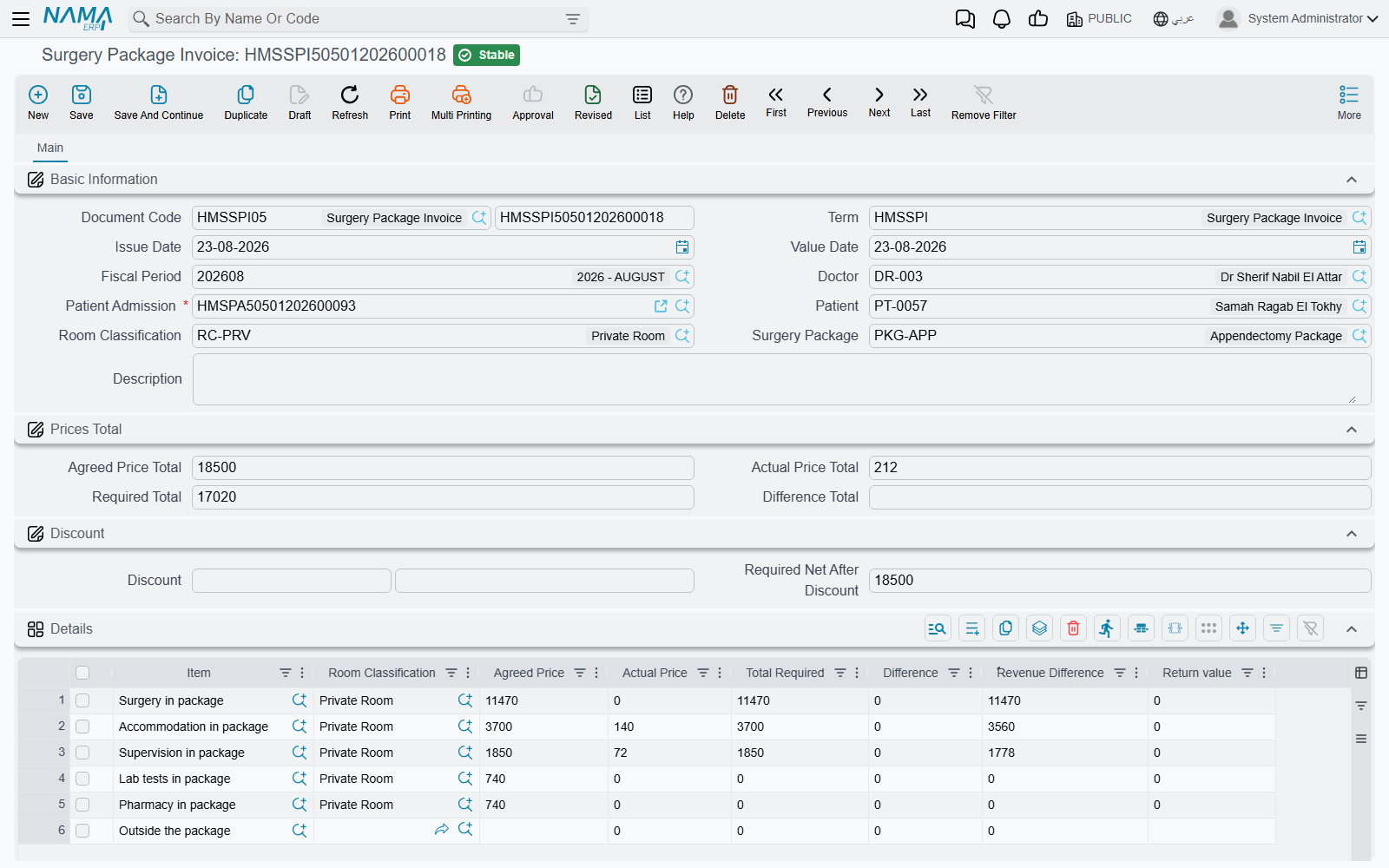
Surgery Package Invoice bills an operation against an agreed package price instead of itemized billing. It shows the agreed price total, the actual total and the difference, and per item: the agreed price, the actual price, and the difference and revenue difference. Accounting-wise, it posts the gap between the package price and the actual cost of services via dedicated difference accounts.
The closing invoice
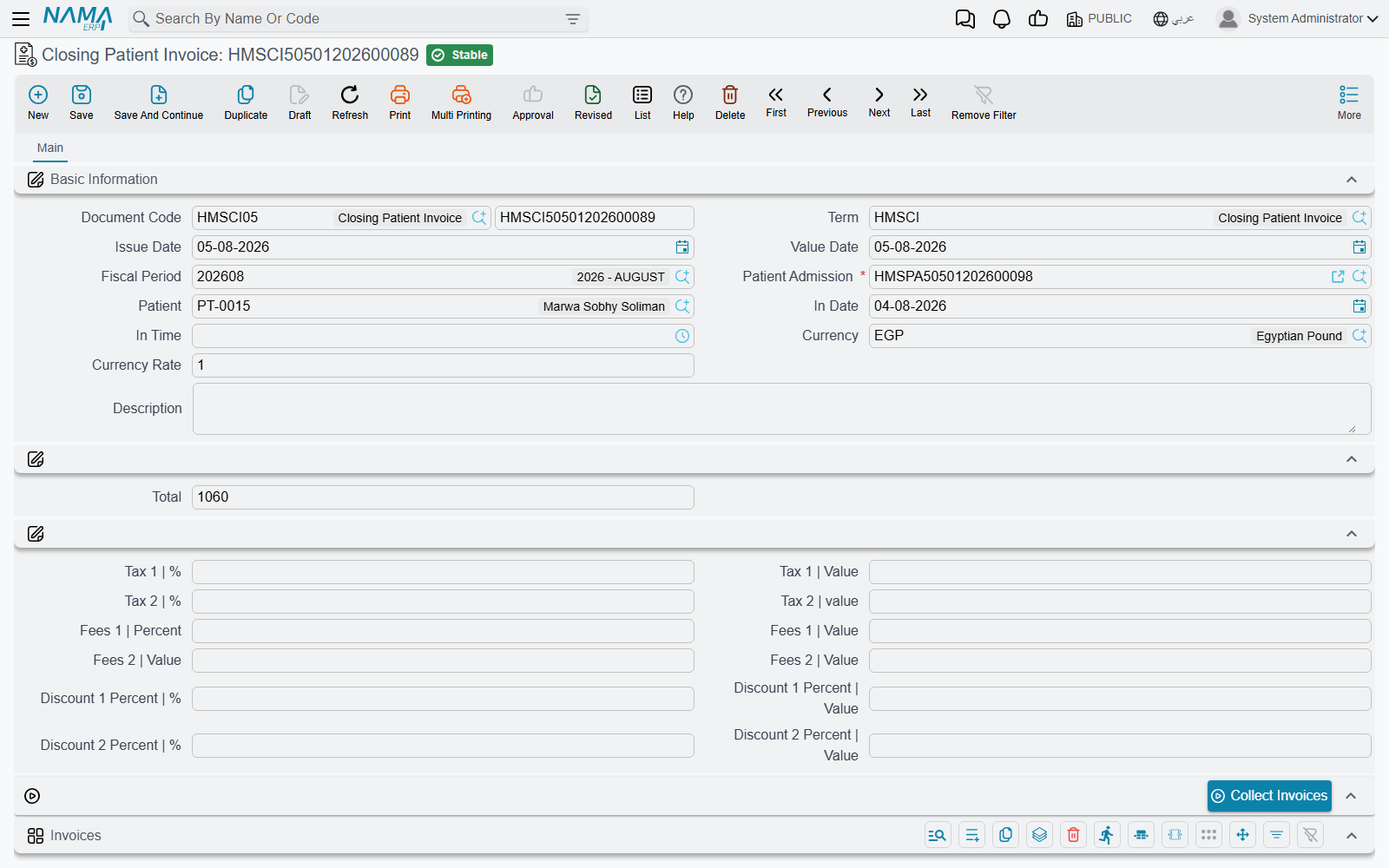
Closing Invoice is the discharge settlement document. When a patient leaves, this single invoice gathers every individual invoice issued during the stay into one statement, then applies admission-level taxes, fees and discounts to reach the final amount owed by the patient/insurer.
Its heart is the Collect Invoices button, which pulls all the patient's invoices tied to the admission into the details grid (invoice, date, value). Its header carries the admission, patient and in-date, plus Tax 1/2, Fees 1/2 and Discount 1/2 fields (percent + value) for admission-level adjustments. It posts the consolidated patient and insurance receivables together with those adjustments.