
Daily Labour and Site Diary
Two documents in this part of the module are written by the people who are actually on site, at the end of the day, in their own handwriting before anyone types them up. The Daily Labour Book (مستند السركى) records who worked and what they are owed. The Daily Engineering Diary (مستند الأعمال الهندسية اليومية) records what was built. They look like a pair, and they behave nothing alike: the first books a journal entry and puts real cost on the project, the second is a written record and nothing else.
Both are reached from Contracting > Contractor Contracting and need the contracting licence. The Labour Book also appears as an embedded list on the subcontract screen, so everything recorded against a particular subcontract can be seen from it.
The Daily Labour Book has no connection to payroll — at all
Start here, because almost everyone assumes the opposite and the assumption leads to hours of fruitless searching.
The worker is a name typed into a text box. There is no employee reference on a labour line, no lookup, no validation, nothing that ties "Rajesh K." to anything else in the system. Type the name differently tomorrow and the system will not notice.
The wage is arithmetic done on the document. Days times a daily rate, less deductions. Nothing is read from a salary structure, a grade, an allowance table or a contract of employment.
The journal entry is the document's own. The Labour Book books directly to the accounts named on its document term. It does not produce a salary document, and no payroll run consumes it, absorbs it or knows it exists.
Even the cost bucket is different. Labour Book cost lands in the Workers column of a Cost Execution; payroll cost lands in Salaries. They are separate totals precisely because they come from separate worlds.
This is not an oversight. It is what the document is for: casual, day-rate site labour — the gang the foreman hires through a labour supplier for a week of stacking blocks, paid by the day, never on the company payroll. If your site labour genuinely is on payroll, the Labour Book is the wrong document entirely; use the allocation and cost-distribution chain described in Employees, Equipment and Their Costs, which reads real salary documents.
The Labour Book, page by page
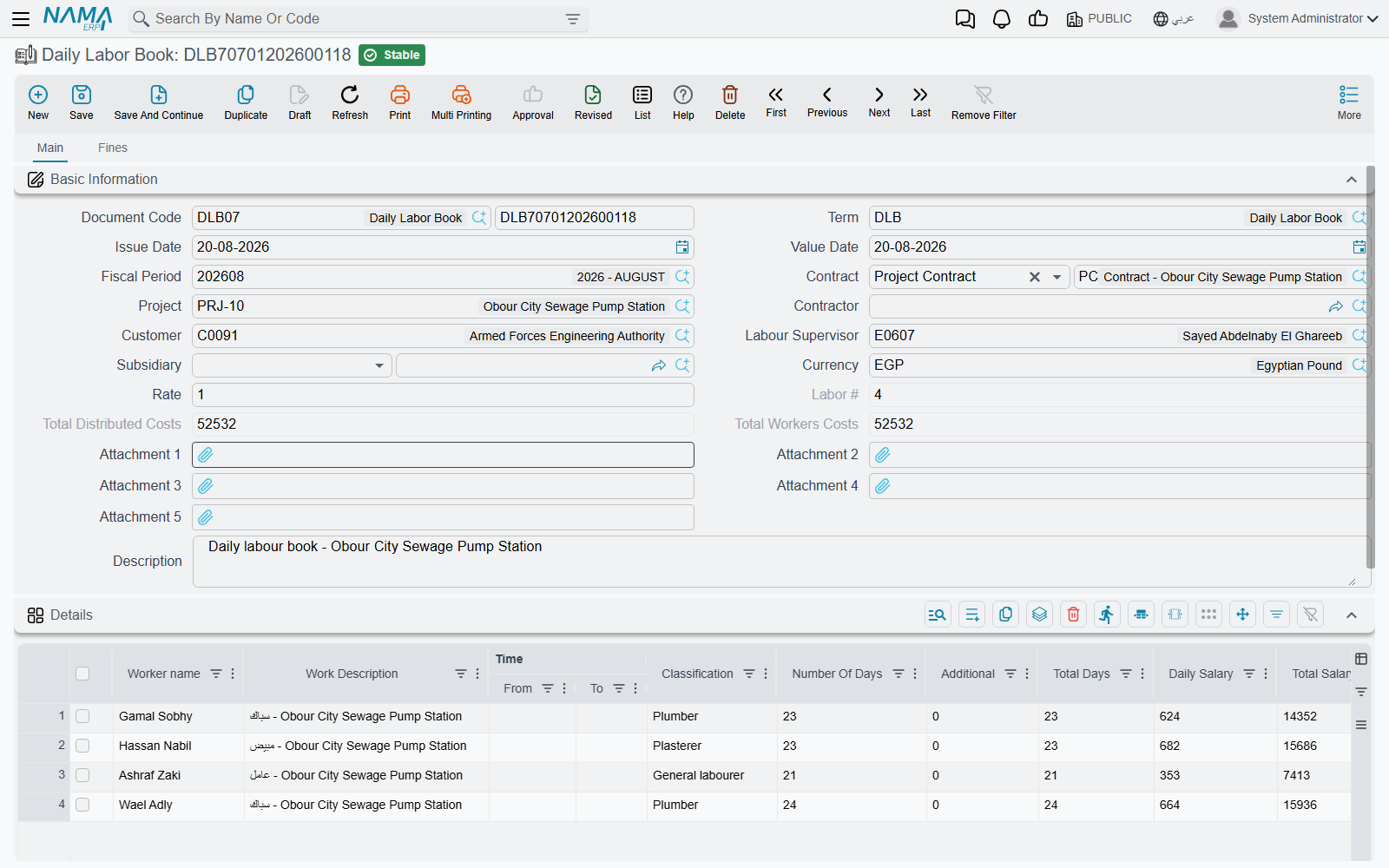
The header
A document term is required, because this document has an accounting effect. Beyond the usual dates and fiscal period:
- Contract accepts either a project contract or a subcontract. Whichever you pick, the Project fills itself in, and — importantly — the cost lines are always attributed to the project contract: choose a subcontract and the system resolves it to the project contract behind it.
- Subsidiary is the counterparty of the journal entry: the contractor, third party, customer or supplier who is going to be paid for these men. This is the field that matters accounting-wise, and a line can override it for one worker.
- Currency and rate default from the legal entity's main ledger currency, with a rate of 1.
- Labour # is filled by the system on commit with the sequence number of this book within its contract, so "the eighteenth labour sheet on Tower A" is a real, findable thing.
- Two read-only totals sit here — Total Workers Costs (from the details grid) and Total Distributed Costs (from the cost allocation grid) — and their agreement is what the document is validated on.
Three further header fields — Contractor, Customer and Labour Supervisor — are informational. They are recorded on the document and can be printed or reported on, but no rule, calculation or account selection reads them.
The details grid — who worked
| Column | What it does |
|---|---|
| Worker name | free text; this is the labourer's name and nothing more |
| Work Description, Classification | descriptive |
| Time From, Time To | descriptive |
| Number Of Days | input |
| Additional | overtime, expressed in days — 0.5 means half a day extra |
| Total Days | read-only, days + additional |
| Daily Salary | the day rate |
| Total Salary | read-only, daily salary × total days |
| Deductions | anything withheld from this man |
| Work Cost | total salary − deductions — the figure that reaches the ledger |
| Subsidiary | overrides the header counterparty for this one line |
The wage is computed from four fields only: number of days, additional days, daily salary and deductions. The times and the classification play no part in it — Time From 07:00 and Time To 17:00 do not become ten hours and do not become a day and a quarter. If a man worked overtime, express it in Additional as a fraction of a day. And if all four numeric fields are left empty, a Work Cost typed by hand is left exactly as typed, which is the escape hatch for a lump-sum arrangement with no day rate behind it.
The cost allocation grid — which terms carry the wage bill
The second grid answers the question the details grid does not: the site owes these men 380 between them, but against which terms of the contract? Each line names a term code (plus optionally the executive and estimated budget term codes, an analysis term code and an analysis card), a cost, and a narration.
The rule enforced on commit is a simple one and worth understanding precisely:
The total of the cost allocation grid must equal the total of the worker costs. Otherwise the commit is refused, with the message naming both figures.
But note the condition attached to it: the check only runs if the cost allocation grid has at least one line. Leave it completely empty and the document commits happily, produces a perfectly correct journal entry — and puts zero cost on the project. The same is true of an individual line whose term code is blank: it is skipped in silence. If someone reports labour cost missing from a project, the allocation grid is the first place to look.
What happens on commit
Three things, in this order.
- The project is charged. The cost lines are written against their term codes, so the contract's term line moves immediately in Actual Cost, and the same cost is deposited in the pool that a Cost Execution later absorbs as Workers cost.
- The journal entry is produced. One debit/credit pair per worker, not per cost line, valued at that worker's Work Cost. The document's dimensions apply, unless a line overrides them. Delivery is a background business request, so the entry appears a moment after the save and a failure is retried from the Business Requests view.
- Subcontractor fines are created. See the next section.
Debit 2 and Credit 2 are the only accounts
On this document, as on every contracting document, the accounting sides on the term are labelled Debit 2 / مدين 2 and Credit 2 / دائن 2. There is no "Debit 1" to look for. The usual wiring is Debit 2 = the labour cost or work-in-progress account, Credit 2 = the labour supplier's subsidiary account. Leave both empty and no entry is produced at all.
The term also offers the two analysis-card ceilings — refuse the save if the actual quantity or the actual cost on a term would exceed what its analysis card planned.
The Fines page — real fine documents, made here
The Labour Book has a second page for something the foreman also discovers during the day: a subcontractor who did something that costs money to put right. Rather than making the foreman open a separate screen, the fine lines are typed here, and on commit the system creates real Subcontractor Fine documents from them.
Each fine line names the subcontract, the subcontractor, a fine value, a fine reason, the contracting condition through which it will be recovered, and a payment method with its percentage or value. The generated fines are grouped: lines that share the same payment method, percentage, value, condition and subcontract produce one fine document between them. Take a group away and re-commit and its fine document is deleted; cancel the Labour Book and all of them are deleted.
The fine book and term must be configured, or nothing is created
The generation reads a book and a document term for the subcontractor fine from the Labour Book's own term. If either is missing, the fine lines are stored on the document and no fine document is ever produced — silently. This is the first thing to check when someone says "I entered the deduction and it never reached his extract".
Once created, those fines behave exactly like fines entered directly, and reach the subcontractor's money through his extract — see Subcontractor Fines.
The Site Diary is a record, and only a record
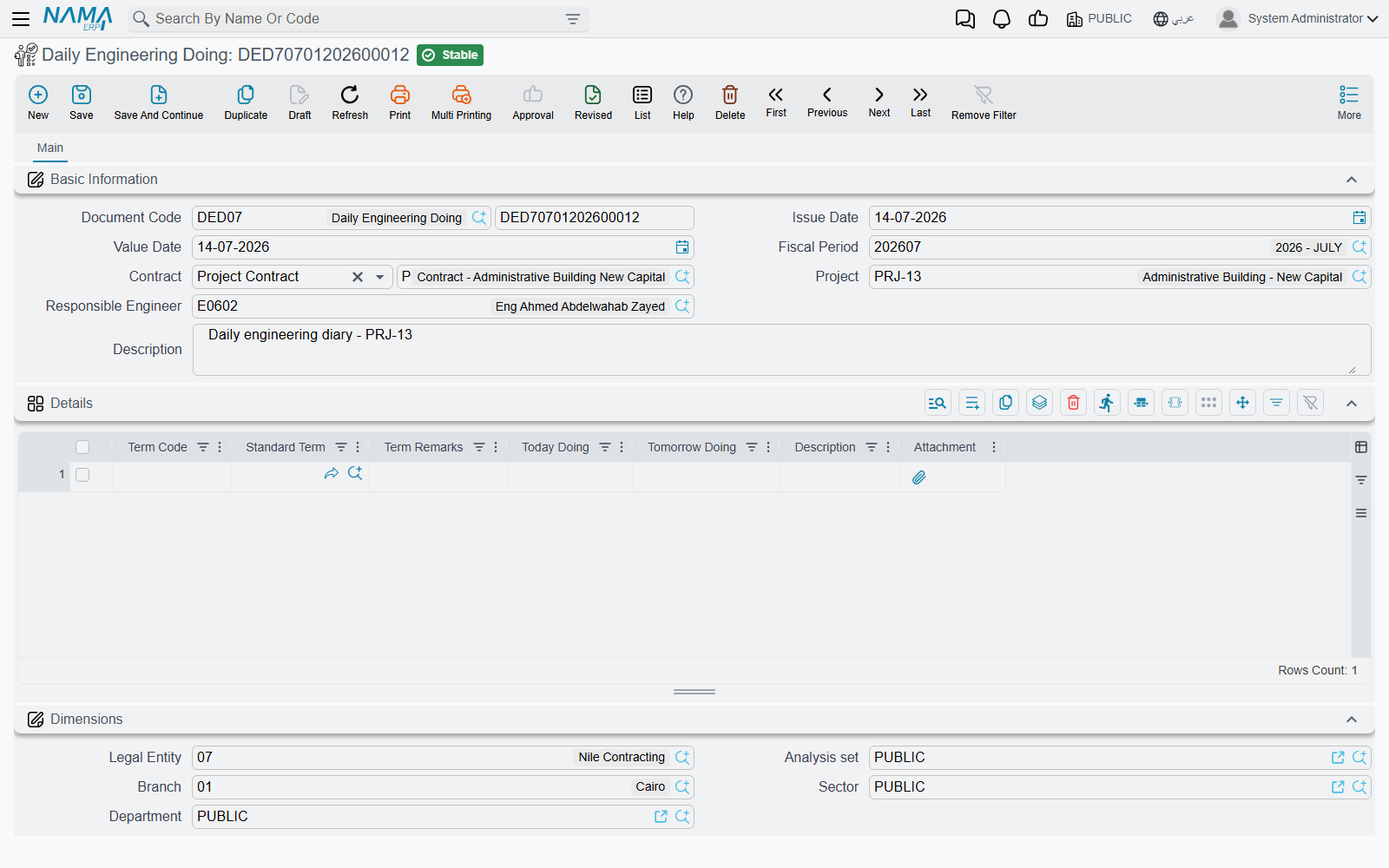
The Daily Engineering Diary is the site diary in its purest form. Each evening the responsible engineer writes, term by term, what was done today and what is planned for tomorrow, and attaches a photograph if there is one. Picking the contract fills in the project and the responsible engineer; the term code column offers the contract's terms as suggestions and, once chosen, brings the standard term and the term's description across.
Then it stops. There is no document term on the diary at all, no accounting effect, no cost entries, and — the point people get wrong — it drives no quantities. Today's and tomorrow's work are free narrative text, and nothing reads them. Executed quantities come only from project execution, subcontractor execution and the cost execution.
That is not a shortcoming. A defensible daily record of what happened on site, term by term, signed off by a named engineer, is exactly what wins a delay claim two years later. Its value is the record itself.
Worked example: a week of the block-laying gang
Tower A for Al-Fanar Development, project contract PC-2026-001, term 3.01 Blockwork. The foreman keeps one sheet per gang per week and writes each man's total days on it.
DLB-000318, value date 13 March 2026, contract PC-2026-001, subsidiary = labour supplier SUP-0044, currency and rate as defaulted.
Details — who worked:
| # | Worker name | Classification | Days | Additional | Total days | Daily salary | Total salary | Deductions | Work Cost |
|---|---|---|---|---|---|---|---|---|---|
| 1 | Rajesh K. | Mason | 1 | 0.5 | 1.5 | 120 | 180 | — | 180 |
| 2 | Anwar S. | Mason | 1 | — | 1 | 120 | 120 | 20 | 100 |
| 3 | Bilal H. | Helper | 1 | 0.25 | 1.25 | 80 | 100 | — | 100 |
| Total Workers Costs | 380 |
Rajesh worked a day and a half — the extra half day is entered as 0.5 in Additional, not as four hours in the time columns. Anwar had 20 withheld for a broken level, so his Work Cost is 100 rather than 120.
Cost Allocation — where it lands:
| Term Code | Executive Term | Cost | Narration |
|---|---|---|---|
3.01 | EX-3.01 | 380 | Blockwork gang, week ending 13/03 |
| Total Distributed Costs 380 |
380 equals 380, so the commit is accepted. Then:
- The journal entry is three debit/credit pairs — Debit 2 the labour cost account 180, 100 and 100, Credit 2 the
SUP-0044subsidiary 380 in total — produced as a background request. - The project gets 380 of cost against term
3.01: the contract's term line rises by 380 in Actual Cost, and 380 of Workers cost is waiting in the pool. - Labour # is stamped as 18 — the eighteenth labour sheet on this contract.
Change Anwar's deduction to 30 and forget to change the allocation line, and the commit is refused: 370 of worker cost against 380 distributed. Delete the allocation line altogether and the document commits with a correct journal entry and no project cost at all.