
Transfers Between Companies
Moving a machine between two branches of one company is bookkeeping housekeeping: the same balances sit under a different label. Moving it between two companies is a sale in everything but name. One legal entity has to stop carrying the asset and the other has to start, each in its own set of books, and the two sets of books have to agree.
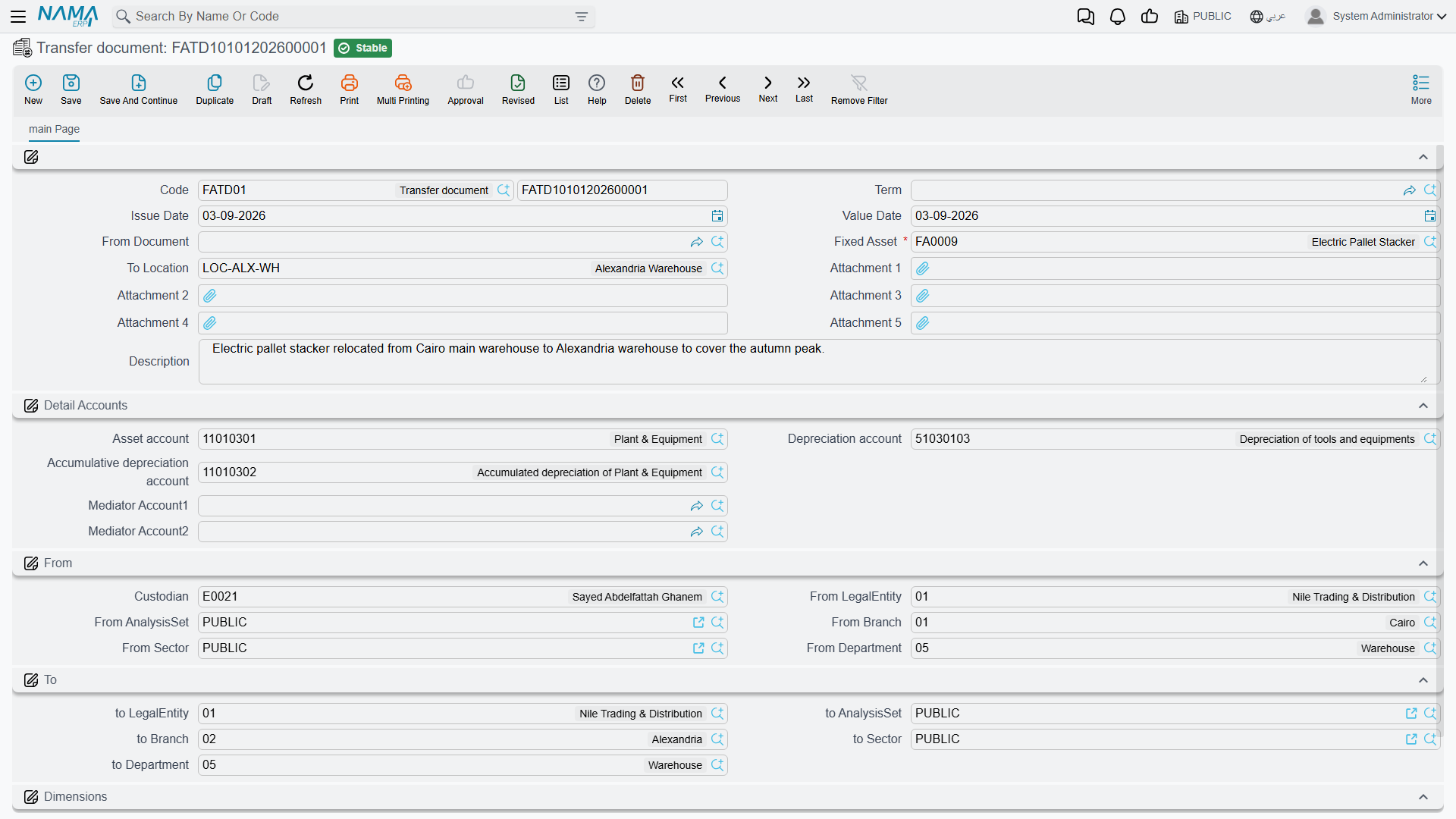
Nama handles this with the ordinary transfer document. You do not choose an inter-company mode — you simply set a different company in the إلى / To group, and the document changes shape underneath you: instead of one journal entry it produces two, one in each company, joined by a pair of mediator accounts.
The one rule that governs the whole thing
Everything below follows from a single decision the module makes: the receiving company takes the asset at net book value.
Gross cost and accumulated depreciation do not cross the boundary. As far as the Jeddah company's ledger is concerned, it has just acquired a machine at 176,100 and has never depreciated it. The history stays behind in the company that owned it.
That is the same convention an accountant would apply to any transfer of a used asset between related entities, and once you have it, the two entries below are the only sensible entries there could be.
Before you can commit: mediator accounts
The two entries are separate — separate companies, separate ledgers — so each needs a balancing counterpart. That counterpart is the mediator account (حساب وسيط الشركة): an inter-company account through which the transfer passes.
There are two of them, and they are not interchangeable:
| Field | Whose account it is |
|---|---|
| Mediator Account 1 (حساب وسيط الشركة 1) | The source company — the one the asset is leaving |
| Mediator Account 2 (حساب وسيط الشركة 2) | The destination company — the one receiving it |

You do not normally type them. Each legal entity's own record carries a mediator account, and the transfer falls back to it when the field on the document is empty. Setting it once per company is the right way to work; the fields on the document exist for the case where a particular move should pass through a different inter-company account.
What you cannot do is skip it. If the companies differ and neither the document nor the legal entity supplies a mediator account, the commit is refused with "You must specify mediator account for legal entity …", naming the company that is missing one.
Set the document's own legal entity to the company the asset is leaving
The transfer works out how much to move by reading the balances the asset has already accumulated in the ledger — gross cost on its cost account, accumulated depreciation on its accumulated-depreciation account — as at the value date, in the company named in the document's own المحددات / Dimensions group.
On an inter-company move it is tempting to file the document under the receiving company. Do not. The balances live in the source company; if the document's dimensions name anything else the lookup comes back empty, every line is zero, and the transfer commits with no entry at all. Source company in the Dimensions group, destination company in the To group.
The two entries, worked
MCH-0007 at the end of December 2027, after its upgrade and two years of depreciation:
| Cost | 270,000 |
| Accumulated depreciation | 93,900 |
| Net book value | 176,100 |
Al-Waha Industries transfers it to its Jeddah company. The document names Al-Waha Industries in the Dimensions group and Al-Waha Jeddah in the To group.
Entry one — in Al-Waha Industries, which is losing the machine. It clears both of the asset's balances and parks the difference on the inter-company account:
| Account | Debit | Credit |
|---|---|---|
| Accumulated depreciation | 93,900 | |
| Inter-company (Mediator Account 1) | 176,100 | |
| Asset cost | 270,000 | |
| Total | 270,000 | 270,000 |
The machine is now completely off Al-Waha Industries' books. What is left is a 176,100 receivable from the sister company, sitting on the mediator account.
Entry two — in Al-Waha Jeddah, which is gaining it:
| Account | Debit | Credit |
|---|---|---|
| Asset cost | 176,100 | |
| Inter-company (Mediator Account 2) | 176,100 |
Jeddah now carries the machine at 176,100 gross, with nothing in accumulated depreciation, and a 176,100 payable to Riyadh on its own mediator account.
The accounts used on each side are the ones on that side of the document: entry one uses the accounts the asset was sitting on before the move, entry two uses the accounts in the Detail Accounts group — which is why, on an inter-company transfer, you should check those accounts belong to the receiving company's chart before committing.
The mediator accounts are the settlement, not the payment
Nothing here moves money. The two mediator balances are a matched pair — a receivable in one company and a payable in the other — and they stay open until the two companies settle with each other. That settlement is an ordinary accounting-module matter: a payment voucher, a netting entry at consolidation, or whatever your group does with inter-company balances. The fixed-assets module's job ends when the machine is on the right books.
What the register says afterwards, and what the ledger says
This is the part that catches people out, so it is worth stating flatly. There is one asset record. The transfer changes which company it belongs to — but it does not rewrite its history.
| The asset record shows | The receiving company's ledger shows | |
|---|---|---|
| Cost | 270,000 | 176,100 |
| Accumulated depreciation | 93,900 | nil |
| Book value | 176,100 | 176,100 |
The two agree on the number that matters — the carrying amount — and disagree on how it is composed, by design. The register keeps the machine's whole life, from a 240,000 purchase in January 2026 onward, because that is what a fixed-asset register is for. The ledger of a company that has owned the machine for one day records what it paid for it.
Depreciation afterwards
Depreciation carries on from the register's figures, not the ledger's. The instalment is unchanged — the same 4,225 a period the machine was charging in Riyadh — and the remaining life is unchanged too. The machine will finish depreciating on exactly the date it was always going to. What changes is where the charge lands: the depreciation entry now uses the asset's new dimensions, so the expense appears in Jeddah.
If you want the receiving company to depreciate the machine over a fresh life instead — a common group policy — that is a separate decision made with a properties document after the transfer, which re-derives the instalment from a new remaining life.
Actions on this screen
There is no inter-company transfer screen, and so no button to press to start one. This is the ordinary transfer document, which has no buttons of its own; what switches it into inter-company behaviour is simply the company you pick in the To group. The two entries, the mediator postings and the change of legal entity on the asset then all follow from committing the document.
Sequencing an inter-company move
- Depreciate the asset up to the month of the move. The transfer will not commit unless depreciation is current, and you want the accumulated figure the transfer moves to be the real one.
- Check that both companies have a mediator account, or fill the two fields on the document.
- Set the document's Dimensions group to the source company.
- Pick the destination location — it brings the destination company, branch, sector, department and analysis set with it — and check the three accounts in the Detail Accounts group are the receiving company's.
- Commit, then watch the queue. Two ledger requests are produced and processed in the background; both should appear as processed. The More menu on the document lists the ledger transactions it created, and a failure is retried from the Business Requests list view with More → Reprocess.
- Check both sides. The source company's asset cost account should be clear of the machine, and the two mediator balances should be equal and opposite.
Cancelling or deleting the transfer reverses the lot: both entries are removed and the asset goes back to the company, location, dimensions and accounts it had before. If the move later stops being inter-company — somebody corrects the destination to a branch of the same company — the second entry is removed and a single intra-company entry replaces the first.
Moving several assets between companies at once is possible with the aggregated transfer document described on the transfer document page; the mediator requirement is checked row by row, so one line missing an account blocks the whole batch.