
Salary Structures
Setting up every allowance and deduction on every employee one by one doesn't scale once a company has more than a handful of staff. A Salary Structure is a reusable template — "the standard package for a sales representative", say — that lists a set of component types with their values or formulas already filled in, ready to be applied to any employee who needs that package.
Salary Structure
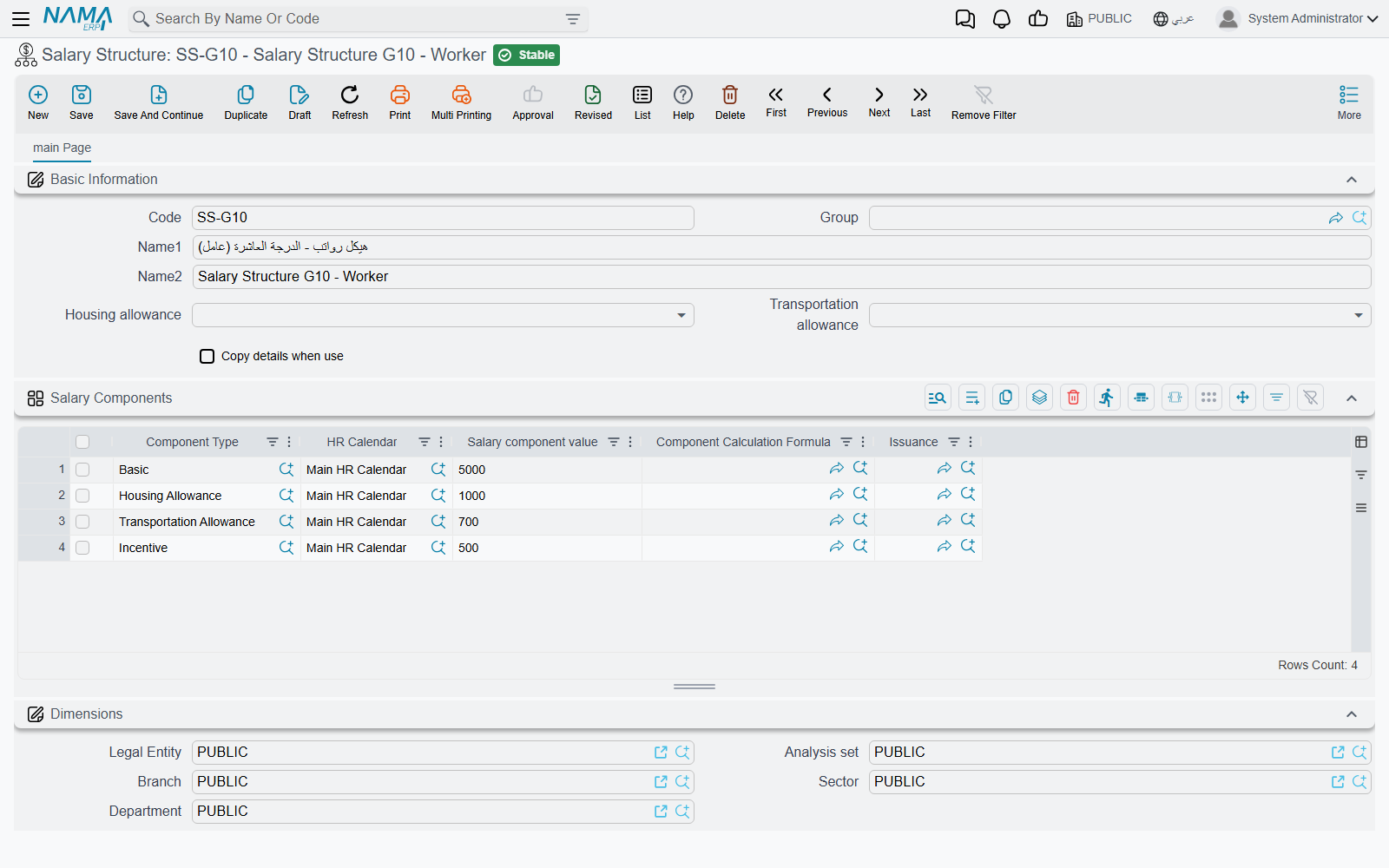
Found at Payroll > Salary Configurations > Salary Structure.
| Field (English) | Arabic label | Purpose |
|---|---|---|
| Code / Group / Arabic Name / English Name | الكود / المجموعة / الاسم العربي / الاسم الإنجليزي | Identification. |
| Housing Allowance | بدل سكن | One of None (بدون), Applicable (مطبق), or Insured (مؤمن) — the same three-way switch found on Employee HR Information. |
| Transportation Allowance | بدل مواصلات | The same None / Applicable / Insured choice, for the transportation allowance. |
| Copy Details When Use | نسخ التفاصيل عند الأستخدام | Whether the structure's component lines are copied down into the target record when the structure is applied, rather than only referenced. |
The heart of the screen is the Salary Components grid (مفردات رواتب), where each line names a Component Type, the HR Calendar it runs against, an Issuance, and — the actual pricing — either a Salary Component Value (a flat number) or a Component Calculation Formula. A structure line is keyed by component type, not by a single fixed component record, which is exactly what lets one structure generate the right priced component for whichever employee it's applied to.
The key rule: a fallback, not an override
This is the single most important thing to understand about salary structures: a structure is only ever a fallback. When a salary is generated, Nama reads the employee's own component lines first — the ones on their Employee HR Information record, or the ones fixed on their job offer. A structure is consulted only when the employee has none of their own lines for that component type at all.
A structure never silently overwrites an individual
Assigning a structure to a whole department is safe precisely because of this rule. If one employee in that department already has a personal housing allowance set on their own record, the structure's housing-allowance line simply never applies to them — it isn't compared against, blended with, or used to override what's already there. The structure fills gaps; it never replaces what an employee already has.
Within the structure itself, each line's value or formula can still be adjusted independently of the component master it points to — so one structure can host small per-role variations (a slightly different transportation rate for one job grade, say) without needing to define a whole new component for each variation.
Where structures are used
A structure is most often set directly on an employee's HR Information record, so that every one of that employee's missing component lines falls back to it. It also shows up earlier in the hiring pipeline: a job offer can carry its own proposed salary structure, which then carries forward once the candidate becomes an employee — so the structure a candidate was offered on is the same fallback their eventual payslip reads from.
Like most master data in payroll, a structure can be scoped with the standard Dimensions — legal entity, branch, sector, department, analysis set — so different parts of the organization can maintain their own structures without them colliding.
Actions on this screen
The Salary Structure screen has no buttons of its own; it is filled in and saved.
Related pages
- Salary Components — the component types and components a structure's lines point to.
- Job Offers & Tests — where a salary structure is often first proposed, before an employee even joins.
- How Salary Is Calculated — how structures fit into the full five-step pipeline.
- Employee HR Information — the employee's own component lines, which always take priority over a structure.