
Security and Login
Everything about getting into the system and what you can see once you are in: login attempts and sessions, password rules, two-factor authentication, LDAP, record-level visibility, and the public user-registration page.
For the wider picture of profiles and capabilities, see the Security overview.
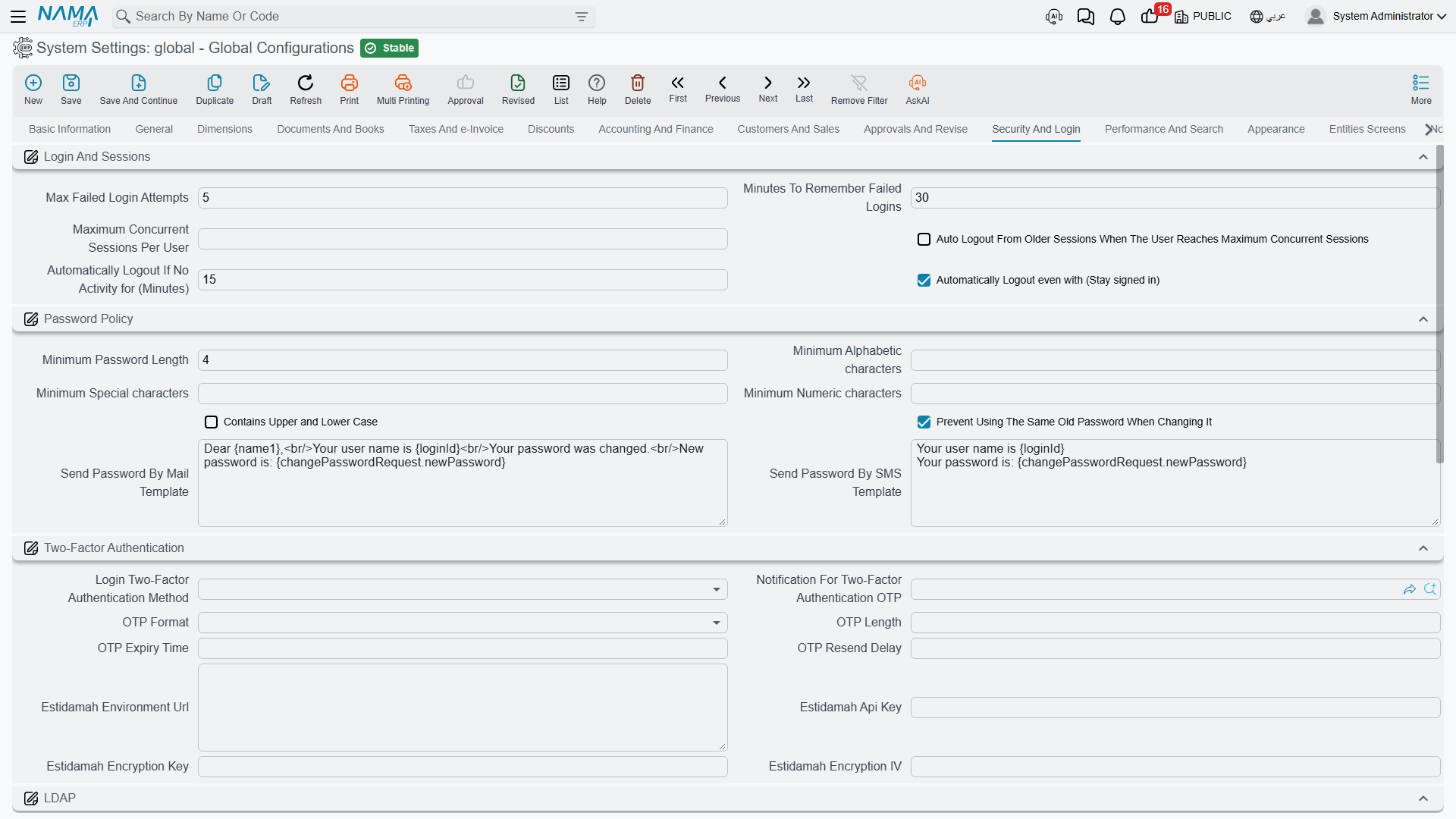
Login and sessions
Maximum Failed Login Attempts value.info.maxFailedLoginAttempts (default 5) — Consecutive failures before the account is blocked.
Minutes to Remember Failed Logins value.info.minutesToRememberFailedLogins (default 30) — The window those failures are counted over. Five attempts in thirty minutes locks the account; the same five spread across a day do not. Together the two numbers separate a forgetful user from someone guessing passwords.
Maximum Login Sessions value.info.maxLoginSessions — How many sessions one user may hold at once. Leave it empty for no limit.
Auto Logout with Maximum Sessions value.info.autoLogoutWithMaxSessions — What happens at that limit: with this on, the oldest session is logged out to make room; with it off, the new login is refused. The first is kinder to users who left a session open on another machine.
Auto Logout Time value.info.autoLogoutTime (default 15) — Idle minutes before a session is closed automatically.
Auto Logout Remember Me value.info.autoLogoutRememberMe (default on) — Whether "remember me" sessions are also subject to that idle timeout.
Password policy
These are checked whenever a password is set or changed.
Minimum Password Length value.info.minPasswordLength (default 6), Minimum Alphabetic Characters value.info.minAlphaChars, Minimum Special Characters value.info.minSpecialChars, Minimum Numeric Characters value.info.minNumbersChars, Upper and Lower Case value.info.upperAndLowerCase — The usual complexity requirements.
Prevent Same Password When Changing value.info.preventSamePasswordWhenChanging (default on) — Refuses a "change" that sets the password back to what it already was.
Send Password by Mail Template / Send Password by SMS Template value.info.sendPasswordByMailTemplate, value.info.sendPasswordBySMSTemplate — The messages sent when a new password is delivered. Both accept placeholders — {name1} for the user's name, {loginId} for the login, and {changePasswordRequest.newPassword} for the new password itself.
Two-factor authentication
Login Two-Factor Authentication Method value.info.login2FAMethod — The second factor required at login: None, Authenticator App (a rotating code from an app on the user's phone), Message OTP (a one-time code sent to the user), or Estidamah API.
Notification for Two-Factor Authentication OTP value.info.notificationFor2FAOtp — The notification that carries the code. Required when the method is Message OTP — the system refuses to save otherwise, since a code nobody receives locks everyone out.
OTP Format value.info.otpFormat — Numeric, Alphanumeric or Alphabetic. Numeric is easiest to read off a phone and type; alphanumeric is stronger for the same length.
OTP Length / OTP Expiry Time / OTP Resend Delay value.info.otpLength, value.info.otpExpiryTime, value.info.otpResendDelay — How long the code is, how long it stays valid, and how long a user must wait before asking for another. The resend delay is what stops a stuck user from triggering a flood of messages.
Estidamah Environment URL, Estidamah Api Key, Estidamah Encryption Key, Estidamah Encryption IV value.info.estidamahEnvironmentUrl, value.info.estidamahApiKey, value.info.estidamahEncryptionKey, value.info.estidamahEncryptionIV — Endpoint and cryptographic material for the Estidamah service. All four are required when that method is selected.
Estidamah needs a server setting too
Selecting the Estidamah method also requires the custom password validator to be enabled in the server's nama.properties file (use-custom-password-validator=true). The configuration refuses to save until that is in place, and tells you exactly which setting is missing.
LDAP
Use LDAP for Users Login value.info.useLDAPForUsersLogin — Authenticates users against your directory server instead of against passwords held in Nama.
LDAP Server URL / Default LDAP Domain value.info.ldapServerURL, value.info.defaultLDAPDomain — The directory server address and the domain assumed when a user types a bare user name.
LDAP also needs a server setting
Like Estidamah, this requires use-ldap-for-authentication=true in nama.properties before the configuration will save.
Record security
Allow Disabling Code Field with Security value.info.allowDisablingCodeFieldWithSecurity (default on) — Permits a security profile to disable the Code field.
Allow Filling Disabled Fields with Creators value.info.allowFillingDisabledFieldsWithCreators (default on) — Lets the system's own field creators write into fields the user is not allowed to edit. Usually what you want: a user who may not type the branch by hand should still get it filled in automatically.
Merge Alternate Security Profiles into Main User value.info.mergeAlternateSecurityProfilesIntoMainUser — A user can hold alternate profiles. Normally they are switched between; with this on, they are merged into one effective set of permissions, so the user always has the union of what all their profiles allow.
Display Prevented Records value.info.displayPreventedRecords — Records the user has no view capability for are still listed (blocked, not opened) instead of vanishing. Some organisations prefer the visible "you may not see this" to a silently shorter list.
Do Not Display Prevented Records in List View value.info.doNotdispPrevRecInListView — The same decision taken separately for list views. Both can also be set per security profile, which overrides what is set here.
Display Records with Update Capability to Users value.info.displayRecordsWithUpdateCapabilityToUsers — A record becomes visible if the user has either the view or the update capability, rather than requiring view specifically. Fixes the surprising case of a user who may edit a record but not see it.
Ignore Record Capabilities in All List Views value.info.ignoreRecordCapabilitiesInAllListViews — Switches record-capability filtering off across every list view.
Ignore Record Capabilities In value.info.ignoreRecordCapabilitiesIn (table) — The same, restricted to the entity types you list. Prefer this over the blanket option above.
Prevent Delete User Related to Entity System Entries value.info.preventDeleteUserRelatedToEntitySystemEntries (default on) — Refuses to delete a user that system entries still reference. Leave it on — deleting such a user breaks the audit trail those entries represent.
User add requests
Nama can expose a public page where new users request an account. These settings control it.
User Add Request Term / User Add Request Book value.info.userAddRequestTerm, value.info.userAddRequestBook — The document term and book used for the requests that page creates.
Do Not Display Employee / Contractor / Customer / Supplier Type value.info.dontDisplayEmployeeType, ...dontDisplayContractorType, ...dontDisplayCustomerType, ...dontDisplaySupplierType — Removes each account type from the choices the public page offers. A business that only registers customers should switch off the other three.
User Add Request Welcome Message (Arabic) / (English) value.info.userAddRequestWelcomeMessageAr, value.info.userAddRequestWelcomeMessageEn — The text shown to someone arriving on that page, in each language.