
Approvals and Revise
Nama has two separate ways of putting a human check between "someone entered this" and "the system acted on it". Approvals route a document to the people who must agree to it. Revise requires a number of people to mark a record as reviewed. This tab configures both, plus record version history.
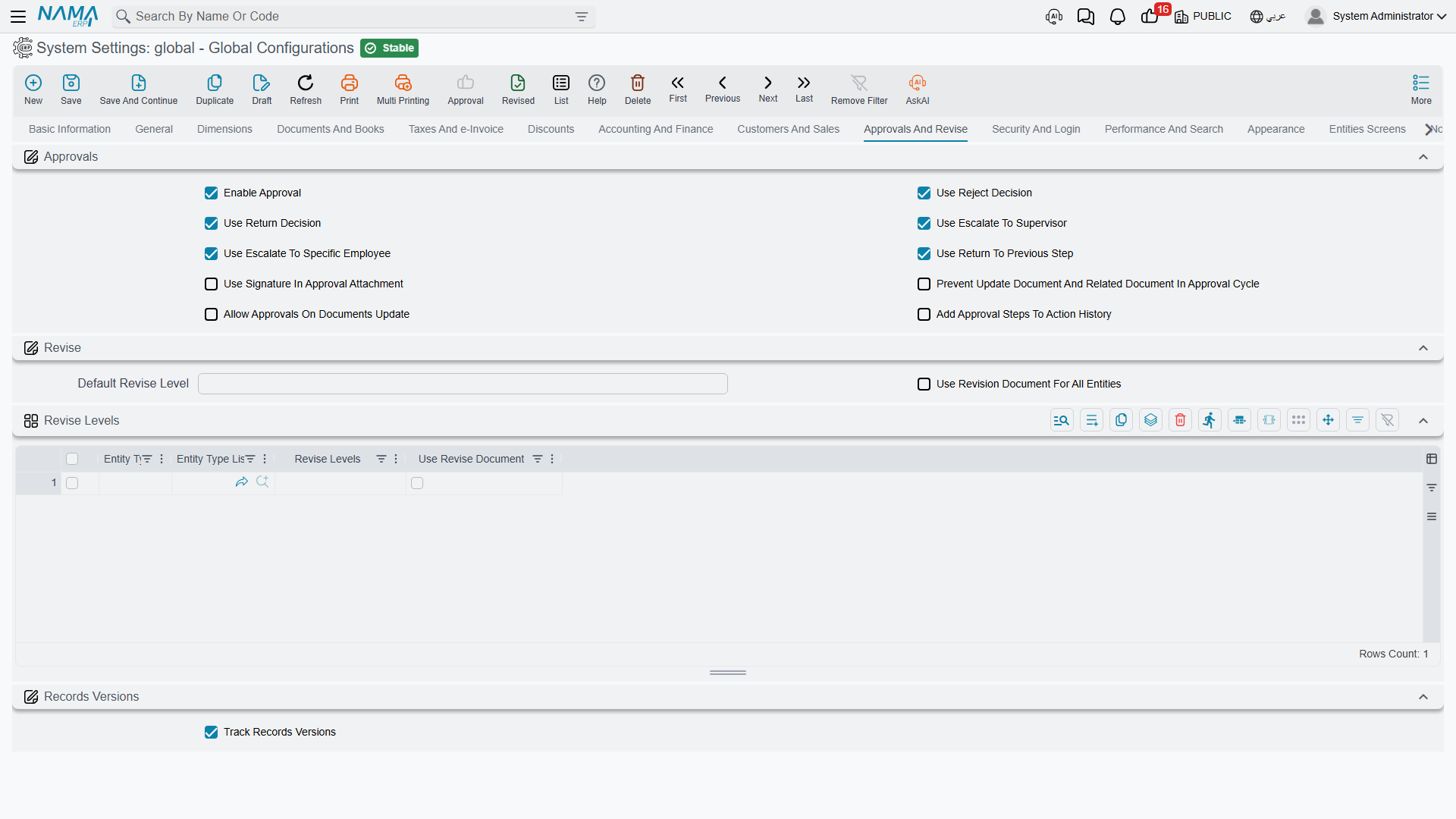
Approvals
Approval Enabled value.approvalEnabled (default on) — The master switch for the whole approval engine. With it off, approval rules are ignored everywhere.
The next five options decide which buttons an approver actually sees. Every one you leave on is another choice the approver has to weigh, so a deliberately short list often produces faster, more consistent decisions.
Use Reject Decision value.info.useRejectDecision (default on) — Shows Reject, which ends the approval and refuses the document.
Use Return Decision value.info.useReturnDecision (default on) — Shows Return, which sends the document back to its author to be fixed and resubmitted, rather than killing it.
Use Escalate to Supervisor value.info.useEscalateToSupervisor (default on) — Shows Escalate to Supervisor, passing the decision up the org chart.
Use Escalate to Specific Employee value.info.useEscalateToSpecificEmployee (default on) — Shows Escalate to Employee, letting the approver choose who should decide instead.
Use Return to Previous Step value.info.useReturnToPreviousStep (default on) — Shows Return to Previous Step, sending the document back one stage in the approval chain rather than all the way to its author.
Use Signature in Approval Attachment value.info.useSignatureInApprovalAttachment — Stamps the approver's stored signature image onto the attachment produced by the approval, so the printed record carries a visible signature.
Prevent Update of Document and Related Documents in Approval value.info.preventUpdateDocAndRelatedDocInApproval — Locks the document and the documents linked to it while it waits for a decision. Without this, an author can quietly change what the approver is looking at.
Allow Approvals on Documents Update value.info.allowApprovalsOnDocumentsUpdate — Re-runs the approval rules when an already-approved document is edited, so a material change goes back through the chain instead of inheriting the old approval.
Add Approval Steps to Action History value.info.addApprovalStepsToActionHistory — Writes each approval step into the record's action history, giving a permanent audit trail of who decided what and when. Worth the small storage cost anywhere approvals carry weight.
Revise
Revise is lighter than approval: no routing, no decisions, just a required number of sign-offs before a record is considered checked.
Default Revise Level value.info.defaultReviseLevel — How many revise levels apply to entities with no rule of their own. Negative values are rejected.
Use Revise Document for All Entities value.info.useReviseDocumentForAllEntities — Every entity is revised through the separate Revise Document flow rather than in place on the record itself.
Revise Levels value.info.entitiesReviseLevels (table) — Per-entity rules. Each row names an entity type (or a list of them), the number of revise levels it needs, and whether it uses the Revise Document. This is how you require two sign-offs on journal entries and none on a stock transfer.
Record versions
Track Records Versions value.trackVersionsEnabled (default on) — Keeps a full version history of records, so you can see what a document looked like before an edit and who changed it. Individual entities can override this through their own entity configuration.
History costs storage, not speed
Version tracking writes a copy of the record on change. On high-volume documents that adds up over years, which is why the per-entity override exists — keep full history on the records an auditor will ask about, and turn it off on high-churn operational records where nobody ever looks back.