
Attachments and Storage
Where attached files live, how their disk space is watched, and the two external tools the system uses to scan paper and convert documents.
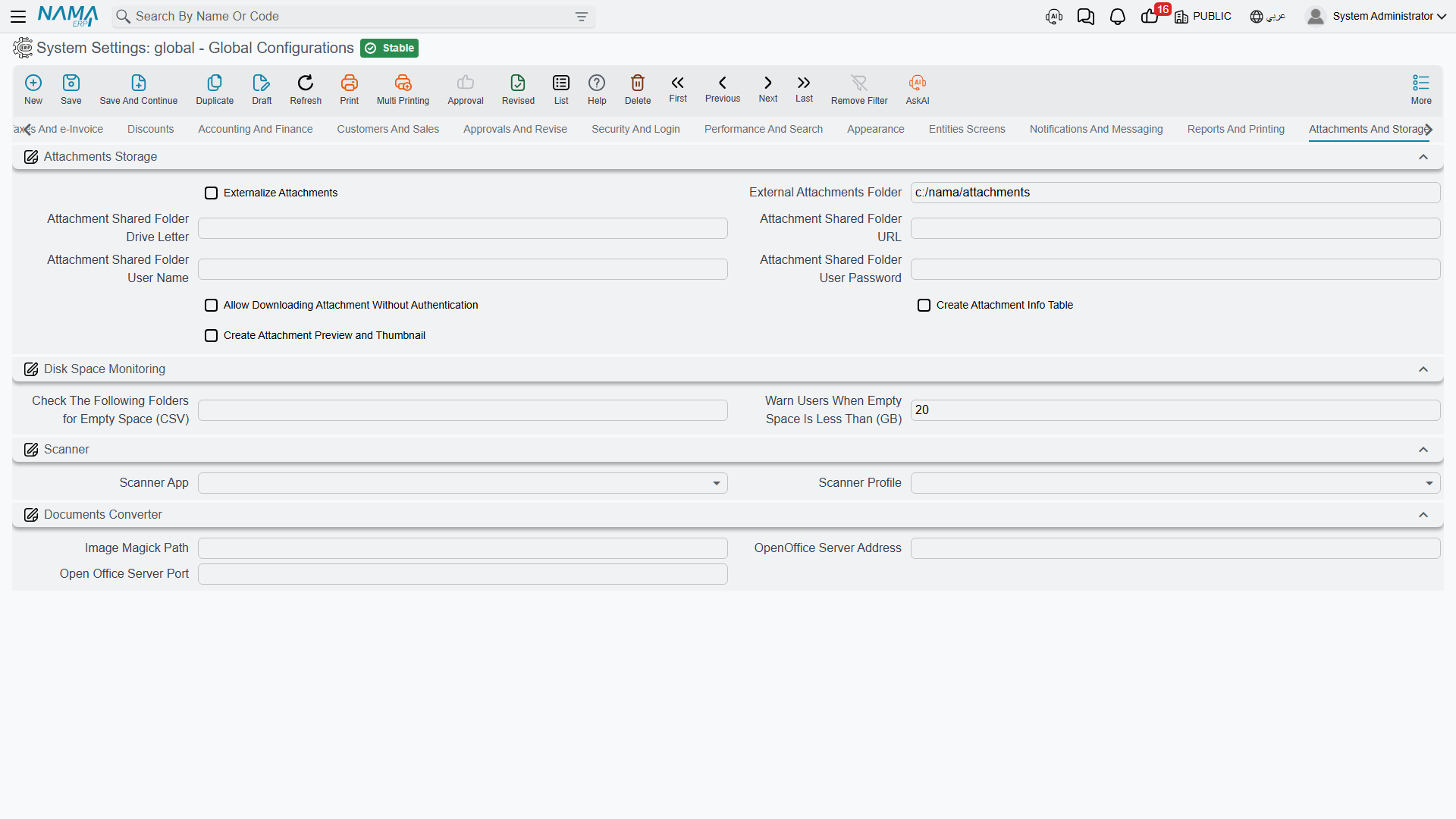
Attachment storage
By default an attachment's bytes are stored inside the database. That is simple and keeps backups self-contained, but a few years of scanned invoices will make the database far larger than the business data it holds.
Externalize Attachments value.info.externalizeAttachments — Stores attachment content on disk instead of in the database. The database keeps only the metadata and a pointer.
Externalized attachments change your backup story
Once files live on disk, a database backup no longer contains them. The folder must be backed up too, and restored alongside the database — a database restored without its attachment folder will show every attachment as missing.
External Attachments Folder value.info.externalAttachmentsFolder (default c:/nama/attachments on Windows, /var/nama/attachments elsewhere) — The root folder for those files.
Attachment Share Drive Letter / Attachment Share URL / Attachment Share User / Attachment Share Password value.info.attachmentShareDriveLetter, value.info.attachmentShareURL, value.info.attachmentShareUser, value.info.attachmentSharePassword — When the folder is a network share rather than a local disk, these mount it. Fill in any one of them and the drive letter and URL become required; the system tells you which is missing when you save.
Allow Download Attachment Without Authentication value.info.allowDownloadAttachmentWithoutAuthentication — Attachment links work without a session. Needed by some external viewers and portals, but it means anyone holding a link can fetch the file — turn it on only when you know that is acceptable.
Create Attachment Info Table value.info.createAttachmentInfoTable — Maintains a separate table describing attachments, and exposes it in menus and screens, so you can report on what is attached where and how much space it occupies.
Create Attachment Preview and Thumbnail value.info.createAttachmentPreviewAndThumbnail — Generates a preview and a thumbnail for each uploaded file. Thumbnails make an attachments list far easier to scan, at the cost of some processing on upload and a little extra storage.
Disk space monitoring
Folders to Check Space value.info.foldersToCheckSpace — The folders whose free space the system watches. List the attachment folder here, and anywhere else that filling up would stop work.
Notify When Empty Space Reaches (GB) value.info.notifyWhenEmptySpaceReachesGB (default 20) — Below this many free gigabytes, the system raises a critical message. Set it high enough that someone has time to react — a disk that fills completely stops attachments, exports and often the database itself.
Scanner
Scanner App value.info.scannerApp — Which scanning integration the attach-from-scanner action uses: cScanTwain or DynamicWebTWAIN.
Scanner Profile value.info.scannerProfile — The default scan settings: Black and White Document, Color Document, Grayscale, or Show Scanner UI to let the user choose each time. Black and white keeps document scans small; use colour only where the colour carries information, such as a stamped or signed original.
Documents converter
Nama converts Office files and images to PDF for previewing and printing, using two external tools.
ImageMagick Path value.info.docConverterSettings.imageMagicPath — The path to the ImageMagick executable on the server, used for image conversion.
OpenOffice Server Address / OpenOffice Server Port value.info.docConverterSettings.openOfficeServerAddress, ...openOfficeServerPort — The address and port of the LibreOffice or OpenOffice conversion service that turns Word, Excel and similar files into PDF.
These are server paths, not user paths
Both settings point at software installed on the application server, not on the user's machine. If document previews stop working after a server move, these are the first two values to check.