
Returning Cars to the Supplier
مردود مشتريات سيارة / Car Purchase Return — سيارات > مشتريات السيارات > مردود مشتريات سيارة.
Sometimes a car goes back. It arrived damaged, it is the wrong specification, the importer sent seven when the order said six. The Car Purchase Return sends it back and reverses the money.
Unlike most of the cancel-flavoured documents in this module, this one is a real financial document. It always books, and it always moves stock.
Required licence
srvcenter-subitems.
The screen
The return shares its layout with the Car Purchase Order: a basic group with the supplier, the purchasing agent, the warehouse and locator, the invoice classification, the money block, the price classifiers and remarks; then a line grid with item, measures, quantities, prices, discounts, taxes, net value, the السياره (Customer Car) column, dimensions and remarks.
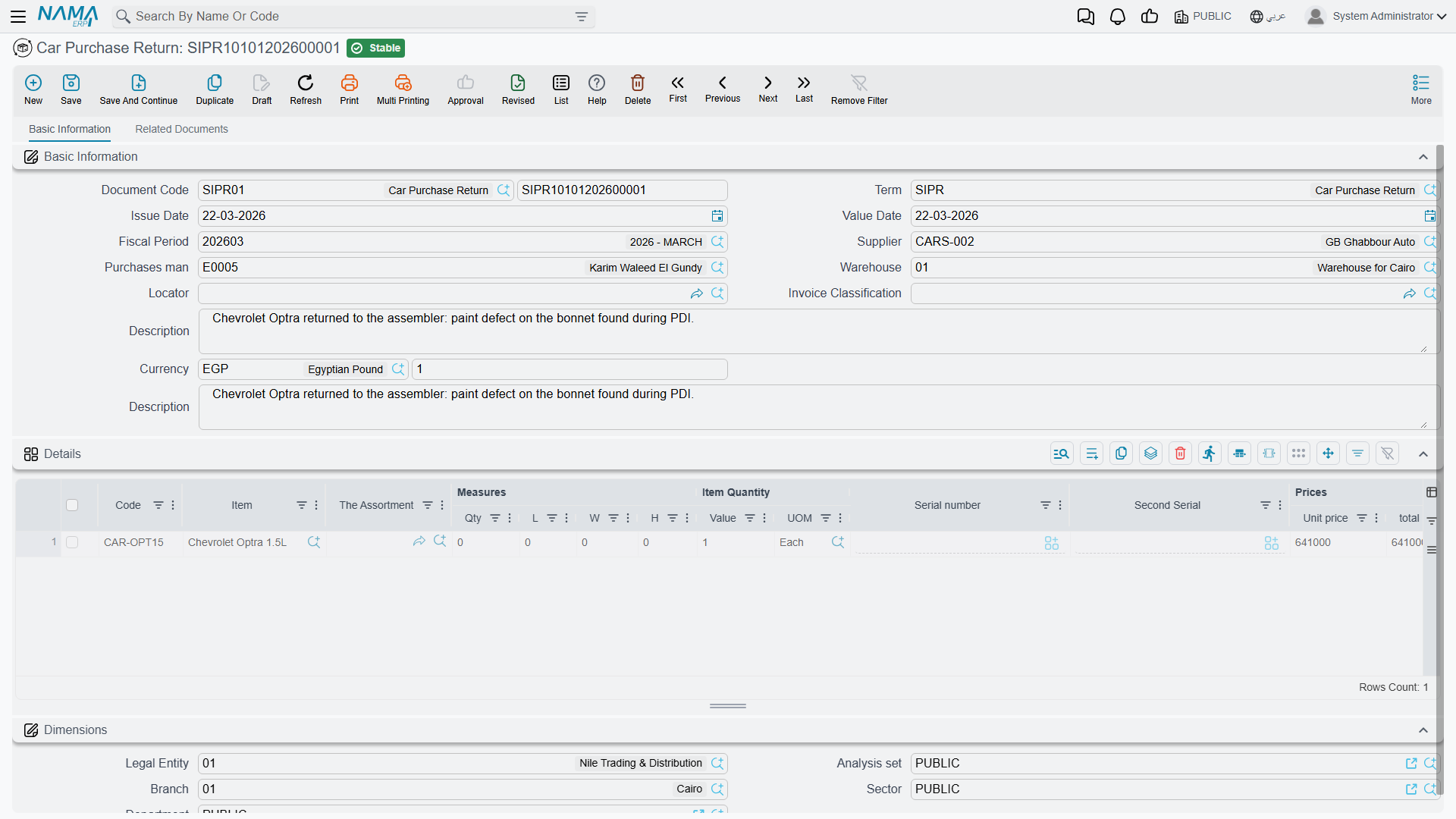
Each line also carries a reference back to the source invoice, which is what lets the return update the original invoice's returned and remaining quantities. It is not on the default grid — add it through a screen modification if your process needs it visible.
More menu: إنشاء صنف فرعي من السطر (Create Sub Item From Line Information) — which you should leave switched off on this term, for the reason given below.
What it does on commit
- Accounting: always. The return posts through its owndocument term's accounts — the debit and credit sides plus the dedicated purchase return difference accounts, the discount stages and the taxes. It does not re-read the original invoice's term. The price basis for the reversal is controlled by the term's source invoice calculation option.
- Stock: yes — it generates a Stock Issue, listed in its stock documents grid, which takes the car back out of the warehouse.
- The source invoice's line figures — returned quantity and remaining — are updated.
- Status entries on the car, if you configured any for the return.
What happens to the car record
Nothing, unless you say so.
The Car Purchase Return does not delete the car record, does not void it, and does not mark it cancelled. The record stays exactly where it was, and its status moves only if you wrote an updater row targeting the return's entity type, book or term in the item's Car Status Configurations. With no matching row the car keeps whatever status it had, which — after the stock has gone out — will look wrong to anybody reading the car file.
So configure it deliberately. Most showrooms send a returned car to one of the أخرى (Other) statuses, or back to the initial status, and add the matching movement row so the transition is legal. If the term also has Update Cancelled By Doc switched on, the return stamps itself into the car's cancelled-by field.
Never switch Create Sub Item From Line Information on for a return term
The car-creation routine runs on the purchase return exactly as it runs on the purchase order and the purchase invoice. With the option on, saving a return creates brand-new car records — which is the precise opposite of what a return is for.
If the return was built بناءا على the invoice, the lines carry the existing cars forward and the routine re-edits them instead, silently rewriting their master group, warehouse, locator, item classes and price classifiers from the return's lines. If the lines were typed fresh, you get duplicate car records for cars you are sending away — and since nothing validates chassis-number uniqueness anywhere, nothing tells you.
Leave the option off on every return term. The same applies to the Car Sales Return.
Reversing a car that is already in stock
The purchase return is the document that genuinely takes a received car back out of stock and off the supplier account. Do not reach for the Car Receipt Cancel instead — it looks like the obvious reversal and it is not one.
Cancelling a car receipt reverses nothing
A Car Receipt Cancel does not delete the stock receipt the original Car Receipt generated, and it reverses no accounting. The cars stay in stock and stay at cost. It writes a status entry, and that is the whole of its effect — see Receiving Cars into the Showroom.
So a user who raises one and expects the receipt to be undone will be wrong, and has to reverse the stock movement themselves: either cancel or delete the original Car Receipt, or — when the cars really are going back to the supplier — raise this purchase return.
What the return does not reverse
Two things readers reasonably expect and do not get:
- The landed cost. The additional-cost mechanism lives on the purchase invoice only. A return reverses the purchase value through its own accounts; it does not un-spread the freight and customs that were distributed over the shipment. If you return one of six cars after
RAC-2026-009has spread 15,000 across them, the remaining five still carry 2,500 each and the returned one takes its 2,500 with it. Adjust deliberately if the charge is genuinely recoverable. - The reference stamps on the car. Whatever was written onto the car record by the purchase invoice — the invoice reference, the stock receipt reference, the warehouse — stays there unless a document explicitly clears it.