
Closing a Job Order
The car is finished, the parts have been fitted, the technicians have booked their time. The job order closing (إغلاق أمر شغل) is the document that draws a line under all of it: it gathers what was actually done, totals what each payer owes, relieves the consumed parts from stock, works out when the vehicle should come back, and puts the job order into Closed — the state that unlocks the invoice buttons and locks the job order against further editing.
There is exactly one closing per job order, for ever. That is worth knowing before you create it.
Menu: Service Center > Documents > Job Order Closing (مركز خدمة > المستندات > إغلاق أمر شغل).
Required licence
srvcenter. A document term is required, and it is the term that carries the two accounting sides and the stock-issue book — without them the closing posts nothing and issues nothing.
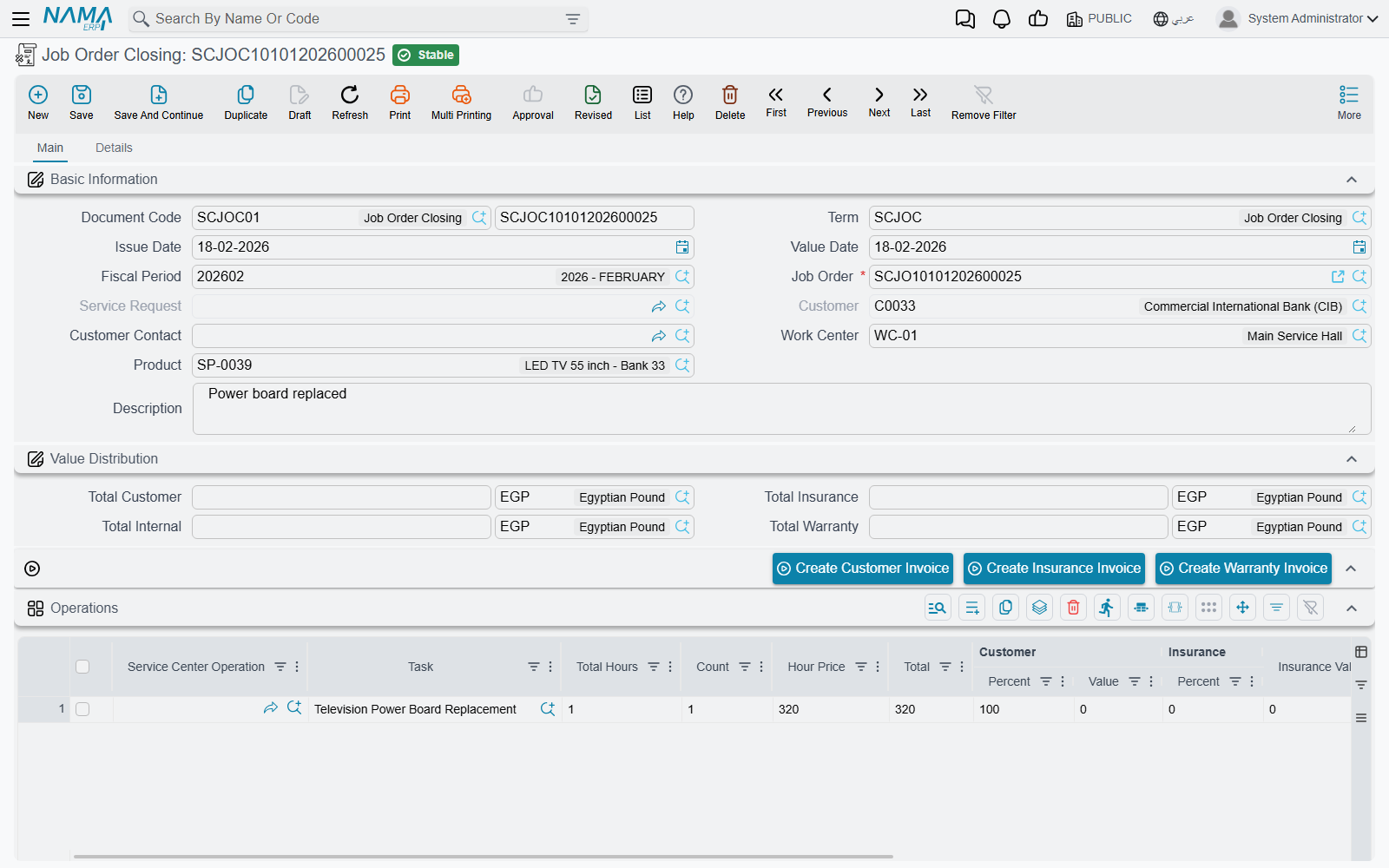
Closing Fahad's job
SCJOC-2026-0392, value date 4 March 2026. The only thing anyone types is the job order.
Choosing SCJO-2026-0417 in the Job Order (أمر الشغل) field does the rest: the product, the customer, the work centre, the service request behind it, the next-visit fields, both grids and all four money boxes are filled in for you. The customer and the service request fields are disabled — they belong to the job order, not to you — and the job-order picker deliberately hides orders that are already closed.
What gets pulled in
- Operations: only the lines whose status is Finished. A service row is pulled in if any of its child tasks is finished. If you need everything regardless of status, the term has an option to ignore the operation lines' status.
- Materials: all of the job order's spare-part lines, unfiltered.
Both grids arrive with their four payer percent-and-value pairs intact, copied from the job order. The four money boxes are recomputed from those lines on every save, so they are read-only totals, not figures you can adjust:
| Box | Arabic | Fahad's job |
|---|---|---|
| Total Customer | إجمالي العميل | 695 |
| Total Insurance | إجمالى التأمين | 60 |
| Total Warranty | إجمالى الضمان | 2,400 |
| Total Internal | إجمالى الشركة | 60 |
Together, 3,215 — the job total. The full derivation is on Who Pays for What.
What reaches the ledger
Only the customer amount is posted
The four money boxes look like a four-way posting. They are not. The journal entry this closing produces is two lines — one debit, one credit, taken from the term's debit and credit sides — and both carry the customer amount only.
For Fahad's job that is 695, not 3,215.
- Insurance (60) and warranty (2,400) reach accounting only when you press their invoice buttons. No invoice, no entry.
- The internal share (60) reaches accounting nowhere at all. There is no document, no book and no button for it anywhere in the module.
If your dealership relies on this module to account for warranty work recovered from the manufacturer, understand exactly where that recovery comes from: the warranty invoice. A month of closings with no warranty invoices leaves a silent hole the size of all your warranty labour and parts.
The accounts themselves are resolved with the job order's work-centre warehouse as the source, and the dimensions come from the closing document. Currency follows the customer money's currency.
Like every effect in Nama, the entry is created as a business request processed in the background. If it does not appear, look in the Business Requests list view, filter to failed and use More → Reprocess.
What it does to stock
The closing generates a stock issue — and this is where the parts finally leave inventory in the accounting sense.
It is worth being precise about what goes onto it, because it is not what the closing's own materials grid shows. The issue is built from the job order's parts ledger: for each item, what was transferred to the work-in-progress store minus what was returned. Lines with nothing left are skipped. Warehouse and locator are forced to the job order's WIP warehouse and locator.
For Fahad's job, six litres of oil were drawn and one came back, so five are consumed; the filter, the pad set and the compressor are consumed in full. The issue relieves the inventory cost of those parts — (5 × 21) + 28 + 245 + 1,290 = 1,668 — which has nothing to do with the 2,435 the customer and the warranty provider are billed. There is no markup mechanism between the two numbers.
No issue book, no stock issue — and no warning
The stock issue is only generated if both the issue book and the issue term are filled in on the closing's document term. If either is missing, nothing is generated and nothing is said. Check both on every closing term you create.
The stock issue is committed automatically, regenerated whenever the closing is re-saved, and removed if the closing is cancelled or deleted. The Details page carries a read-only list of the issues this closing has produced, so you can always see whether one exists.
The next visit
The closing also works out when the vehicle should come back. It takes the vehicle's average daily mileage and the shortest kilometre interval among the job order's tasks, projects a date, and writes it onto both the closing and the job order.
Fahad's car covers about 60.7 km a day. Its oil service recurs every 10,000 km and the last one was at 36,000, so the next falls due at 46,000 — 700 km, about 11.5 days, from the 45,300 read on arrival. The closing projects 15 March 2026. If it cannot compute a date it falls back to whatever the job order already said. Full mechanics on Odometer Readings and Service Intervals.
What the closing refuses
- An order that is already closed. One closing per job order; a second is refused outright.
- Suspended orders. A Cancelled, Pending or Stopped job order is refused unless the term ticks Allow Closing Suspended Orders.
- Unfinished work. With the module setting Prevent Closing With Unfinished Task on — and it is on by default — any execution line for this job order that is missing a start or an end time blocks the close, naming the task and the technician. This is the check that makes technicians finish their time sheets.
- Unissued materials, if the term ticks the option for it: every spare part on the job order must have been issued in at least the planned quantity. Note that this check aggregates by item, so a part that appears on two different tasks is counted once — issuing enough for one task can satisfy it for both.
Undoing a closing
A closing is an ordinary document: cancel or delete it and its effects unwind. The status entry disappears, so the job order's status is re-derived from what remains and stops being Closed; the generated stock issue is deleted; the product status entry is removed; and a delete request is sent for the journal entry.
Create the invoices last
The closing cannot be deleted once any one of the three invoices exists — and the check is all-or-nothing. Generate only the customer invoice and the closing is already frozen, even though the insurance and warranty invoices are still missing.
So the safe order of work is: close, check the four money boxes and the stock issue, and only then raise the invoices. If you have to correct the job order after invoicing, you are deleting invoices first.
Remember too that a Closed job order cannot be edited at all, so correcting a price or a split always means deleting the closing first.
The other way a closing is created
There is a second route that support staff should recognise. The Job Order Execution document — the shop-floor time sheet, which the English menu currently labels Production Review — has a button that creates and immediately commits a closing, using the closing book and term configured on the execution document's own term.
That automatic closing copies the job order's task and material lines wholesale: it does not apply the "finished lines only" filter that the manual screen uses. It is a convenience for shops that close a job the moment the last technician clocks off. If you use it, put the same care into the execution document's term as you would into the closing term, because that is where its book, term and therefore its accounts come from.