
Car Sales Invoices
There are two documents in the menu with "invoice" in the name, they look almost identical on screen, and only one of them is a sale. Getting the difference straight is the single most valuable thing on this page.
- Car Proforma Sales Invoice (
سيارات > مبيعات السيارات > فاتورة مبيعات سيارة مبدئية) — a priced, complete-looking document you can print and hand to a bank, an insurer or a customs broker. It books nothing meaningful. - Car Sales Invoice (
سيارات > مبيعات السيارات > فاتورة مبيعات سيارة) — the sale. Revenue, tax, the customer receivable, the cost of goods sold, the stock issue and the e-invoice submission all come from here, and from nowhere else.
Required licence
srvcenter-subitems.
The two documents, side by side
| Pro-forma Sales Invoice | Sales Invoice | |
|---|---|---|
| Revenue and receivable | No. Only a generic debit/credit pair, and only if the term happens to fill it | Yes, always |
| Tax | No | Yes — taxes 1–4 and header taxes |
| Cost of goods sold | No | Yes, through the stock issue |
| Stock movement | None at all | Out — a stock issue for the car |
| Submitted to the tax authority | No | Yes |
| Can be returned | No return document targets it | Yes — the Car Sales Return |
| نوع البيع / المرخص له on screen | No | Yes |
| Payment lines, schedule, external payments | Yes | Yes |
| Moves the car's status, stamps references | Yes | Yes |
Read that table once more from the top: the pro-forma is not a financial document. Do not present it to anyone as a "provisional posting" or an "invoice awaiting confirmation" — nothing is waiting, because nothing was booked. Its value is entirely that it is a complete, printable, priced document with a book and a number, safe to issue outside the company without touching your ledger, your tax return or your stock.
The one thing the pro-forma shares with every other car document is its effect on the car itself: it writes a status line and can stamp its reference onto the car's Statistics tab. So a showroom that wants "a pro-forma has been issued" to be visible on the car can model exactly that as a status.
The Car Sales Invoice
This is the point of no return. Once it commits, undoing the sale means raising a Car Sales Return — deleting is not the answer, and the cancellation documents in this module do not touch money or stock.
What it books
On commit the invoice produces, in the ordinary way and always:
- the customer receivable (or cash, if the term points there) against revenue;
- tax on the line and header taxes;
- invoice and line discounts, and any of the service-fee sides the term configures;
- the stock issue that takes the car out of the showroom warehouse, and with it the cost of goods sold entry that relieves the car's landed cost.
All of this is created as business requests processed in the background — the invoice itself saves immediately. If an effect fails, retry it from the Business Requests list view: filter by failed, select the rows and use More → Reprocess / Recommit.
Fields you meet only here
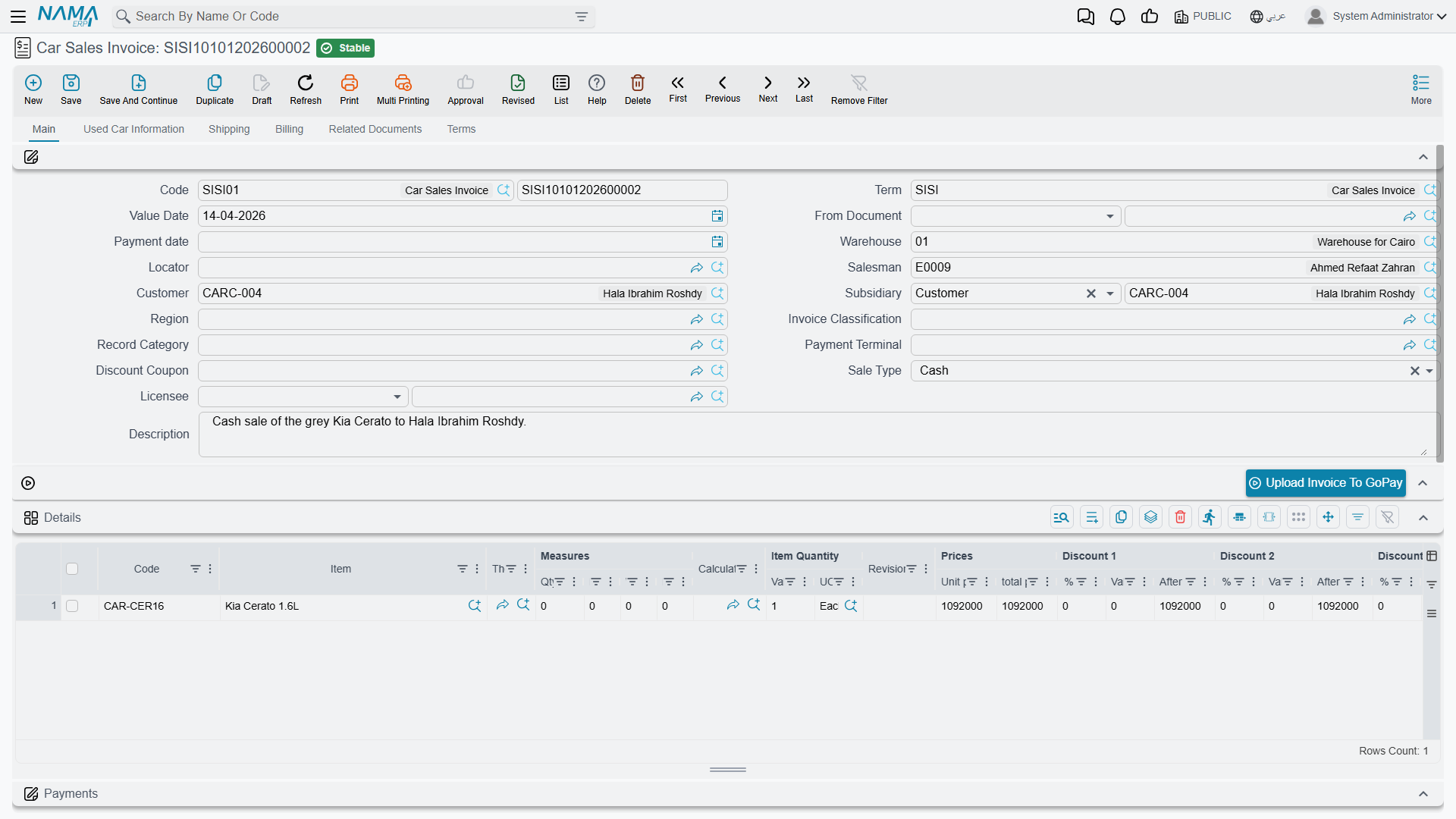
Alongside the standard sales-invoice layout, the car sales invoice carries نوع البيع (Sale Type) — Cash or Instalment — and المرخص له (Licensee), plus the instalment block and the Used Car Info tab carried forward from the sales order.
The chassis is named in the السياره (Customer Car) column of the line, exactly as on every other document in this family. When the invoice is built on an allocation or an order through From Document, the picker offers only the cars on that source.
Nothing checks who the car was allocated to
The invoice happily sells a car that was allocated to somebody else. The allocation fields are an informational stamp and no rule reads them — see Allocating a Chassis. The only thing that can refuse the sale is the car's own status configuration, or the منع البيع (Prevent Sales) flag on the car record.
The worked example
CAR-000318 is invoiced to Layla Al-Harbi on 1 March 2026 as SISI-2026-0498:
| Amount | |
|---|---|
| Agreed sale price | 87,000 |
| VAT at 15 % | 13,050 |
| Invoice total | 100,050 |
| Cost of sales — the car's landed cost | 76,500 |
| Gross margin | 10,500 |
The 76,500 is what the car actually cost Al-Sahra: 74,000 paid to the importer plus 2,500 of freight and customs spread over the six cars in the shipment. The invoice generates stock issue STI-2026-1201 out of the showroom store WH-SHOW, and that issue is what relieves the 76,500 to cost of sales.
Note what has already happened before this document: the sales order posted a 5,000 booking deposit against its reservation-value accounts back on 24 February. That entry is not touched by the invoice; it is settled the ordinary way, through the customer's account.
The one setup rule that keeps stock correct
The car can be issued from stock twice
The Car Sales Invoice generates a stock issue. So can the Car Final Delivery. Neither document can see the other's stock document — each looks only for an issue raised from itself — and neither checks whether the car has already left stock.
Follow the natural path with both terms configured to generate, and the same chassis is issued twice: the landed cost is relieved to cost of sales twice and the car sits at −1 on hand. Where negative stock is allowed, both documents commit silently and nothing warns. Where it is blocked, the second document fails with a generic shortage error that names an auto-generated stock document rather than the car document you were saving — which reads as an unrelated inventory problem.
The rule: fill Generation Book and Generation Term on exactly one of the two document terms. If the invoice is your stock-out document — the normal choice for an ordinary sale, and the one Al-Sahra makes — leave the final-delivery term's generation book and term empty.
Unticking أنشاء مستندات تلقائيا (Generate Document) on the final-delivery term does not stop it: that switch is ignored there. Only blanking the book and the term works. The invoice, by contrast, does honour the switch — but relying on that asymmetry is how sites get into trouble, so publish the simple rule instead. The invoice and the final delivery are alternatives for moving stock, never a sequence.
After the invoice
- The car's status moves — typically to مفوتر كلياً (Invoiced) — if a status updater line targets the sales invoice, and the invoice's reference is stamped onto the car's Statistics tab.
- The physical hand-over is recorded on a Car Final Delivery, which is a record and a status move, not a financial event.
- If the sale falls through, raise a Car Sales Return. There is no cancellation document for a sales invoice, and there should not be — money that has reached the ledger comes back through a return, not through a marker.